

9 Frustrated Lewis Pairs Based on Transition Metals
335
N C Pt N
B
N C Pt
N
B
N C
Pt
N
B
N
B
N C Pt
N
B
N C
Pt
N
B
H
H
H2
N C
Pt
N
B
H
N
H
O2N
p-O2NC6H4NH2
N C Pt
N
B
H
O
R
ROH
N C
Pt
N
B
H
C C
Ph
PhCCH
1
R 2 RC O
H
O
R 1
R 2
R 1 , R 2 = Me
R 1 = Ph, R 2 =H
O
O
CO2
N
N
N
R
RN3
S8
N C
Pt
N
B
S
N
MeCN
N
B
N
O
Bu t
t BuNCO
32
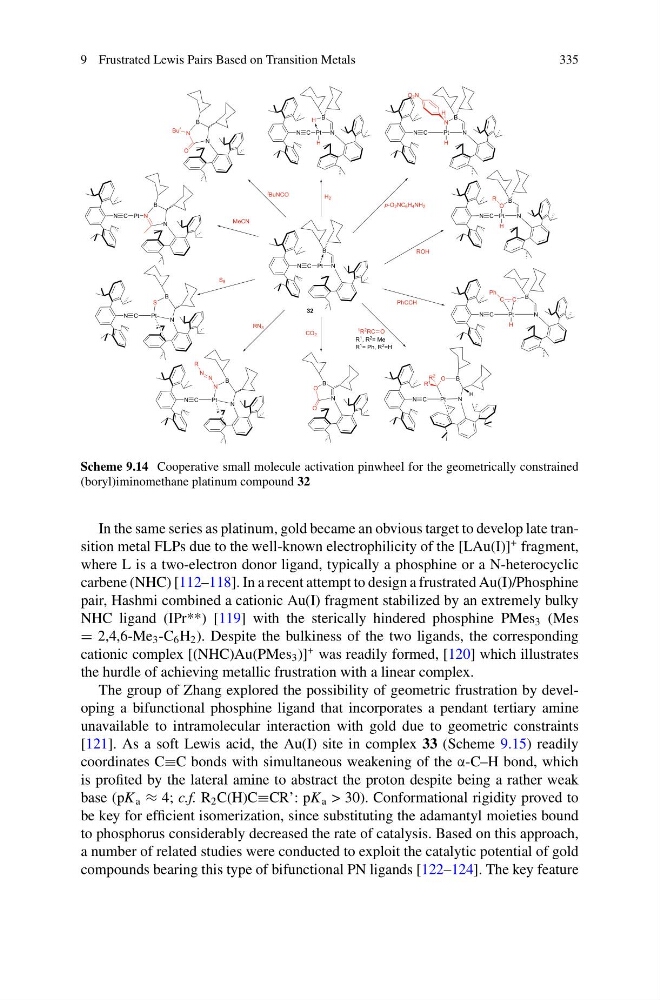
Scheme 9.14 Cooperative small molecule activation pinwheel for the geometrically constrained
(boryl)iminomethane platinum compound 32
In the same series as platinum, gold became an obvious target to develop late transition metal FLPs due to the well-known electrophilicity of the [LAu(I)]
+ fragment,
where L is a two-electron donor ligand, typically a phosphine or a N-heterocyclic
carbene (NHC) [112–118]. In a recent attempt to design a frustrated Au(I)/Phosphine
pair, Hashmi combined a cationic Au(I) fragment stabilized by an extremely bulky
NHC ligand (IPr**) [119] with the sterically hindered phosphine PMes 3 (Mes
= 2,4,6-Me 3 -C 6 H 2 ). Despite the bulkiness of the two ligands, the corresponding
cationic complex [(NHC)Au(PMes 3 )]
+ was readily formed, [120] which illustrates
the hurdle of achieving metallic frustration with a linear complex.
The group of Zhang explored the possibility of geometric frustration by developing a bifunctional phosphine ligand that incorporates a pendant tertiary amine
unavailable to intramolecular interaction with gold due to geometric constraints
[121]. As a soft Lewis acid, the Au(I) site in complex 33 (Scheme 9.15) readily
coordinates C≡C bonds with simultaneous weakening of the α-C–H bond, which
is profited by the lateral amine to abstract the proton despite being a rather weak
base (pK a ≈ 4; c.f. R 2 C(H)C≡CR’: pK a > 30). Conformational rigidity proved to
be key for efficient isomerization, since substituting the adamantyl moieties bound
to phosphorus considerably decreased the rate of catalysis. Based on this approach,
a number of related studies were conducted to exploit the catalytic potential of gold
compounds bearing this type of bifunctional PN ligands [122–124]. The key feature
335
N C Pt N
B
N C Pt
N
B
N C
Pt
N
B
N
B
N C Pt
N
B
N C
Pt
N
B
H
H
H2
N C
Pt
N
B
H
N
H
O2N
p-O2NC6H4NH2
N C Pt
N
B
H
O
R
ROH
N C
Pt
N
B
H
C C
Ph
PhCCH
1
R 2 RC O
H
O
R 1
R 2
R 1 , R 2 = Me
R 1 = Ph, R 2 =H
O
O
CO2
N
N
N
R
RN3
S8
N C
Pt
N
B
S
N
MeCN
N
B
N
O
Bu t
t BuNCO
32
Scheme 9.14 Cooperative small molecule activation pinwheel for the geometrically constrained
(boryl)iminomethane platinum compound 32
In the same series as platinum, gold became an obvious target to develop late transition metal FLPs due to the well-known electrophilicity of the [LAu(I)]
+ fragment,
where L is a two-electron donor ligand, typically a phosphine or a N-heterocyclic
carbene (NHC) [112–118]. In a recent attempt to design a frustrated Au(I)/Phosphine
pair, Hashmi combined a cationic Au(I) fragment stabilized by an extremely bulky
NHC ligand (IPr**) [119] with the sterically hindered phosphine PMes 3 (Mes
= 2,4,6-Me 3 -C 6 H 2 ). Despite the bulkiness of the two ligands, the corresponding
cationic complex [(NHC)Au(PMes 3 )]
+ was readily formed, [120] which illustrates
the hurdle of achieving metallic frustration with a linear complex.
The group of Zhang explored the possibility of geometric frustration by developing a bifunctional phosphine ligand that incorporates a pendant tertiary amine
unavailable to intramolecular interaction with gold due to geometric constraints
[121]. As a soft Lewis acid, the Au(I) site in complex 33 (Scheme 9.15) readily
coordinates C≡C bonds with simultaneous weakening of the α-C–H bond, which
is profited by the lateral amine to abstract the proton despite being a rather weak
base (pK a ≈ 4; c.f. R 2 C(H)C≡CR’: pK a > 30). Conformational rigidity proved to
be key for efficient isomerization, since substituting the adamantyl moieties bound
to phosphorus considerably decreased the rate of catalysis. Based on this approach,
a number of related studies were conducted to exploit the catalytic potential of gold
compounds bearing this type of bifunctional PN ligands [122–124]. The key feature