

334
N. Hidalgo et al.
Pt
P
P
CO
P
P
=
P
t Bu 2
P
t Bu 2
Pt
P
P
H
CO
H
B(C 6 F 5 ) 3
Pt
P
P
O
B(C 6 F 5 ) 3
Pt
P
P
H 2 (1 atm)
B(C 6 F 5 ) 3
+
31
C 2 H 4
CO 2 (1 atm)
25 ºC, 10 h
3 days
(1 atm)
C
O
O
B(C 6 F 5 ) 3
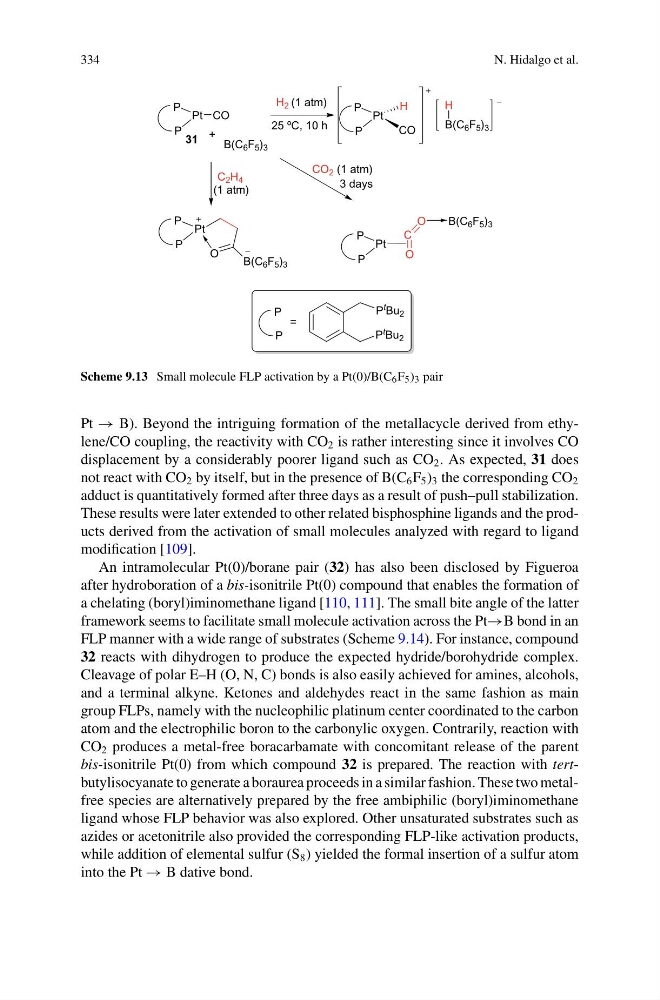
Scheme 9.13 Small molecule FLP activation by a Pt(0)/B(C 6 F 5 ) 3 pair
Pt → B). Beyond the intriguing formation of the metallacycle derived from ethylene/CO coupling, the reactivity with CO 2 is rather interesting since it involves CO
displacement by a considerably poorer ligand such as CO 2 . As expected, 31 does
not react with CO 2 by itself, but in the presence of B(C 6 F 5 ) 3 the corresponding CO 2
adduct is quantitatively formed after three days as a result of push–pull stabilization.
These results were later extended to other related bisphosphine ligands and the products derived from the activation of small molecules analyzed with regard to ligand
modification [109].
An intramolecular Pt(0)/borane pair (32) has also been disclosed by Figueroa
after hydroboration of a bis-isonitrile Pt(0) compound that enables the formation of
a chelating (boryl)iminomethane ligand [110, 111]. The small bite angle of the latter
framework seems to facilitate small molecule activation across the Pt→B bond in an
FLP manner with a wide range of substrates (Scheme 9.14). For instance, compound
32 reacts with dihydrogen to produce the expected hydride/borohydride complex.
Cleavage of polar E–H (O, N, C) bonds is also easily achieved for amines, alcohols,
and a terminal alkyne. Ketones and aldehydes react in the same fashion as main
group FLPs, namely with the nucleophilic platinum center coordinated to the carbon
atom and the electrophilic boron to the carbonylic oxygen. Contrarily, reaction with
CO 2 produces a metal-free boracarbamate with concomitant release of the parent
bis-isonitrile Pt(0) from which compound 32 is prepared. The reaction with tertbutylisocyanate to generate a boraurea proceeds in a similar fashion. These two metalfree species are alternatively prepared by the free ambiphilic (boryl)iminomethane
ligand whose FLP behavior was also explored. Other unsaturated substrates such as
azides or acetonitrile also provided the corresponding FLP-like activation products,
while addition of elemental sulfur (S 8 ) yielded the formal insertion of a sulfur atom
into the Pt → B dative bond.
N. Hidalgo et al.
Pt
P
P
CO
P
P
=
P
t Bu 2
P
t Bu 2
Pt
P
P
H
CO
H
B(C 6 F 5 ) 3
Pt
P
P
O
B(C 6 F 5 ) 3
Pt
P
P
H 2 (1 atm)
B(C 6 F 5 ) 3
+
31
C 2 H 4
CO 2 (1 atm)
25 ºC, 10 h
3 days
(1 atm)
C
O
O
B(C 6 F 5 ) 3
Scheme 9.13 Small molecule FLP activation by a Pt(0)/B(C 6 F 5 ) 3 pair
Pt → B). Beyond the intriguing formation of the metallacycle derived from ethylene/CO coupling, the reactivity with CO 2 is rather interesting since it involves CO
displacement by a considerably poorer ligand such as CO 2 . As expected, 31 does
not react with CO 2 by itself, but in the presence of B(C 6 F 5 ) 3 the corresponding CO 2
adduct is quantitatively formed after three days as a result of push–pull stabilization.
These results were later extended to other related bisphosphine ligands and the products derived from the activation of small molecules analyzed with regard to ligand
modification [109].
An intramolecular Pt(0)/borane pair (32) has also been disclosed by Figueroa
after hydroboration of a bis-isonitrile Pt(0) compound that enables the formation of
a chelating (boryl)iminomethane ligand [110, 111]. The small bite angle of the latter
framework seems to facilitate small molecule activation across the Pt→B bond in an
FLP manner with a wide range of substrates (Scheme 9.14). For instance, compound
32 reacts with dihydrogen to produce the expected hydride/borohydride complex.
Cleavage of polar E–H (O, N, C) bonds is also easily achieved for amines, alcohols,
and a terminal alkyne. Ketones and aldehydes react in the same fashion as main
group FLPs, namely with the nucleophilic platinum center coordinated to the carbon
atom and the electrophilic boron to the carbonylic oxygen. Contrarily, reaction with
CO 2 produces a metal-free boracarbamate with concomitant release of the parent
bis-isonitrile Pt(0) from which compound 32 is prepared. The reaction with tertbutylisocyanate to generate a boraurea proceeds in a similar fashion. These two metalfree species are alternatively prepared by the free ambiphilic (boryl)iminomethane
ligand whose FLP behavior was also explored. Other unsaturated substrates such as
azides or acetonitrile also provided the corresponding FLP-like activation products,
while addition of elemental sulfur (S 8 ) yielded the formal insertion of a sulfur atom
into the Pt → B dative bond.