

9 Frustrated Lewis Pairs Based on Transition Metals
333
The use of ligands with pendant boranes has been successful for designing efficient cooperative catalysts, particularly those involving hydrogen transfer between
the metal center and the boron atom [102]. The cooperative mechanism by which
these complexes activate E–H (E = H, Si, C, O, N…) bonds is reminiscent of frustrated systems. This analogy was drawn by Peters regarding the study of a nickel
metalloborane bearing a diphosphine-borane ligand which turned out to be an efficient hydrogenation catalyst [103]. The same group has made extensive use of
diphosphine-borane ligands to impart cooperative reactivity to first-row transition
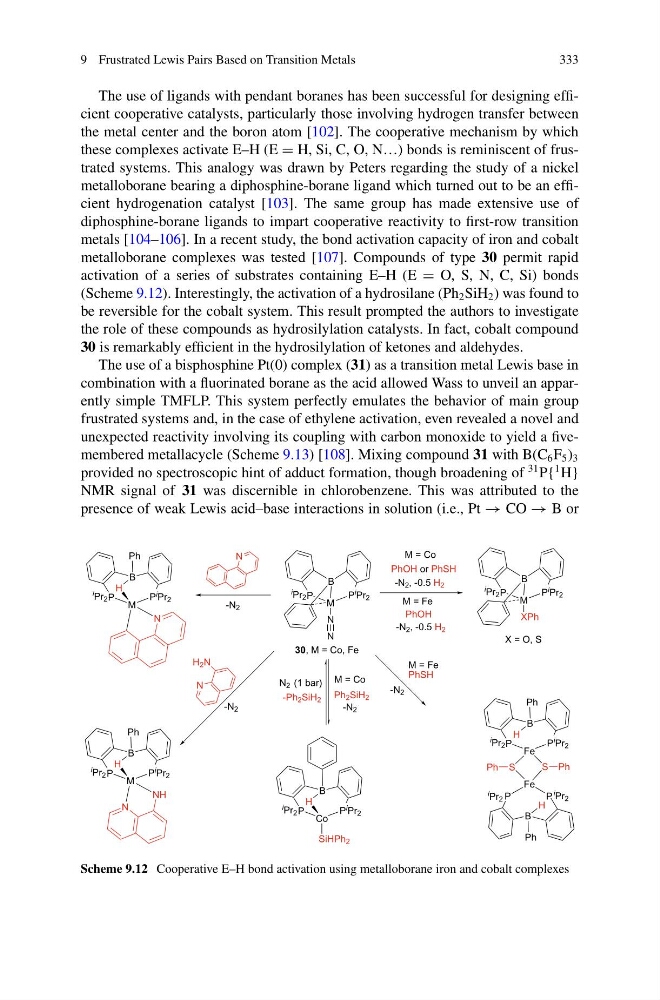
metals [104–106]. In a recent study, the bond activation capacity of iron and cobalt
metalloborane complexes was tested [107]. Compounds of type 30 permit rapid
activation of a series of substrates containing E–H (E = O, S, N, C, Si) bonds
(Scheme 9.12). Interestingly, the activation of a hydrosilane (Ph 2 SiH 2 ) was found to
be reversible for the cobalt system. This result prompted the authors to investigate
the role of these compounds as hydrosilylation catalysts. In fact, cobalt compound
30 is remarkably efficient in the hydrosilylation of ketones and aldehydes.
The use of a bisphosphine Pt(0) complex (31) as a transition metal Lewis base in
combination with a fluorinated borane as the acid allowed Wass to unveil an apparently simple TMFLP. This system perfectly emulates the behavior of main group
frustrated systems and, in the case of ethylene activation, even revealed a novel and
unexpected reactivity involving its coupling with carbon monoxide to yield a fivemembered metallacycle (Scheme 9.13) [108]. Mixing compound 31 with B(C 6 F 5 ) 3
provided no spectroscopic hint of adduct formation, though broadening of
31 P{
1 H}
NMR signal of 31 was discernible in chlorobenzene. This was attributed to the
presence of weak Lewis acid–base interactions in solution (i.e., Pt → CO → B or
M
B
P i Pr 2
P
i Pr 2
N
N
M
B
P
i
Pr 2
P
i Pr 2
XPh
Fe
B
P i Pr 2
P
i Pr 2
Ph
H
S
S
Fe
B
P
P
i
Pr 2
Ph
H
i Pr 2
Ph
Ph
M
B
P
i Pr 2
P
i
Pr 2
Ph
H
N
M
B
P
i Pr 2
P
Ph
H
N
NH
i
Pr 2
Co
B
P
i
Pr 2
P
H
i
Pr 2
SiHPh 2
30, M = Co, Fe
X = O, S
Ph 2 SiH 2
N 2 (1 bar)
PhOH or PhSH
M = Co
PhOH
M = Fe
M = Fe
PhSH
N
N
H 2 N
-N 2
-N 2
-N 2 , -0.5 H 2
-N 2
-N 2
-Ph 2 SiH 2
M = Co
-N 2 , -0.5 H 2
Scheme 9.12 Cooperative E–H bond activation using metalloborane iron and cobalt complexes
333
The use of ligands with pendant boranes has been successful for designing efficient cooperative catalysts, particularly those involving hydrogen transfer between
the metal center and the boron atom [102]. The cooperative mechanism by which
these complexes activate E–H (E = H, Si, C, O, N…) bonds is reminiscent of frustrated systems. This analogy was drawn by Peters regarding the study of a nickel
metalloborane bearing a diphosphine-borane ligand which turned out to be an efficient hydrogenation catalyst [103]. The same group has made extensive use of
diphosphine-borane ligands to impart cooperative reactivity to first-row transition
metals [104–106]. In a recent study, the bond activation capacity of iron and cobalt
metalloborane complexes was tested [107]. Compounds of type 30 permit rapid
activation of a series of substrates containing E–H (E = O, S, N, C, Si) bonds
(Scheme 9.12). Interestingly, the activation of a hydrosilane (Ph 2 SiH 2 ) was found to
be reversible for the cobalt system. This result prompted the authors to investigate
the role of these compounds as hydrosilylation catalysts. In fact, cobalt compound
30 is remarkably efficient in the hydrosilylation of ketones and aldehydes.
The use of a bisphosphine Pt(0) complex (31) as a transition metal Lewis base in
combination with a fluorinated borane as the acid allowed Wass to unveil an apparently simple TMFLP. This system perfectly emulates the behavior of main group
frustrated systems and, in the case of ethylene activation, even revealed a novel and
unexpected reactivity involving its coupling with carbon monoxide to yield a fivemembered metallacycle (Scheme 9.13) [108]. Mixing compound 31 with B(C 6 F 5 ) 3
provided no spectroscopic hint of adduct formation, though broadening of
31 P{
1 H}
NMR signal of 31 was discernible in chlorobenzene. This was attributed to the
presence of weak Lewis acid–base interactions in solution (i.e., Pt → CO → B or
M
B
P i Pr 2
P
i Pr 2
N
N
M
B
P
i
Pr 2
P
i Pr 2
XPh
Fe
B
P i Pr 2
P
i Pr 2
Ph
H
S
S
Fe
B
P
P
i
Pr 2
Ph
H
i Pr 2
Ph
Ph
M
B
P
i Pr 2
P
i
Pr 2
Ph
H
N
M
B
P
i Pr 2
P
Ph
H
N
NH
i
Pr 2
Co
B
P
i
Pr 2
P
H
i
Pr 2
SiHPh 2
30, M = Co, Fe
X = O, S
Ph 2 SiH 2
N 2 (1 bar)
PhOH or PhSH
M = Co
PhOH
M = Fe
M = Fe
PhSH
N
N
H 2 N
-N 2
-N 2
-N 2 , -0.5 H 2
-N 2
-N 2
-Ph 2 SiH 2
M = Co
-N 2 , -0.5 H 2
Scheme 9.12 Cooperative E–H bond activation using metalloborane iron and cobalt complexes