

332
N. Hidalgo et al.
undertaken [98]. A concerted σ-bond metathesis pathway across the Ru–S bond was
proposed which, although conceptually differs from the mode of action of FLPs,
shares some common features with the latter such as the polarized landscape between
the two intervening nuclei and the heterolytic nature of the splitting. Related work by
Tatsumi and Sakaki on a hydroxo-/sulfido-bridged ruthenium—germanium complex
also draws the analogy with the heterolytic mode of activation of FLPs [99, 100].
In the group 9, a very recent study by Carmona and Rodríguez demonstrated that
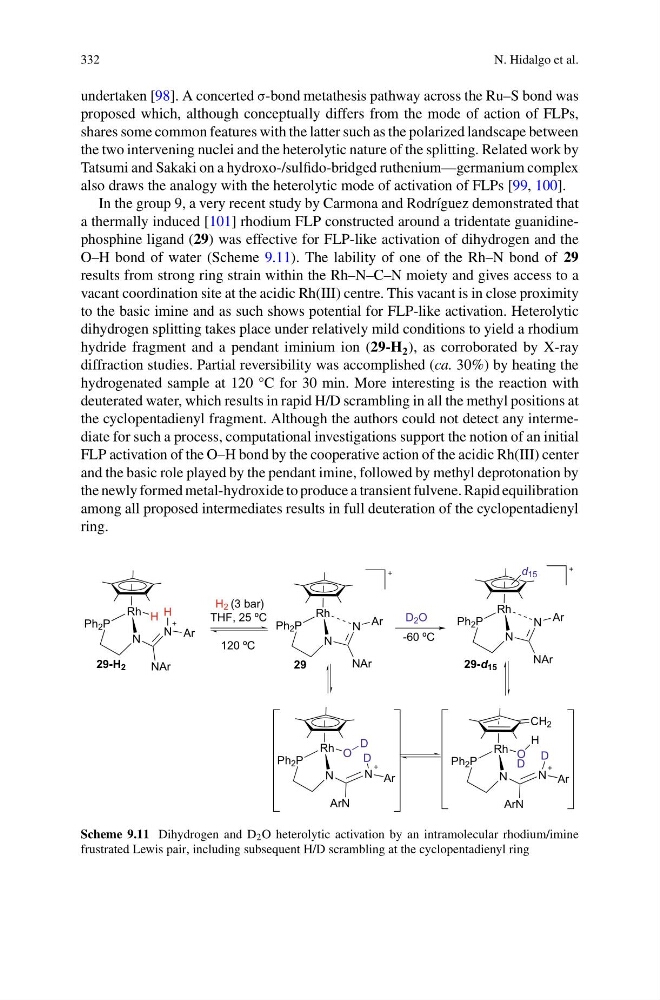
a thermally induced [101] rhodium FLP constructed around a tridentate guanidinephosphine ligand (29) was effective for FLP-like activation of dihydrogen and the
O–H bond of water (Scheme 9.11). The lability of one of the Rh–N bond of 29
results from strong ring strain within the Rh–N–C–N moiety and gives access to a
vacant coordination site at the acidic Rh(III) centre. This vacant is in close proximity
to the basic imine and as such shows potential for FLP-like activation. Heterolytic
dihydrogen splitting takes place under relatively mild conditions to yield a rhodium
hydride fragment and a pendant iminium ion (29-H 2 ), as corroborated by X-ray
diffraction studies. Partial reversibility was accomplished (ca. 30%) by heating the
hydrogenated sample at 120 °C for 30 min. More interesting is the reaction with
deuterated water, which results in rapid H/D scrambling in all the methyl positions at
the cyclopentadienyl fragment. Although the authors could not detect any intermediate for such a process, computational investigations support the notion of an initial
FLP activation of the O–H bond by the cooperative action of the acidic Rh(III) center
and the basic role played by the pendant imine, followed by methyl deprotonation by
the newly formed metal-hydroxide to produce a transient fulvene. Rapid equilibration
among all proposed intermediates results in full deuteration of the cyclopentadienyl
ring.
Rh
Ph 2 P
N
N
NAr
Ar
Rh
Ph 2 P
N
N
NAr
Ar
H H
Rh
Ph 2 P
N
N
ArN
Ar
O D
H 2 (3 bar)
THF, 25 ºC
120 ºC
D 2 O
-60 ºC
Rh
Ph 2 P
N
N
NAr
Ar
d 15
Rh
Ph 2 P
N
N
ArN
CH 2
Ar
O
D
D
D
H
29
29-d 15
29-H 2
Scheme 9.11 Dihydrogen and D 2 O heterolytic activation by an intramolecular rhodium/imine
frustrated Lewis pair, including subsequent H/D scrambling at the cyclopentadienyl ring
N. Hidalgo et al.
undertaken [98]. A concerted σ-bond metathesis pathway across the Ru–S bond was
proposed which, although conceptually differs from the mode of action of FLPs,
shares some common features with the latter such as the polarized landscape between
the two intervening nuclei and the heterolytic nature of the splitting. Related work by
Tatsumi and Sakaki on a hydroxo-/sulfido-bridged ruthenium—germanium complex
also draws the analogy with the heterolytic mode of activation of FLPs [99, 100].
In the group 9, a very recent study by Carmona and Rodríguez demonstrated that
a thermally induced [101] rhodium FLP constructed around a tridentate guanidinephosphine ligand (29) was effective for FLP-like activation of dihydrogen and the
O–H bond of water (Scheme 9.11). The lability of one of the Rh–N bond of 29
results from strong ring strain within the Rh–N–C–N moiety and gives access to a
vacant coordination site at the acidic Rh(III) centre. This vacant is in close proximity
to the basic imine and as such shows potential for FLP-like activation. Heterolytic
dihydrogen splitting takes place under relatively mild conditions to yield a rhodium
hydride fragment and a pendant iminium ion (29-H 2 ), as corroborated by X-ray
diffraction studies. Partial reversibility was accomplished (ca. 30%) by heating the
hydrogenated sample at 120 °C for 30 min. More interesting is the reaction with
deuterated water, which results in rapid H/D scrambling in all the methyl positions at
the cyclopentadienyl fragment. Although the authors could not detect any intermediate for such a process, computational investigations support the notion of an initial
FLP activation of the O–H bond by the cooperative action of the acidic Rh(III) center
and the basic role played by the pendant imine, followed by methyl deprotonation by
the newly formed metal-hydroxide to produce a transient fulvene. Rapid equilibration
among all proposed intermediates results in full deuteration of the cyclopentadienyl
ring.
Rh
Ph 2 P
N
N
NAr
Ar
Rh
Ph 2 P
N
N
NAr
Ar
H H
Rh
Ph 2 P
N
N
ArN
Ar
O D
H 2 (3 bar)
THF, 25 ºC
120 ºC
D 2 O
-60 ºC
Rh
Ph 2 P
N
N
NAr
Ar
d 15
Rh
Ph 2 P
N
N
ArN
CH 2
Ar
O
D
D
D
H
29
29-d 15
29-H 2
Scheme 9.11 Dihydrogen and D 2 O heterolytic activation by an intramolecular rhodium/imine
frustrated Lewis pair, including subsequent H/D scrambling at the cyclopentadienyl ring