

9 Frustrated Lewis Pairs Based on Transition Metals
331
Fe
X
X
R
R
N
N
R
R
OC
OC
O
Fe
X
X
R
R
OC
OC
O
H
H
Fe
X
X
R
R
OC
OC
OH
H
CO
1) Me 3 NO
2) H 2
Fe
OC
OC
CO
NH
i Pr
1) Me 3 NO
2) H 2
N
N
R
R
Fe
OC
OC
NH
i Pr
H
H
R'NH 2
N
N
R
R
Fe
OC
OC
NH
i
Pr
H
- R'NH 2 H
+
26
(-CO 2 )
(-CO 2 )
25, X = NCH 3, CH 2
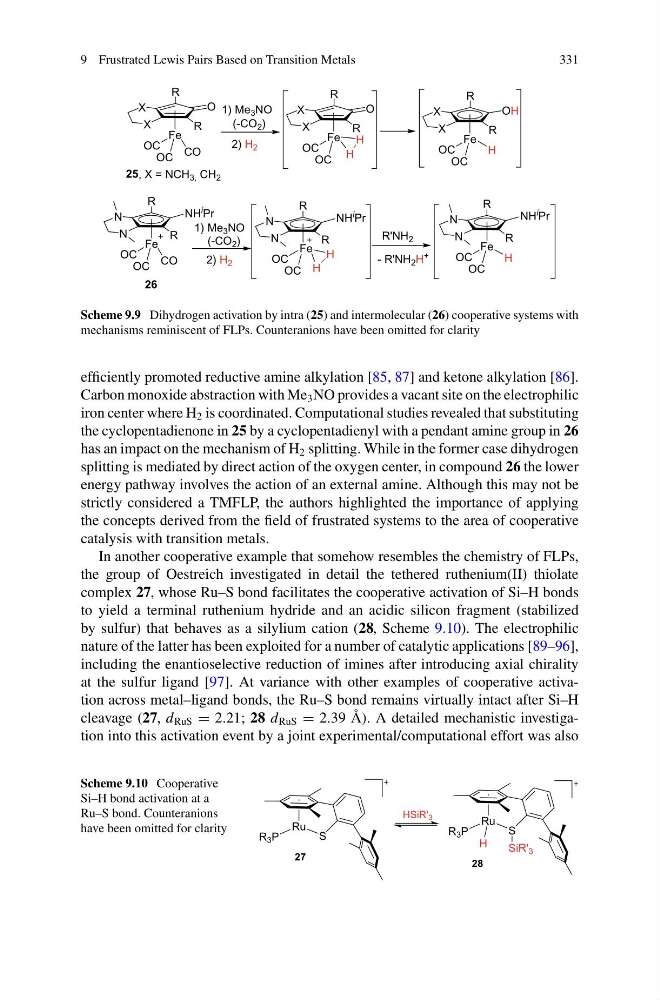
Scheme 9.9 Dihydrogen activation by intra (25) and intermolecular (26) cooperative systems with
mechanisms reminiscent of FLPs. Counteranions have been omitted for clarity
efficiently promoted reductive amine alkylation [85, 87] and ketone alkylation [86].
Carbon monoxide abstraction with Me 3 NO provides a vacant site on the electrophilic
iron center where H 2 is coordinated. Computational studies revealed that substituting
the cyclopentadienone in 25 by a cyclopentadienyl with a pendant amine group in 26
has an impact on the mechanism of H 2 splitting. While in the former case dihydrogen
splitting is mediated by direct action of the oxygen center, in compound 26 the lower
energy pathway involves the action of an external amine. Although this may not be
strictly considered a TMFLP, the authors highlighted the importance of applying
the concepts derived from the field of frustrated systems to the area of cooperative
catalysis with transition metals.
In another cooperative example that somehow resembles the chemistry of FLPs,
the group of Oestreich investigated in detail the tethered ruthenium(II) thiolate
complex 27, whose Ru–S bond facilitates the cooperative activation of Si–H bonds
to yield a terminal ruthenium hydride and an acidic silicon fragment (stabilized
by sulfur) that behaves as a silylium cation (28, Scheme 9.10). The electrophilic
nature of the latter has been exploited for a number of catalytic applications [89–96],
including the enantioselective reduction of imines after introducing axial chirality
at the sulfur ligand [97]. At variance with other examples of cooperative activation across metal–ligand bonds, the Ru–S bond remains virtually intact after Si–H
cleavage (27, d RuS = 2.21; 28 d RuS = 2.39 Å). A detailed mechanistic investigation into this activation event by a joint experimental/computational effort was also
Scheme 9.10 Cooperative
Si–H bond activation at a
Ru–S bond. Counteranions
have been omitted for clarity
Ru
S
R 3 P
27
Ru
S
R 3 P
28
H
SiR' 3
HSiR' 3
331
Fe
X
X
R
R
N
N
R
R
OC
OC
O
Fe
X
X
R
R
OC
OC
O
H
H
Fe
X
X
R
R
OC
OC
OH
H
CO
1) Me 3 NO
2) H 2
Fe
OC
OC
CO
NH
i Pr
1) Me 3 NO
2) H 2
N
N
R
R
Fe
OC
OC
NH
i Pr
H
H
R'NH 2
N
N
R
R
Fe
OC
OC
NH
i
Pr
H
- R'NH 2 H
+
26
(-CO 2 )
(-CO 2 )
25, X = NCH 3, CH 2
Scheme 9.9 Dihydrogen activation by intra (25) and intermolecular (26) cooperative systems with
mechanisms reminiscent of FLPs. Counteranions have been omitted for clarity
efficiently promoted reductive amine alkylation [85, 87] and ketone alkylation [86].
Carbon monoxide abstraction with Me 3 NO provides a vacant site on the electrophilic
iron center where H 2 is coordinated. Computational studies revealed that substituting
the cyclopentadienone in 25 by a cyclopentadienyl with a pendant amine group in 26
has an impact on the mechanism of H 2 splitting. While in the former case dihydrogen
splitting is mediated by direct action of the oxygen center, in compound 26 the lower
energy pathway involves the action of an external amine. Although this may not be
strictly considered a TMFLP, the authors highlighted the importance of applying
the concepts derived from the field of frustrated systems to the area of cooperative
catalysis with transition metals.
In another cooperative example that somehow resembles the chemistry of FLPs,
the group of Oestreich investigated in detail the tethered ruthenium(II) thiolate
complex 27, whose Ru–S bond facilitates the cooperative activation of Si–H bonds
to yield a terminal ruthenium hydride and an acidic silicon fragment (stabilized
by sulfur) that behaves as a silylium cation (28, Scheme 9.10). The electrophilic
nature of the latter has been exploited for a number of catalytic applications [89–96],
including the enantioselective reduction of imines after introducing axial chirality
at the sulfur ligand [97]. At variance with other examples of cooperative activation across metal–ligand bonds, the Ru–S bond remains virtually intact after Si–H
cleavage (27, d RuS = 2.21; 28 d RuS = 2.39 Å). A detailed mechanistic investigation into this activation event by a joint experimental/computational effort was also
Scheme 9.10 Cooperative
Si–H bond activation at a
Ru–S bond. Counteranions
have been omitted for clarity
Ru
S
R 3 P
27
Ru
S
R 3 P
28
H
SiR' 3
HSiR' 3