

330
N. Hidalgo et al.
M
P
P
P
Ph 2
Ph 2
P
N
N
Ph
H
(C 6 F 5 ) 3 B
B(C 6 F 5 ) 3
23; M=Mo, W
Fe
PEt 2
Et 2 P
PEt 2
Et 2 P
N N
B(C 6 F 5 ) 3
Toluene, 25 ºC
-N 2
Toluene,
25 ºC, 15 min
HSiEt 3
H
Fe
PEt 2
Et 2 P
PEt 2
Et 2 P
N N
B(C 6 F 5 ) 3
PhF, 25 ºC
Fe
PEt 2
Et 2 P
PEt 2
Et 2 P
N N
B(C 6 F 5 ) 3
PhF, -30 ºC
HBAr F
24
Ph 2
M
P
P
P
Ph 2
Ph 2
P
N
N
Ph
H
Ph 2
Et 3 Si
M
P
Ph 2
P
P
Ph 2
Ph 2
P
N
N
Ph 2
N
N
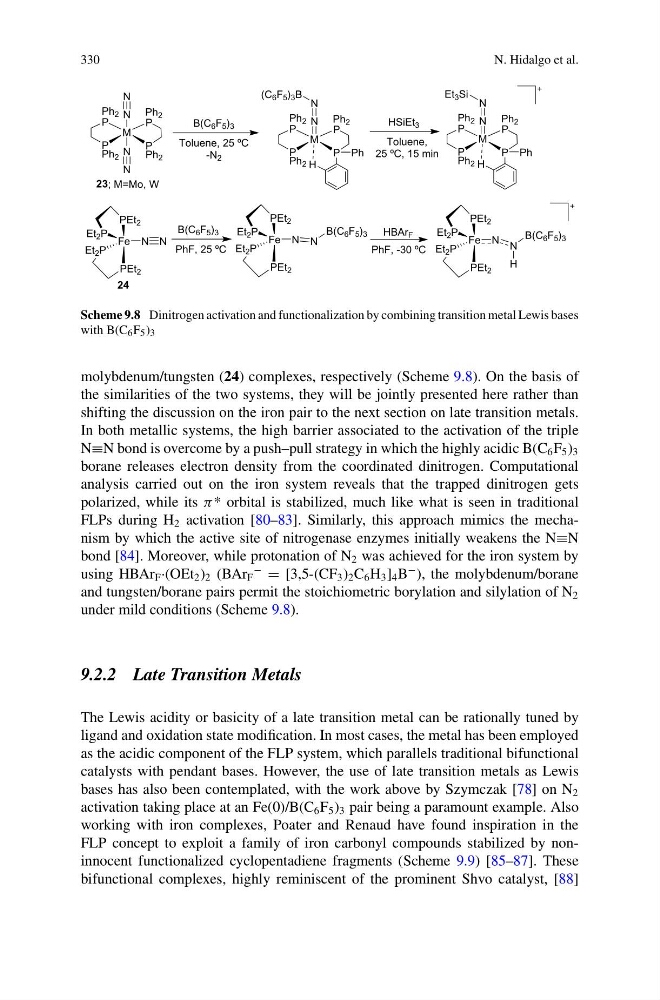
Scheme 9.8 Dinitrogen activation and functionalization by combining transition metal Lewis bases
with B(C 6 F 5 ) 3
molybdenum/tungsten (24) complexes, respectively (Scheme 9.8). On the basis of
the similarities of the two systems, they will be jointly presented here rather than
shifting the discussion on the iron pair to the next section on late transition metals.
In both metallic systems, the high barrier associated to the activation of the triple
N≡N bond is overcome by a push–pull strategy in which the highly acidic B(C 6 F 5 ) 3
borane releases electron density from the coordinated dinitrogen. Computational
analysis carried out on the iron system reveals that the trapped dinitrogen gets
polarized, while its π * orbital is stabilized, much like what is seen in traditional
FLPs during H 2 activation [80–83]. Similarly, this approach mimics the mechanism by which the active site of nitrogenase enzymes initially weakens the N≡N
bond [84]. Moreover, while protonation of N 2 was achieved for the iron system by
using HBAr F ·(OEt 2 ) 2 (BAr F
−
= [3,5-(CF 3 ) 2 C 6 H 3 ] 4 B
− ), the molybdenum/borane
and tungsten/borane pairs permit the stoichiometric borylation and silylation of N 2
under mild conditions (Scheme 9.8).
9.2.2 Late Transition Metals
The Lewis acidity or basicity of a late transition metal can be rationally tuned by
ligand and oxidation state modification. In most cases, the metal has been employed
as the acidic component of the FLP system, which parallels traditional bifunctional
catalysts with pendant bases. However, the use of late transition metals as Lewis
bases has also been contemplated, with the work above by Szymczak [78] on N 2
activation taking place at an Fe(0)/B(C 6 F 5 ) 3 pair being a paramount example. Also
working with iron complexes, Poater and Renaud have found inspiration in the
FLP concept to exploit a family of iron carbonyl compounds stabilized by noninnocent functionalized cyclopentadiene fragments (Scheme 9.9) [85–87]. These
bifunctional complexes, highly reminiscent of the prominent Shvo catalyst, [88]
N. Hidalgo et al.
M
P
P
P
Ph 2
Ph 2
P
N
N
Ph
H
(C 6 F 5 ) 3 B
B(C 6 F 5 ) 3
23; M=Mo, W
Fe
PEt 2
Et 2 P
PEt 2
Et 2 P
N N
B(C 6 F 5 ) 3
Toluene, 25 ºC
-N 2
Toluene,
25 ºC, 15 min
HSiEt 3
H
Fe
PEt 2
Et 2 P
PEt 2
Et 2 P
N N
B(C 6 F 5 ) 3
PhF, 25 ºC
Fe
PEt 2
Et 2 P
PEt 2
Et 2 P
N N
B(C 6 F 5 ) 3
PhF, -30 ºC
HBAr F
24
Ph 2
M
P
P
P
Ph 2
Ph 2
P
N
N
Ph
H
Ph 2
Et 3 Si
M
P
Ph 2
P
P
Ph 2
Ph 2
P
N
N
Ph 2
N
N
Scheme 9.8 Dinitrogen activation and functionalization by combining transition metal Lewis bases
with B(C 6 F 5 ) 3
molybdenum/tungsten (24) complexes, respectively (Scheme 9.8). On the basis of
the similarities of the two systems, they will be jointly presented here rather than
shifting the discussion on the iron pair to the next section on late transition metals.
In both metallic systems, the high barrier associated to the activation of the triple
N≡N bond is overcome by a push–pull strategy in which the highly acidic B(C 6 F 5 ) 3
borane releases electron density from the coordinated dinitrogen. Computational
analysis carried out on the iron system reveals that the trapped dinitrogen gets
polarized, while its π * orbital is stabilized, much like what is seen in traditional
FLPs during H 2 activation [80–83]. Similarly, this approach mimics the mechanism by which the active site of nitrogenase enzymes initially weakens the N≡N
bond [84]. Moreover, while protonation of N 2 was achieved for the iron system by
using HBAr F ·(OEt 2 ) 2 (BAr F
−
= [3,5-(CF 3 ) 2 C 6 H 3 ] 4 B
− ), the molybdenum/borane
and tungsten/borane pairs permit the stoichiometric borylation and silylation of N 2
under mild conditions (Scheme 9.8).
9.2.2 Late Transition Metals
The Lewis acidity or basicity of a late transition metal can be rationally tuned by
ligand and oxidation state modification. In most cases, the metal has been employed
as the acidic component of the FLP system, which parallels traditional bifunctional
catalysts with pendant bases. However, the use of late transition metals as Lewis
bases has also been contemplated, with the work above by Szymczak [78] on N 2
activation taking place at an Fe(0)/B(C 6 F 5 ) 3 pair being a paramount example. Also
working with iron complexes, Poater and Renaud have found inspiration in the
FLP concept to exploit a family of iron carbonyl compounds stabilized by noninnocent functionalized cyclopentadiene fragments (Scheme 9.9) [85–87]. These
bifunctional complexes, highly reminiscent of the prominent Shvo catalyst, [88]