

9 Frustrated Lewis Pairs Based on Transition Metals
329
of imines using a range of zirconocenes bearing mesityl aryloxide and where the
imine substrate served as the base as well [66].
Moving forward to group 6 of the periodic table, Bullock explored the reversible
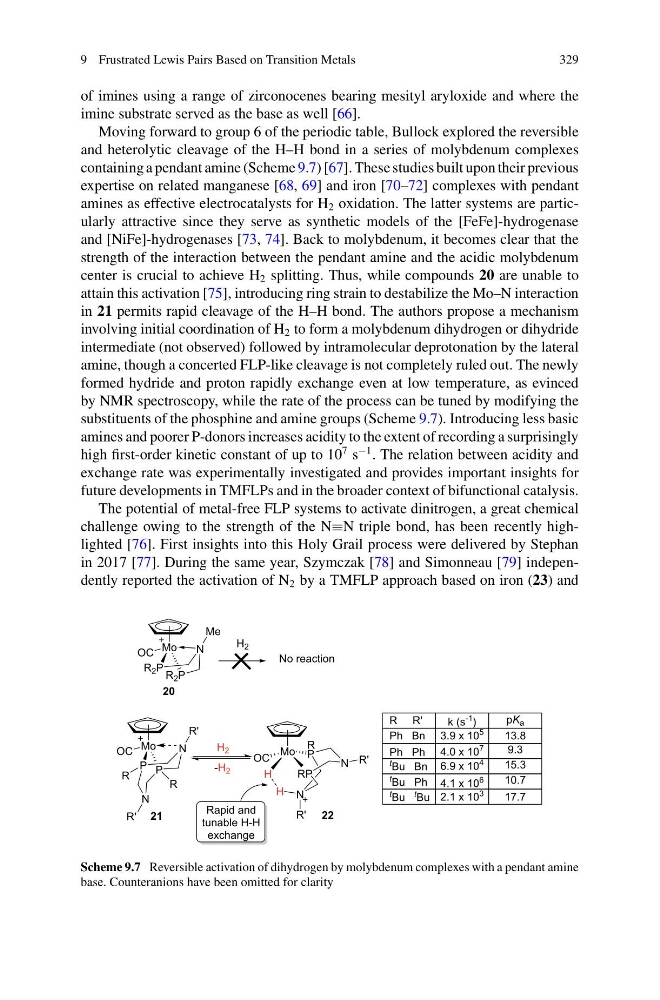
and heterolytic cleavage of the H–H bond in a series of molybdenum complexes
containing a pendant amine (Scheme 9.7) [67]. These studies built upon their previous
expertise on related manganese [68, 69] and iron [70–72] complexes with pendant
amines as effective electrocatalysts for H 2 oxidation. The latter systems are particularly attractive since they serve as synthetic models of the [FeFe]-hydrogenase
and [NiFe]-hydrogenases [73, 74]. Back to molybdenum, it becomes clear that the
strength of the interaction between the pendant amine and the acidic molybdenum
center is crucial to achieve H 2 splitting. Thus, while compounds 20 are unable to
attain this activation [75], introducing ring strain to destabilize the Mo–N interaction
in 21 permits rapid cleavage of the H–H bond. The authors propose a mechanism
involving initial coordination of H 2 to form a molybdenum dihydrogen or dihydride
intermediate (not observed) followed by intramolecular deprotonation by the lateral
amine, though a concerted FLP-like cleavage is not completely ruled out. The newly
formed hydride and proton rapidly exchange even at low temperature, as evinced
by NMR spectroscopy, while the rate of the process can be tuned by modifying the
substituents of the phosphine and amine groups (Scheme 9.7). Introducing less basic
amines and poorer P-donors increases acidity to the extent of recording a surprisingly
high first-order kinetic constant of up to 10
7 s
−1 . The relation between acidity and
exchange rate was experimentally investigated and provides important insights for
future developments in TMFLPs and in the broader context of bifunctional catalysis.
The potential of metal-free FLP systems to activate dinitrogen, a great chemical
challenge owing to the strength of the N≡N triple bond, has been recently highlighted [76]. First insights into this Holy Grail process were delivered by Stephan
in 2017 [77]. During the same year, Szymczak [78] and Simonneau [79] independently reported the activation of N 2 by a TMFLP approach based on iron (23) and
Mo
OC
P P
N
R'
R
R
N
R'
Mo
H
OC
R
P
RP
N
N
H
R'
R'
H 2
Mo
OC
R 2 P R 2 P
N
Me
H 2
No reaction
Rapid and
tunable H-H
exchange
R R'
k (s
-1 )
pK a
Ph Bn 3.9 x 10
5
13.8
Ph Ph 4.0 x 10
7
9.3
t Bu Bn 6.9 x 10
4
15.3
t Bu Ph 4.1 x 10
6
10.7
t Bu
t Bu 2.1 x 10
3
17.7
20
21
22
-H 2
Scheme 9.7 Reversible activation of dihydrogen by molybdenum complexes with a pendant amine
base. Counteranions have been omitted for clarity
329
of imines using a range of zirconocenes bearing mesityl aryloxide and where the
imine substrate served as the base as well [66].
Moving forward to group 6 of the periodic table, Bullock explored the reversible
and heterolytic cleavage of the H–H bond in a series of molybdenum complexes
containing a pendant amine (Scheme 9.7) [67]. These studies built upon their previous
expertise on related manganese [68, 69] and iron [70–72] complexes with pendant
amines as effective electrocatalysts for H 2 oxidation. The latter systems are particularly attractive since they serve as synthetic models of the [FeFe]-hydrogenase
and [NiFe]-hydrogenases [73, 74]. Back to molybdenum, it becomes clear that the
strength of the interaction between the pendant amine and the acidic molybdenum
center is crucial to achieve H 2 splitting. Thus, while compounds 20 are unable to
attain this activation [75], introducing ring strain to destabilize the Mo–N interaction
in 21 permits rapid cleavage of the H–H bond. The authors propose a mechanism
involving initial coordination of H 2 to form a molybdenum dihydrogen or dihydride
intermediate (not observed) followed by intramolecular deprotonation by the lateral
amine, though a concerted FLP-like cleavage is not completely ruled out. The newly
formed hydride and proton rapidly exchange even at low temperature, as evinced
by NMR spectroscopy, while the rate of the process can be tuned by modifying the
substituents of the phosphine and amine groups (Scheme 9.7). Introducing less basic
amines and poorer P-donors increases acidity to the extent of recording a surprisingly
high first-order kinetic constant of up to 10
7 s
−1 . The relation between acidity and
exchange rate was experimentally investigated and provides important insights for
future developments in TMFLPs and in the broader context of bifunctional catalysis.
The potential of metal-free FLP systems to activate dinitrogen, a great chemical
challenge owing to the strength of the N≡N triple bond, has been recently highlighted [76]. First insights into this Holy Grail process were delivered by Stephan
in 2017 [77]. During the same year, Szymczak [78] and Simonneau [79] independently reported the activation of N 2 by a TMFLP approach based on iron (23) and
Mo
OC
P P
N
R'
R
R
N
R'
Mo
H
OC
R
P
RP
N
N
H
R'
R'
H 2
Mo
OC
R 2 P R 2 P
N
Me
H 2
No reaction
Rapid and
tunable H-H
exchange
R R'
k (s
-1 )
pK a
Ph Bn 3.9 x 10
5
13.8
Ph Ph 4.0 x 10
7
9.3
t Bu Bn 6.9 x 10
4
15.3
t Bu Ph 4.1 x 10
6
10.7
t Bu
t Bu 2.1 x 10
3
17.7
20
21
22
-H 2
Scheme 9.7 Reversible activation of dihydrogen by molybdenum complexes with a pendant amine
base. Counteranions have been omitted for clarity