

328
N. Hidalgo et al.
Fine control of stereoelectronic properties in this type of systems remains a challenge from a synthetic point of view. To overcome this limitation, a more convenient route toward Zr
+ /pairs was reported by means of facile insertion of nonenolisable carbonyl compounds (including CO 2 ) into the Zr–E (E = P, N) bond of
phosphido- and amidozirconocene complexes of type [Cp 2 Zr(ER 2 )Me] (E = P, N)
and subsequent (or former) methyl abstraction by B(C 6 F 5 ) 3 [63, 59]. Compounds 18
were prepared by this approach and their coordinating ability as ambiphilic ligands
examined [63].
Drawing on the same theme, Wass explored intermolecular Zr
+ /P FLPs by
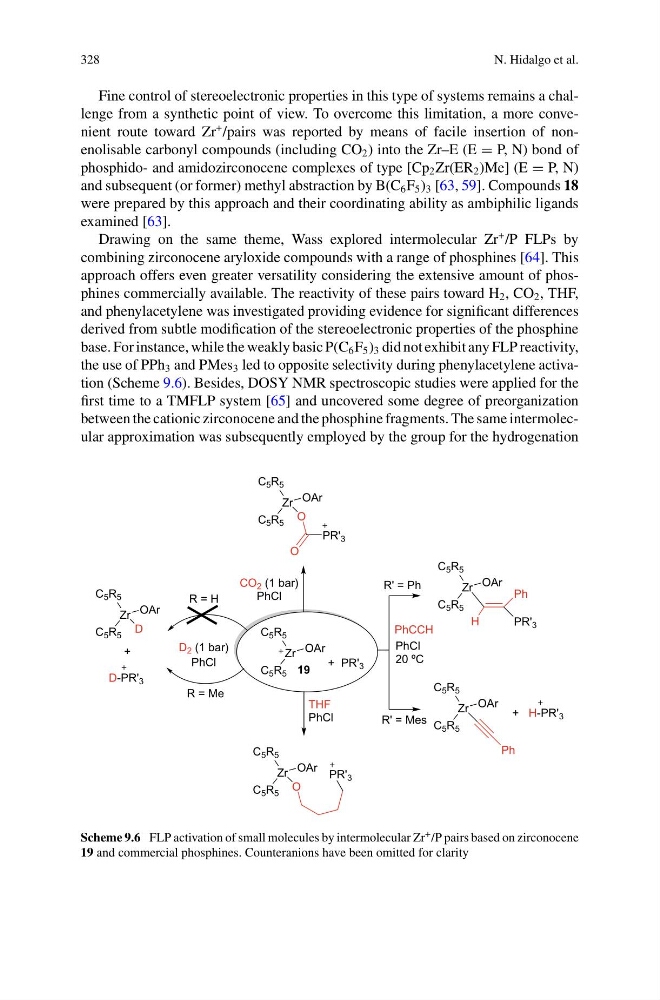
combining zirconocene aryloxide compounds with a range of phosphines [64]. This
approach offers even greater versatility considering the extensive amount of phosphines commercially available. The reactivity of these pairs toward H 2 , CO 2 , THF,
and phenylacetylene was investigated providing evidence for significant differences
derived from subtle modification of the stereoelectronic properties of the phosphine
base. For instance, while the weakly basic P(C 6 F 5 ) 3 did not exhibit any FLP reactivity,
the use of PPh 3 and PMes 3 led to opposite selectivity during phenylacetylene activation (Scheme 9.6). Besides, DOSY NMR spectroscopic studies were applied for the
first time to a TMFLP system [65] and uncovered some degree of preorganization
between the cationic zirconocene and the phosphine fragments. The same intermolecular approximation was subsequently employed by the group for the hydrogenation
C 5 R 5
Zr
C 5 R 5
OAr
+ PR' 3
19
C 5 R 5
Zr
C 5 R 5
OAr
D-PR' 3
D
C 5 R 5
Zr
C 5 R 5
OAr
O
PR' 3
O
C 5 R 5
Zr
C 5 R 5
OAr
O
PR' 3
C 5 R 5
Zr
C 5 R 5
OAr
PR' 3
Ph
H
C 5 R 5
Zr
C 5 R 5
OAr
Ph
+ H-PR' 3
PhCl
20 ºC
R' = Ph
R' = Mes
THF
PhCl
CO 2 (1 bar)
PhCl
D 2 (1 bar)
PhCl
+
R = H
R = Me
PhCCH
Scheme 9.6 FLP activation of small molecules by intermolecular Zr + /P pairs based on zirconocene
19 and commercial phosphines. Counteranions have been omitted for clarity
N. Hidalgo et al.
Fine control of stereoelectronic properties in this type of systems remains a challenge from a synthetic point of view. To overcome this limitation, a more convenient route toward Zr
+ /pairs was reported by means of facile insertion of nonenolisable carbonyl compounds (including CO 2 ) into the Zr–E (E = P, N) bond of
phosphido- and amidozirconocene complexes of type [Cp 2 Zr(ER 2 )Me] (E = P, N)
and subsequent (or former) methyl abstraction by B(C 6 F 5 ) 3 [63, 59]. Compounds 18
were prepared by this approach and their coordinating ability as ambiphilic ligands
examined [63].
Drawing on the same theme, Wass explored intermolecular Zr
+ /P FLPs by
combining zirconocene aryloxide compounds with a range of phosphines [64]. This
approach offers even greater versatility considering the extensive amount of phosphines commercially available. The reactivity of these pairs toward H 2 , CO 2 , THF,
and phenylacetylene was investigated providing evidence for significant differences
derived from subtle modification of the stereoelectronic properties of the phosphine
base. For instance, while the weakly basic P(C 6 F 5 ) 3 did not exhibit any FLP reactivity,
the use of PPh 3 and PMes 3 led to opposite selectivity during phenylacetylene activation (Scheme 9.6). Besides, DOSY NMR spectroscopic studies were applied for the
first time to a TMFLP system [65] and uncovered some degree of preorganization
between the cationic zirconocene and the phosphine fragments. The same intermolecular approximation was subsequently employed by the group for the hydrogenation
C 5 R 5
Zr
C 5 R 5
OAr
+ PR' 3
19
C 5 R 5
Zr
C 5 R 5
OAr
D-PR' 3
D
C 5 R 5
Zr
C 5 R 5
OAr
O
PR' 3
O
C 5 R 5
Zr
C 5 R 5
OAr
O
PR' 3
C 5 R 5
Zr
C 5 R 5
OAr
PR' 3
Ph
H
C 5 R 5
Zr
C 5 R 5
OAr
Ph
+ H-PR' 3
PhCl
20 ºC
R' = Ph
R' = Mes
THF
PhCl
CO 2 (1 bar)
PhCl
D 2 (1 bar)
PhCl
+
R = H
R = Me
PhCCH
Scheme 9.6 FLP activation of small molecules by intermolecular Zr + /P pairs based on zirconocene
19 and commercial phosphines. Counteranions have been omitted for clarity