

8 Lewis Acid−Base Pairs for Polymerization Catalysis …
309
O
O
O
R 2
R 2
O
O
O
O
O
O
H
H
O
O
O
H
H
O
O
O
O
O
O
H
H
=
PA
exo-NA
THPA
SA
CA
O
R 1
O
O
O
R 2
R 2
+
t Bu-P 2 /BEt 3
BDM
Ar
O
O
O
R 2
R 2
O
O
R 1
R 1
O
n
H
m
2
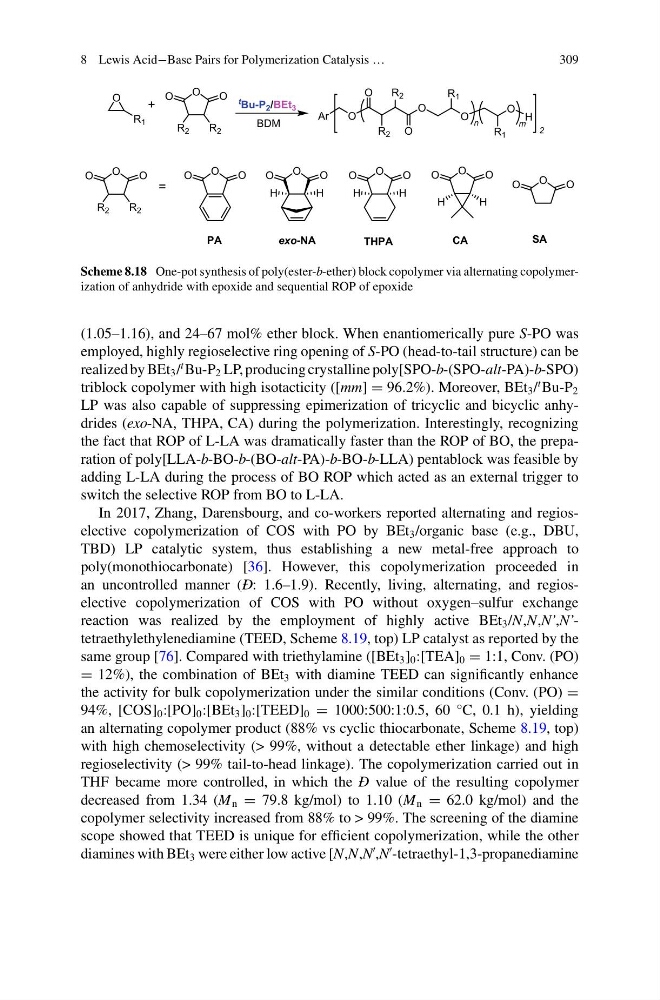
Scheme 8.18 One-pot synthesis of poly(ester-b-ether) block copolymer via alternating copolymerization of anhydride with epoxide and sequential ROP of epoxide
(1.05–1.16), and 24–67 mol% ether block. When enantiomerically pure S-PO was
employed, highly regioselective ring opening of S-PO (head-to-tail structure) can be
realized by BEt 3 /
t Bu-P 2 LP, producing crystalline poly[SPO-b-(SPO-alt-PA)-b-SPO)
triblock copolymer with high isotacticity ([mm] = 96.2%). Moreover, BEt 3 /
t Bu-P 2
LP was also capable of suppressing epimerization of tricyclic and bicyclic anhydrides (exo-NA, THPA, CA) during the polymerization. Interestingly, recognizing
the fact that ROP of L-LA was dramatically faster than the ROP of BO, the preparation of poly[LLA-b-BO-b-(BO-alt-PA)-b-BO-b-LLA) pentablock was feasible by
adding L-LA during the process of BO ROP which acted as an external trigger to
switch the selective ROP from BO to L-LA.
In 2017, Zhang, Darensbourg, and co-workers reported alternating and regioselective copolymerization of COS with PO by BEt 3 /organic base (e.g., DBU,
TBD) LP catalytic system, thus establishing a new metal-free approach to
poly(monothiocarbonate) [36]. However, this copolymerization proceeded in
an uncontrolled manner (Ð: 1.6–1.9). Recently, living, alternating, and regioselective copolymerization of COS with PO without oxygen–sulfur exchange
reaction was realized by the employment of highly active BEt 3 /N,N,N’,N’tetraethylethylenediamine (TEED, Scheme 8.19, top) LP catalyst as reported by the
same group [76]. Compared with triethylamine ([BEt 3 ] 0 :[TEA] 0 = 1:1, Conv. (PO)
= 12%), the combination of BEt 3 with diamine TEED can significantly enhance
the activity for bulk copolymerization under the similar conditions (Conv. (PO) =
94%, [COS] 0 :[PO] 0 :[BEt 3 ] 0 :[TEED] 0 = 1000:500:1:0.5, 60 °C, 0.1 h), yielding
an alternating copolymer product (88% vs cyclic thiocarbonate, Scheme 8.19, top)
with high chemoselectivity (> 99%, without a detectable ether linkage) and high
regioselectivity (> 99% tail-to-head linkage). The copolymerization carried out in
THF became more controlled, in which the Ð value of the resulting copolymer
decreased from 1.34 (M n = 79.8 kg/mol) to 1.10 (M n = 62.0 kg/mol) and the
copolymer selectivity increased from 88% to > 99%. The screening of the diamine
scope showed that TEED is unique for efficient copolymerization, while the other
diamines with BEt 3 were either low active [N,N,N
,N
-tetraethyl-1,3-propanediamine
309
O
O
O
R 2
R 2
O
O
O
O
O
O
H
H
O
O
O
H
H
O
O
O
O
O
O
H
H
=
PA
exo-NA
THPA
SA
CA
O
R 1
O
O
O
R 2
R 2
+
t Bu-P 2 /BEt 3
BDM
Ar
O
O
O
R 2
R 2
O
O
R 1
R 1
O
n
H
m
2
Scheme 8.18 One-pot synthesis of poly(ester-b-ether) block copolymer via alternating copolymerization of anhydride with epoxide and sequential ROP of epoxide
(1.05–1.16), and 24–67 mol% ether block. When enantiomerically pure S-PO was
employed, highly regioselective ring opening of S-PO (head-to-tail structure) can be
realized by BEt 3 /
t Bu-P 2 LP, producing crystalline poly[SPO-b-(SPO-alt-PA)-b-SPO)
triblock copolymer with high isotacticity ([mm] = 96.2%). Moreover, BEt 3 /
t Bu-P 2
LP was also capable of suppressing epimerization of tricyclic and bicyclic anhydrides (exo-NA, THPA, CA) during the polymerization. Interestingly, recognizing
the fact that ROP of L-LA was dramatically faster than the ROP of BO, the preparation of poly[LLA-b-BO-b-(BO-alt-PA)-b-BO-b-LLA) pentablock was feasible by
adding L-LA during the process of BO ROP which acted as an external trigger to
switch the selective ROP from BO to L-LA.
In 2017, Zhang, Darensbourg, and co-workers reported alternating and regioselective copolymerization of COS with PO by BEt 3 /organic base (e.g., DBU,
TBD) LP catalytic system, thus establishing a new metal-free approach to
poly(monothiocarbonate) [36]. However, this copolymerization proceeded in
an uncontrolled manner (Ð: 1.6–1.9). Recently, living, alternating, and regioselective copolymerization of COS with PO without oxygen–sulfur exchange
reaction was realized by the employment of highly active BEt 3 /N,N,N’,N’tetraethylethylenediamine (TEED, Scheme 8.19, top) LP catalyst as reported by the
same group [76]. Compared with triethylamine ([BEt 3 ] 0 :[TEA] 0 = 1:1, Conv. (PO)
= 12%), the combination of BEt 3 with diamine TEED can significantly enhance
the activity for bulk copolymerization under the similar conditions (Conv. (PO) =
94%, [COS] 0 :[PO] 0 :[BEt 3 ] 0 :[TEED] 0 = 1000:500:1:0.5, 60 °C, 0.1 h), yielding
an alternating copolymer product (88% vs cyclic thiocarbonate, Scheme 8.19, top)
with high chemoselectivity (> 99%, without a detectable ether linkage) and high
regioselectivity (> 99% tail-to-head linkage). The copolymerization carried out in
THF became more controlled, in which the Ð value of the resulting copolymer
decreased from 1.34 (M n = 79.8 kg/mol) to 1.10 (M n = 62.0 kg/mol) and the
copolymer selectivity increased from 88% to > 99%. The screening of the diamine
scope showed that TEED is unique for efficient copolymerization, while the other
diamines with BEt 3 were either low active [N,N,N
,N
-tetraethyl-1,3-propanediamine