

308
M. Hong
R(OH) 2 + n
m
+
R O
O
H
H
n'
n'
R O
O
H
H
m'
m'
R O
O
n'
n'
H
m'
H
m'
x > y 0
(y' + y) > x
y' BEt 3
x
t Bu-P 2 + yBEt 3
x
t Bu-P 2 + yBEt 3
y > x > 0
(x' + x) > y
x'
t Bu-P 2
R O
O
n'
n'
H
m'
H
m'
= cyclic ester/carbonate
= epoxide
2n' n, 2m' m, (x' + x) 0.6, (y' + y) 1.0
R O
O
n1
R(OH) 2 + n
m
+
0.1
t Bu-P 2 0.4 BEt 3 0.5
t Bu-P 2 0.6 BEt 3 0.7
t Bu-P 2 0.8 BEt 3 1.0
t Bu-P 2 1.2 BEt 3
m1
n2
m2
n3
H
m3
n4
m4
n4
m3
n3
m2
n2
m1
n1
m4
= -VL
= PO
2(n 1 + n 2 + n 3 + n 4 ) n, 2(m 1 + m 2 + m 3 + m 4 ) m
H
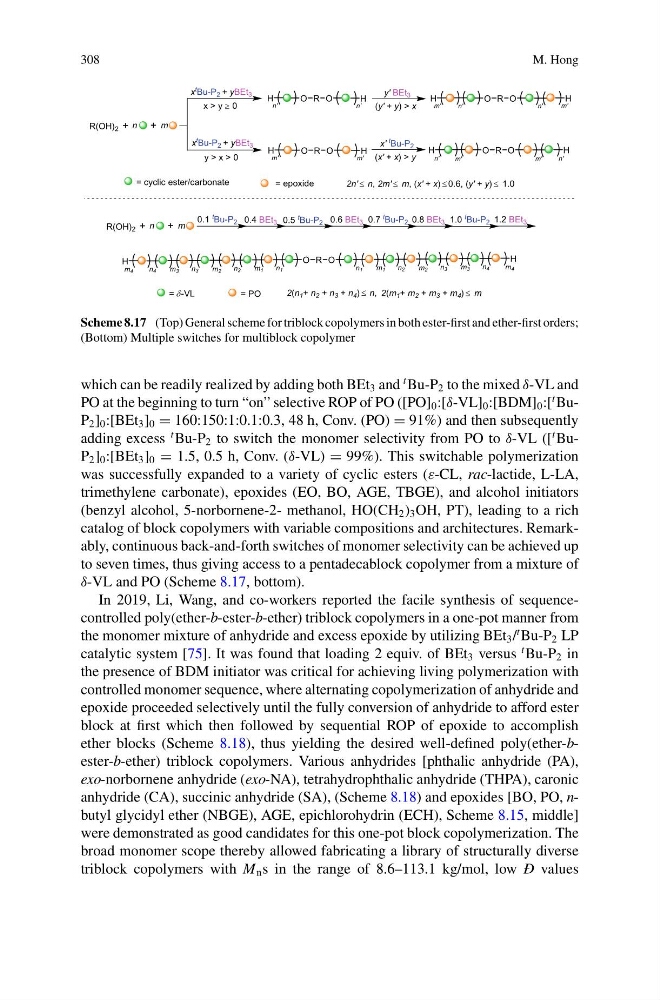
Scheme 8.17 (Top) General scheme for triblock copolymers in both ester-first and ether-first orders;
(Bottom) Multiple switches for multiblock copolymer
which can be readily realized by adding both BEt 3 and
t Bu-P 2 to the mixed δ-VL and
PO at the beginning to turn “on” selective ROP of PO ([PO] 0 :[δ-VL] 0 :[BDM] 0 :[
t BuP 2 ] 0 :[BEt 3 ] 0 = 160:150:1:0.1:0.3, 48 h, Conv. (PO) = 91%) and then subsequently
adding excess
t Bu-P 2 to switch the monomer selectivity from PO to δ-VL ([
t BuP 2 ] 0 :[BEt 3 ] 0 = 1.5, 0.5 h, Conv. (δ-VL) = 99%). This switchable polymerization
was successfully expanded to a variety of cyclic esters (ε-CL, rac-lactide, L-LA,
trimethylene carbonate), epoxides (EO, BO, AGE, TBGE), and alcohol initiators
(benzyl alcohol, 5-norbornene-2- methanol, HO(CH 2 ) 3 OH, PT), leading to a rich
catalog of block copolymers with variable compositions and architectures. Remarkably, continuous back-and-forth switches of monomer selectivity can be achieved up
to seven times, thus giving access to a pentadecablock copolymer from a mixture of
δ-VL and PO (Scheme 8.17, bottom).
In 2019, Li, Wang, and co-workers reported the facile synthesis of sequencecontrolled poly(ether-b-ester-b-ether) triblock copolymers in a one-pot manner from
the monomer mixture of anhydride and excess epoxide by utilizing BEt 3 /
t Bu-P 2 LP
catalytic system [75]. It was found that loading 2 equiv. of BEt 3 versus
t Bu-P 2 in
the presence of BDM initiator was critical for achieving living polymerization with
controlled monomer sequence, where alternating copolymerization of anhydride and
epoxide proceeded selectively until the fully conversion of anhydride to afford ester
block at first which then followed by sequential ROP of epoxide to accomplish
ether blocks (Scheme 8.18), thus yielding the desired well-defined poly(ether-bester-b-ether) triblock copolymers. Various anhydrides [phthalic anhydride (PA),
exo-norbornene anhydride (exo-NA), tetrahydrophthalic anhydride (THPA), caronic
anhydride (CA), succinic anhydride (SA), (Scheme 8.18) and epoxides [BO, PO, nbutyl glycidyl ether (NBGE), AGE, epichlorohydrin (ECH), Scheme 8.15, middle]
were demonstrated as good candidates for this one-pot block copolymerization. The
broad monomer scope thereby allowed fabricating a library of structurally diverse
triblock copolymers with M n s in the range of 8.6–113.1 kg/mol, low Ð values
M. Hong
R(OH) 2 + n
m
+
R O
O
H
H
n'
n'
R O
O
H
H
m'
m'
R O
O
n'
n'
H
m'
H
m'
x > y 0
(y' + y) > x
y' BEt 3
x
t Bu-P 2 + yBEt 3
x
t Bu-P 2 + yBEt 3
y > x > 0
(x' + x) > y
x'
t Bu-P 2
R O
O
n'
n'
H
m'
H
m'
= cyclic ester/carbonate
= epoxide
2n' n, 2m' m, (x' + x) 0.6, (y' + y) 1.0
R O
O
n1
R(OH) 2 + n
m
+
0.1
t Bu-P 2 0.4 BEt 3 0.5
t Bu-P 2 0.6 BEt 3 0.7
t Bu-P 2 0.8 BEt 3 1.0
t Bu-P 2 1.2 BEt 3
m1
n2
m2
n3
H
m3
n4
m4
n4
m3
n3
m2
n2
m1
n1
m4
= -VL
= PO
2(n 1 + n 2 + n 3 + n 4 ) n, 2(m 1 + m 2 + m 3 + m 4 ) m
H
Scheme 8.17 (Top) General scheme for triblock copolymers in both ester-first and ether-first orders;
(Bottom) Multiple switches for multiblock copolymer
which can be readily realized by adding both BEt 3 and
t Bu-P 2 to the mixed δ-VL and
PO at the beginning to turn “on” selective ROP of PO ([PO] 0 :[δ-VL] 0 :[BDM] 0 :[
t BuP 2 ] 0 :[BEt 3 ] 0 = 160:150:1:0.1:0.3, 48 h, Conv. (PO) = 91%) and then subsequently
adding excess
t Bu-P 2 to switch the monomer selectivity from PO to δ-VL ([
t BuP 2 ] 0 :[BEt 3 ] 0 = 1.5, 0.5 h, Conv. (δ-VL) = 99%). This switchable polymerization
was successfully expanded to a variety of cyclic esters (ε-CL, rac-lactide, L-LA,
trimethylene carbonate), epoxides (EO, BO, AGE, TBGE), and alcohol initiators
(benzyl alcohol, 5-norbornene-2- methanol, HO(CH 2 ) 3 OH, PT), leading to a rich
catalog of block copolymers with variable compositions and architectures. Remarkably, continuous back-and-forth switches of monomer selectivity can be achieved up
to seven times, thus giving access to a pentadecablock copolymer from a mixture of
δ-VL and PO (Scheme 8.17, bottom).
In 2019, Li, Wang, and co-workers reported the facile synthesis of sequencecontrolled poly(ether-b-ester-b-ether) triblock copolymers in a one-pot manner from
the monomer mixture of anhydride and excess epoxide by utilizing BEt 3 /
t Bu-P 2 LP
catalytic system [75]. It was found that loading 2 equiv. of BEt 3 versus
t Bu-P 2 in
the presence of BDM initiator was critical for achieving living polymerization with
controlled monomer sequence, where alternating copolymerization of anhydride and
epoxide proceeded selectively until the fully conversion of anhydride to afford ester
block at first which then followed by sequential ROP of epoxide to accomplish
ether blocks (Scheme 8.18), thus yielding the desired well-defined poly(ether-bester-b-ether) triblock copolymers. Various anhydrides [phthalic anhydride (PA),
exo-norbornene anhydride (exo-NA), tetrahydrophthalic anhydride (THPA), caronic
anhydride (CA), succinic anhydride (SA), (Scheme 8.18) and epoxides [BO, PO, nbutyl glycidyl ether (NBGE), AGE, epichlorohydrin (ECH), Scheme 8.15, middle]
were demonstrated as good candidates for this one-pot block copolymerization. The
broad monomer scope thereby allowed fabricating a library of structurally diverse
triblock copolymers with M n s in the range of 8.6–113.1 kg/mol, low Ð values