

298
M. Hong
N
N
t Bu
t Bu
:
H
O
OMe
[Al]
Initiation
Deprotonation
[Al]
N
N
t Bu
t Bu
H
O
OMe
[Al]
O
OMe
[Al]
MC
Catalyst
Recapture
Propagation
C
CO 2 Me
O
OMe
[Al]
N
N
t Bu
t Bu
H
MeO 2
Chain Transfer to MC
O
OMe
[Al]
n
C
CO 2 Me
CO 2 Me
MeO 2
n
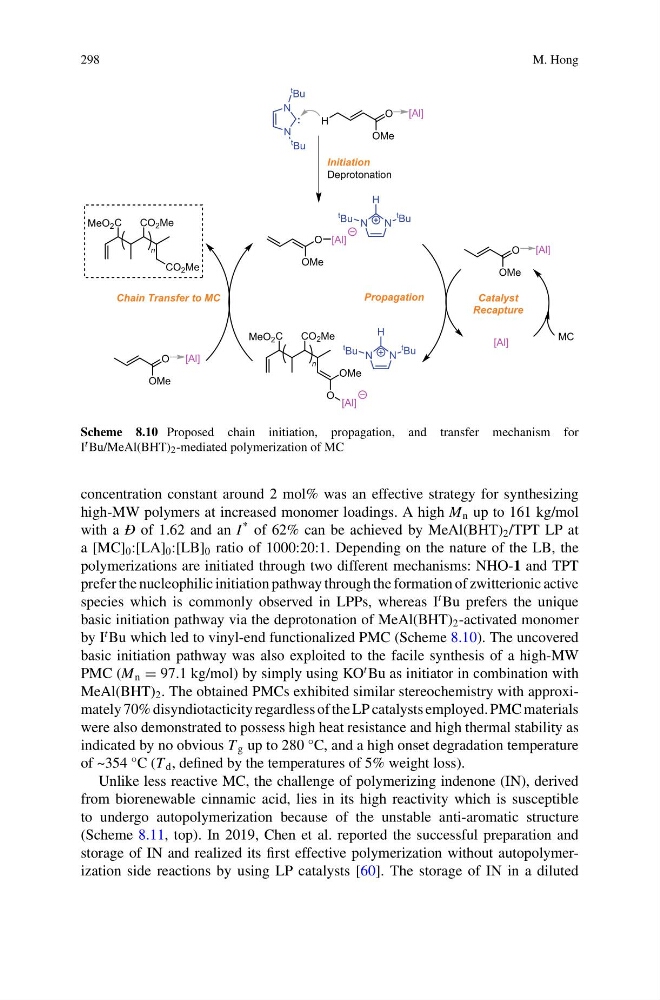
Scheme 8.10 Proposed chain initiation, propagation, and transfer mechanism for
I t Bu/MeAl(BHT) 2 -mediated polymerization of MC
concentration constant around 2 mol% was an effective strategy for synthesizing
high-MW polymers at increased monomer loadings. A high M n up to 161 kg/mol
with a Ð of 1.62 and an I
* of 62% can be achieved by MeAl(BHT) 2 /TPT LP at
a [MC] 0 :[LA] 0 :[LB] 0 ratio of 1000:20:1. Depending on the nature of the LB, the
polymerizations are initiated through two different mechanisms: NHO-1 and TPT
prefer the nucleophilic initiation pathway through the formation of zwitterionic active
species which is commonly observed in LPPs, whereas I
t Bu prefers the unique
basic initiation pathway via the deprotonation of MeAl(BHT) 2 -activated monomer
by I
t Bu which led to vinyl-end functionalized PMC (Scheme 8.10). The uncovered
basic initiation pathway was also exploited to the facile synthesis of a high-MW
PMC (M n = 97.1 kg/mol) by simply using KO
t Bu as initiator in combination with
MeAl(BHT) 2 . The obtained PMCs exhibited similar stereochemistry with approximately 70% disyndiotacticity regardless of the LP catalysts employed. PMC materials
were also demonstrated to possess high heat resistance and high thermal stability as
indicated by no obvious T g up to 280 °C, and a high onset degradation temperature
of ~354 °C (T d , defined by the temperatures of 5% weight loss).
Unlike less reactive MC, the challenge of polymerizing indenone (IN), derived
from biorenewable cinnamic acid, lies in its high reactivity which is susceptible
to undergo autopolymerization because of the unstable anti-aromatic structure
(Scheme 8.11, top). In 2019, Chen et al. reported the successful preparation and
storage of IN and realized its first effective polymerization without autopolymerization side reactions by using LP catalysts [60]. The storage of IN in a diluted
M. Hong
N
N
t Bu
t Bu
:
H
O
OMe
[Al]
Initiation
Deprotonation
[Al]
N
N
t Bu
t Bu
H
O
OMe
[Al]
O
OMe
[Al]
MC
Catalyst
Recapture
Propagation
C
CO 2 Me
O
OMe
[Al]
N
N
t Bu
t Bu
H
MeO 2
Chain Transfer to MC
O
OMe
[Al]
n
C
CO 2 Me
CO 2 Me
MeO 2
n
Scheme 8.10 Proposed chain initiation, propagation, and transfer mechanism for
I t Bu/MeAl(BHT) 2 -mediated polymerization of MC
concentration constant around 2 mol% was an effective strategy for synthesizing
high-MW polymers at increased monomer loadings. A high M n up to 161 kg/mol
with a Ð of 1.62 and an I
* of 62% can be achieved by MeAl(BHT) 2 /TPT LP at
a [MC] 0 :[LA] 0 :[LB] 0 ratio of 1000:20:1. Depending on the nature of the LB, the
polymerizations are initiated through two different mechanisms: NHO-1 and TPT
prefer the nucleophilic initiation pathway through the formation of zwitterionic active
species which is commonly observed in LPPs, whereas I
t Bu prefers the unique
basic initiation pathway via the deprotonation of MeAl(BHT) 2 -activated monomer
by I
t Bu which led to vinyl-end functionalized PMC (Scheme 8.10). The uncovered
basic initiation pathway was also exploited to the facile synthesis of a high-MW
PMC (M n = 97.1 kg/mol) by simply using KO
t Bu as initiator in combination with
MeAl(BHT) 2 . The obtained PMCs exhibited similar stereochemistry with approximately 70% disyndiotacticity regardless of the LP catalysts employed. PMC materials
were also demonstrated to possess high heat resistance and high thermal stability as
indicated by no obvious T g up to 280 °C, and a high onset degradation temperature
of ~354 °C (T d , defined by the temperatures of 5% weight loss).
Unlike less reactive MC, the challenge of polymerizing indenone (IN), derived
from biorenewable cinnamic acid, lies in its high reactivity which is susceptible
to undergo autopolymerization because of the unstable anti-aromatic structure
(Scheme 8.11, top). In 2019, Chen et al. reported the successful preparation and
storage of IN and realized its first effective polymerization without autopolymerization side reactions by using LP catalysts [60]. The storage of IN in a diluted