

8 Lewis Acid−Base Pairs for Polymerization Catalysis …
297
those derived from naturally abundant and renewable feedstocks (e.g., biomass) [54–
57]. As a robust polymerization technology, the application of a LP catalyst system
for the synthesis of novel bio-based polymers with notable properties has emerged
recently, and showed a great potential in polymerizing challenging biomass-derived
monomers that cannot be efficiently realized by traditional polymerization techniques. Accordingly, this section highlights the selected progresses made recently in
the LPPs of biomass-derived polar vinyl monomers.
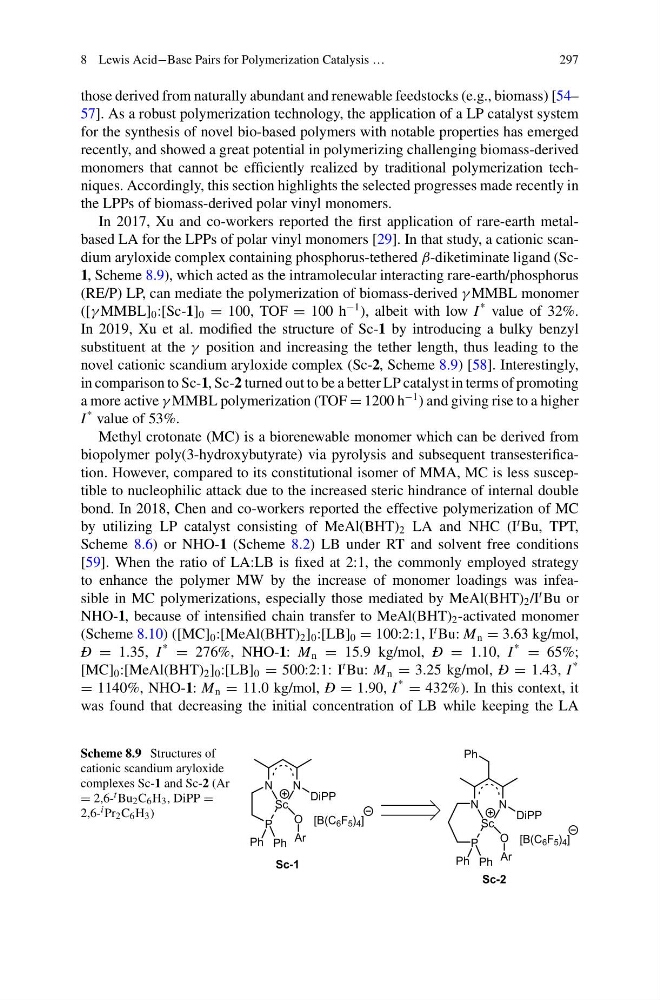
In 2017, Xu and co-workers reported the first application of rare-earth metalbased LA for the LPPs of polar vinyl monomers [29]. In that study, a cationic scandium aryloxide complex containing phosphorus-tethered β-diketiminate ligand (Sc1, Scheme 8.9), which acted as the intramolecular interacting rare-earth/phosphorus
(RE/P) LP, can mediate the polymerization of biomass-derived γ MMBL monomer
([γ MMBL] 0 :[Sc-1] 0 = 100, TOF = 100 h
−1 ), albeit with low I
* value of 32%.
In 2019, Xu et al. modified the structure of Sc-1 by introducing a bulky benzyl
substituent at the γ position and increasing the tether length, thus leading to the
novel cationic scandium aryloxide complex (Sc-2, Scheme 8.9) [58]. Interestingly,
in comparison to Sc-1, Sc-2 turned out to be a better LP catalyst in terms of promoting
a more active γ MMBL polymerization (TOF = 1200 h
−1 ) and giving rise to a higher
I
* value of 53%.
Methyl crotonate (MC) is a biorenewable monomer which can be derived from
biopolymer poly(3-hydroxybutyrate) via pyrolysis and subsequent transesterification. However, compared to its constitutional isomer of MMA, MC is less susceptible to nucleophilic attack due to the increased steric hindrance of internal double
bond. In 2018, Chen and co-workers reported the effective polymerization of MC
by utilizing LP catalyst consisting of MeAl(BHT) 2 LA and NHC (I
t Bu, TPT,
Scheme 8.6) or NHO-1 (Scheme 8.2) LB under RT and solvent free conditions
[59]. When the ratio of LA:LB is fixed at 2:1, the commonly employed strategy
to enhance the polymer MW by the increase of monomer loadings was infeasible in MC polymerizations, especially those mediated by MeAl(BHT) 2 /I
t Bu or
NHO-1, because of intensified chain transfer to MeAl(BHT) 2 -activated monomer
(Scheme 8.10) ([MC] 0 :[MeAl(BHT) 2 ] 0 :[LB] 0 = 100:2:1, I
t Bu: M n = 3.63 kg/mol,
Ð = 1.35, I
*
= 276%, NHO-1: M n = 15.9 kg/mol, Ð = 1.10, I
*
= 65%;
[MC] 0 :[MeAl(BHT) 2 ] 0 :[LB] 0 = 500:2:1: I
t Bu: M n = 3.25 kg/mol, Ð = 1.43, I
*
= 1140%, NHO-1: M n = 11.0 kg/mol, Ð = 1.90, I
*
= 432%). In this context, it
was found that decreasing the initial concentration of LB while keeping the LA
Scheme 8.9 Structures of
cationic scandium aryloxide
complexes Sc-1 and Sc-2 (Ar
= 2,6- t Bu 2 C 6 H 3 , DiPP =
2,6- i Pr 2 C 6 H 3 )
N
N
DiPP
P
Ph Ph
O
Ar
[B(C 6 F 5 ) 4 ]
Sc
N
N
DiPP
P
Ph Ph
O
Ar
[B(C 6 F 5 ) 4 ]
Sc
Ph
Sc-1
Sc-2
297
those derived from naturally abundant and renewable feedstocks (e.g., biomass) [54–
57]. As a robust polymerization technology, the application of a LP catalyst system
for the synthesis of novel bio-based polymers with notable properties has emerged
recently, and showed a great potential in polymerizing challenging biomass-derived
monomers that cannot be efficiently realized by traditional polymerization techniques. Accordingly, this section highlights the selected progresses made recently in
the LPPs of biomass-derived polar vinyl monomers.
In 2017, Xu and co-workers reported the first application of rare-earth metalbased LA for the LPPs of polar vinyl monomers [29]. In that study, a cationic scandium aryloxide complex containing phosphorus-tethered β-diketiminate ligand (Sc1, Scheme 8.9), which acted as the intramolecular interacting rare-earth/phosphorus
(RE/P) LP, can mediate the polymerization of biomass-derived γ MMBL monomer
([γ MMBL] 0 :[Sc-1] 0 = 100, TOF = 100 h
−1 ), albeit with low I
* value of 32%.
In 2019, Xu et al. modified the structure of Sc-1 by introducing a bulky benzyl
substituent at the γ position and increasing the tether length, thus leading to the
novel cationic scandium aryloxide complex (Sc-2, Scheme 8.9) [58]. Interestingly,
in comparison to Sc-1, Sc-2 turned out to be a better LP catalyst in terms of promoting
a more active γ MMBL polymerization (TOF = 1200 h
−1 ) and giving rise to a higher
I
* value of 53%.
Methyl crotonate (MC) is a biorenewable monomer which can be derived from
biopolymer poly(3-hydroxybutyrate) via pyrolysis and subsequent transesterification. However, compared to its constitutional isomer of MMA, MC is less susceptible to nucleophilic attack due to the increased steric hindrance of internal double
bond. In 2018, Chen and co-workers reported the effective polymerization of MC
by utilizing LP catalyst consisting of MeAl(BHT) 2 LA and NHC (I
t Bu, TPT,
Scheme 8.6) or NHO-1 (Scheme 8.2) LB under RT and solvent free conditions
[59]. When the ratio of LA:LB is fixed at 2:1, the commonly employed strategy
to enhance the polymer MW by the increase of monomer loadings was infeasible in MC polymerizations, especially those mediated by MeAl(BHT) 2 /I
t Bu or
NHO-1, because of intensified chain transfer to MeAl(BHT) 2 -activated monomer
(Scheme 8.10) ([MC] 0 :[MeAl(BHT) 2 ] 0 :[LB] 0 = 100:2:1, I
t Bu: M n = 3.63 kg/mol,
Ð = 1.35, I
*
= 276%, NHO-1: M n = 15.9 kg/mol, Ð = 1.10, I
*
= 65%;
[MC] 0 :[MeAl(BHT) 2 ] 0 :[LB] 0 = 500:2:1: I
t Bu: M n = 3.25 kg/mol, Ð = 1.43, I
*
= 1140%, NHO-1: M n = 11.0 kg/mol, Ð = 1.90, I
*
= 432%). In this context, it
was found that decreasing the initial concentration of LB while keeping the LA
Scheme 8.9 Structures of
cationic scandium aryloxide
complexes Sc-1 and Sc-2 (Ar
= 2,6- t Bu 2 C 6 H 3 , DiPP =
2,6- i Pr 2 C 6 H 3 )
N
N
DiPP
P
Ph Ph
O
Ar
[B(C 6 F 5 ) 4 ]
Sc
N
N
DiPP
P
Ph Ph
O
Ar
[B(C 6 F 5 ) 4 ]
Sc
Ph
Sc-1
Sc-2