

296
M. Hong
O
O
+
O
O
[Al]
O
O
+
O
O
[Al]
K eq = 16
RT
n BA
t BA
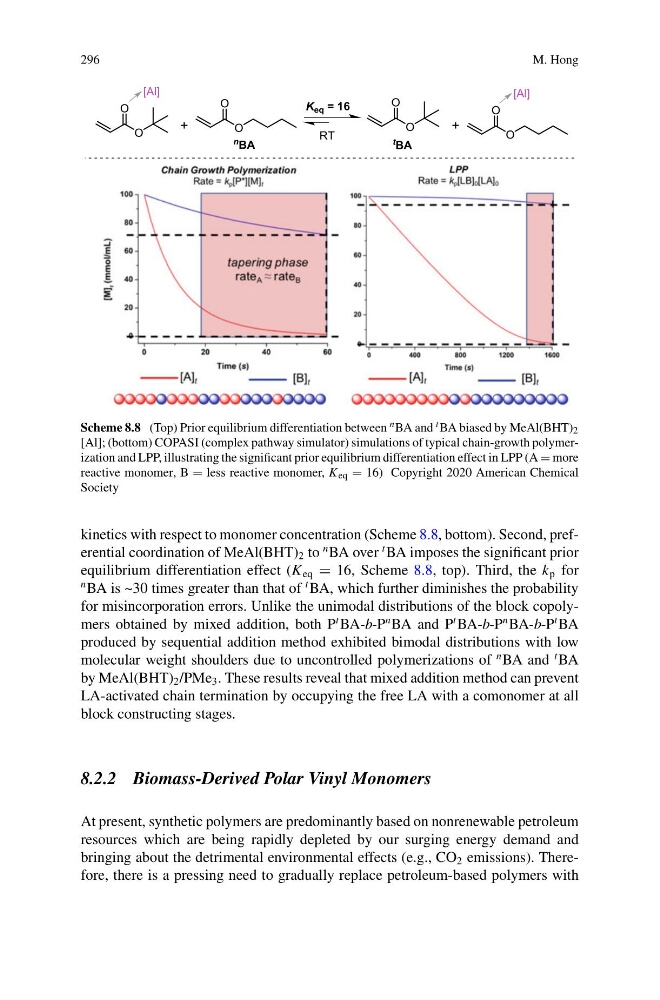
Scheme 8.8 (Top) Prior equilibrium differentiation between n BA and t BA biased by MeAl(BHT) 2
[Al]; (bottom) COPASI (complex pathway simulator) simulations of typical chain-growth polymerization and LPP, illustrating the significant prior equilibrium differentiation effect in LPP (A = more
reactive monomer, B = less reactive monomer, K eq = 16) Copyright 2020 American Chemical
Society
kinetics with respect to monomer concentration (Scheme 8.8, bottom). Second, preferential coordination of MeAl(BHT) 2 to
n BA over
t BA imposes the significant prior
equilibrium differentiation effect (K eq = 16, Scheme 8.8, top). Third, the k p for
n BA is ~30 times greater than that of
t BA, which further diminishes the probability
for misincorporation errors. Unlike the unimodal distributions of the block copolymers obtained by mixed addition, both P
t BA-b-P
n BA and P
t BA-b-P
n BA-b-P
t BA
produced by sequential addition method exhibited bimodal distributions with low
molecular weight shoulders due to uncontrolled polymerizations of
n BA and
t BA
by MeAl(BHT) 2 /PMe 3 . These results reveal that mixed addition method can prevent
LA-activated chain termination by occupying the free LA with a comonomer at all
block constructing stages.
8.2.2 Biomass-Derived Polar Vinyl Monomers
At present, synthetic polymers are predominantly based on nonrenewable petroleum
resources which are being rapidly depleted by our surging energy demand and
bringing about the detrimental environmental effects (e.g., CO 2 emissions). Therefore, there is a pressing need to gradually replace petroleum-based polymers with
M. Hong
O
O
+
O
O
[Al]
O
O
+
O
O
[Al]
K eq = 16
RT
n BA
t BA
Scheme 8.8 (Top) Prior equilibrium differentiation between n BA and t BA biased by MeAl(BHT) 2
[Al]; (bottom) COPASI (complex pathway simulator) simulations of typical chain-growth polymerization and LPP, illustrating the significant prior equilibrium differentiation effect in LPP (A = more
reactive monomer, B = less reactive monomer, K eq = 16) Copyright 2020 American Chemical
Society
kinetics with respect to monomer concentration (Scheme 8.8, bottom). Second, preferential coordination of MeAl(BHT) 2 to
n BA over
t BA imposes the significant prior
equilibrium differentiation effect (K eq = 16, Scheme 8.8, top). Third, the k p for
n BA is ~30 times greater than that of
t BA, which further diminishes the probability
for misincorporation errors. Unlike the unimodal distributions of the block copolymers obtained by mixed addition, both P
t BA-b-P
n BA and P
t BA-b-P
n BA-b-P
t BA
produced by sequential addition method exhibited bimodal distributions with low
molecular weight shoulders due to uncontrolled polymerizations of
n BA and
t BA
by MeAl(BHT) 2 /PMe 3 . These results reveal that mixed addition method can prevent
LA-activated chain termination by occupying the free LA with a comonomer at all
block constructing stages.
8.2.2 Biomass-Derived Polar Vinyl Monomers
At present, synthetic polymers are predominantly based on nonrenewable petroleum
resources which are being rapidly depleted by our surging energy demand and
bringing about the detrimental environmental effects (e.g., CO 2 emissions). Therefore, there is a pressing need to gradually replace petroleum-based polymers with