

1 Frustrated Lewis Pair Catalysis: An Introduction
19
CF 3
Rn
R 3 SiH
Rn
H 2
C
+ R 3 SiF
+ H 2
Alkyl
Alkyl
CF 3
R 3 SiH
H 2
C
Et 3 SiH
R 1
F R 2
R 1
n
R 2
F
R 1
R 3
Me 3 Si
R 2
R 2
R 3
R 1
+
+ Me 3 SiF
t-Bu
E
Et 3 SiH
R 1
F
E
E = O, S, NR
P
C 6 F 5
C 6 F 5
C 6 F 5
F
cat.
cat.
cat.
cat.
R 2
R 2
R 2
R 2
+ R 3 SiF
+ H 2
+ R 3 SiF
+ H 2
+ R 3 SiF
+ H 2
cat.
cat. =
[B(C 6 F 5 ) 4 ]
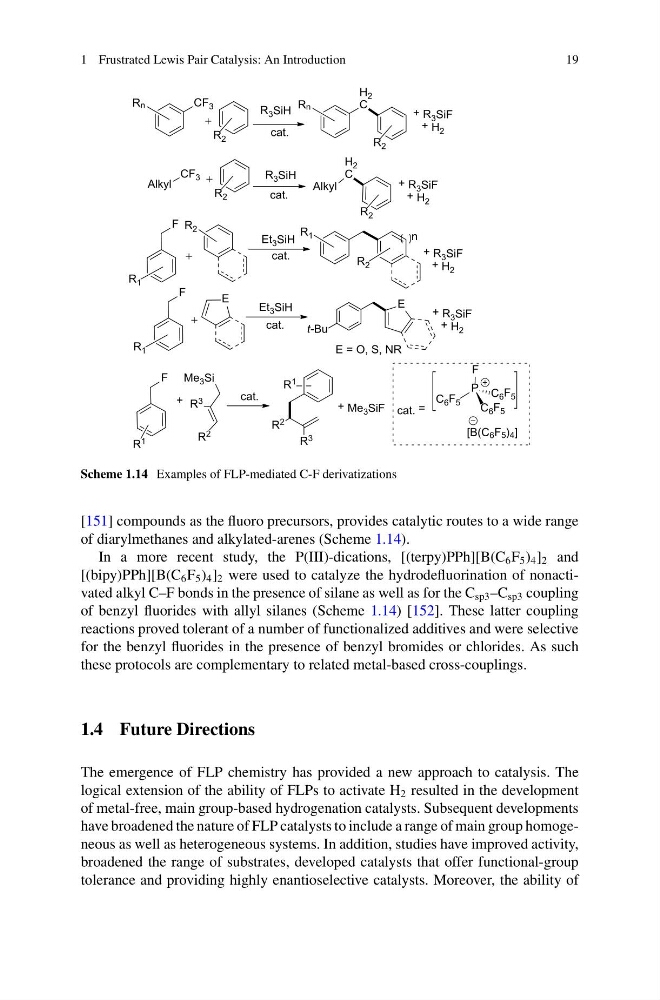
Scheme 1.14 Examples of FLP-mediated C-F derivatizations
[151] compounds as the fluoro precursors, provides catalytic routes to a wide range
of diarylmethanes and alkylated-arenes (Scheme 1.14).
In a more recent study, the P(III)-dications, [(terpy)PPh][B(C 6 F 5 ) 4 ] 2 and
[(bipy)PPh][B(C 6 F 5 ) 4 ] 2 were used to catalyze the hydrodefluorination of nonactivated alkyl C–F bonds in the presence of silane as well as for the C sp3 –C sp3 coupling
of benzyl fluorides with allyl silanes (Scheme 1.14) [152]. These latter coupling
reactions proved tolerant of a number of functionalized additives and were selective
for the benzyl fluorides in the presence of benzyl bromides or chlorides. As such
these protocols are complementary to related metal-based cross-couplings.
1.4 Future Directions
The emergence of FLP chemistry has provided a new approach to catalysis. The
logical extension of the ability of FLPs to activate H 2 resulted in the development
of metal-free, main group-based hydrogenation catalysts. Subsequent developments
have broadened the nature of FLP catalysts to include a range of main group homogeneous as well as heterogeneous systems. In addition, studies have improved activity,
broadened the range of substrates, developed catalysts that offer functional-group
tolerance and providing highly enantioselective catalysts. Moreover, the ability of
19
CF 3
Rn
R 3 SiH
Rn
H 2
C
+ R 3 SiF
+ H 2
Alkyl
Alkyl
CF 3
R 3 SiH
H 2
C
Et 3 SiH
R 1
F R 2
R 1
n
R 2
F
R 1
R 3
Me 3 Si
R 2
R 2
R 3
R 1
+
+ Me 3 SiF
t-Bu
E
Et 3 SiH
R 1
F
E
E = O, S, NR
P
C 6 F 5
C 6 F 5
C 6 F 5
F
cat.
cat.
cat.
cat.
R 2
R 2
R 2
R 2
+ R 3 SiF
+ H 2
+ R 3 SiF
+ H 2
+ R 3 SiF
+ H 2
cat.
cat. =
[B(C 6 F 5 ) 4 ]
Scheme 1.14 Examples of FLP-mediated C-F derivatizations
[151] compounds as the fluoro precursors, provides catalytic routes to a wide range
of diarylmethanes and alkylated-arenes (Scheme 1.14).
In a more recent study, the P(III)-dications, [(terpy)PPh][B(C 6 F 5 ) 4 ] 2 and
[(bipy)PPh][B(C 6 F 5 ) 4 ] 2 were used to catalyze the hydrodefluorination of nonactivated alkyl C–F bonds in the presence of silane as well as for the C sp3 –C sp3 coupling
of benzyl fluorides with allyl silanes (Scheme 1.14) [152]. These latter coupling
reactions proved tolerant of a number of functionalized additives and were selective
for the benzyl fluorides in the presence of benzyl bromides or chlorides. As such
these protocols are complementary to related metal-based cross-couplings.
1.4 Future Directions
The emergence of FLP chemistry has provided a new approach to catalysis. The
logical extension of the ability of FLPs to activate H 2 resulted in the development
of metal-free, main group-based hydrogenation catalysts. Subsequent developments
have broadened the nature of FLP catalysts to include a range of main group homogeneous as well as heterogeneous systems. In addition, studies have improved activity,
broadened the range of substrates, developed catalysts that offer functional-group
tolerance and providing highly enantioselective catalysts. Moreover, the ability of