

18
D. W. Stephan
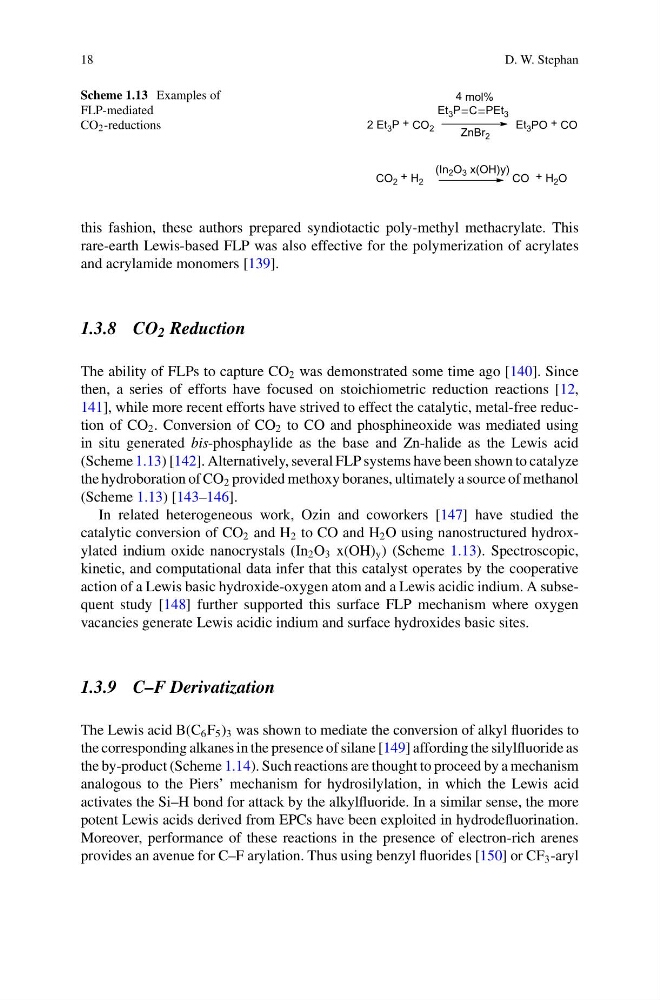
Scheme 1.13 Examples of
FLP-mediated
CO 2 -reductions
Et 3 P C PEt 3
2 Et 3 P + CO 2
ZnBr 2
Et 3 PO + CO
4 mol%
CO 2 + H 2
CO + H 2 O
(In 2 O 3 x(OH)y)
this fashion, these authors prepared syndiotactic poly-methyl methacrylate. This
rare-earth Lewis-based FLP was also effective for the polymerization of acrylates
and acrylamide monomers [139].
1.3.8 CO 2 Reduction
The ability of FLPs to capture CO 2 was demonstrated some time ago [140]. Since
then, a series of efforts have focused on stoichiometric reduction reactions [12,
141], while more recent efforts have strived to effect the catalytic, metal-free reduction of CO 2 . Conversion of CO 2 to CO and phosphineoxide was mediated using
in situ generated bis-phosphaylide as the base and Zn-halide as the Lewis acid
(Scheme 1.13) [142]. Alternatively, several FLP systems have been shown to catalyze
the hydroboration of CO 2 provided methoxy boranes, ultimately a source of methanol
(Scheme 1.13) [143–146].
In related heterogeneous work, Ozin and coworkers [147] have studied the
catalytic conversion of CO 2 and H 2 to CO and H 2 O using nanostructured hydroxylated indium oxide nanocrystals (In 2 O 3 x(OH) y ) (Scheme 1.13). Spectroscopic,
kinetic, and computational data infer that this catalyst operates by the cooperative
action of a Lewis basic hydroxide-oxygen atom and a Lewis acidic indium. A subsequent study [148] further supported this surface FLP mechanism where oxygen
vacancies generate Lewis acidic indium and surface hydroxides basic sites.
1.3.9 C–F Derivatization
The Lewis acid B(C 6 F 5 ) 3 was shown to mediate the conversion of alkyl fluorides to
the corresponding alkanes in the presence of silane [149] affording the silylfluoride as
the by-product (Scheme 1.14). Such reactions are thought to proceed by a mechanism
analogous to the Piers’ mechanism for hydrosilylation, in which the Lewis acid
activates the Si–H bond for attack by the alkylfluoride. In a similar sense, the more
potent Lewis acids derived from EPCs have been exploited in hydrodefluorination.
Moreover, performance of these reactions in the presence of electron-rich arenes
provides an avenue for C–F arylation. Thus using benzyl fluorides [150] or CF 3 -aryl
D. W. Stephan
Scheme 1.13 Examples of
FLP-mediated
CO 2 -reductions
Et 3 P C PEt 3
2 Et 3 P + CO 2
ZnBr 2
Et 3 PO + CO
4 mol%
CO 2 + H 2
CO + H 2 O
(In 2 O 3 x(OH)y)
this fashion, these authors prepared syndiotactic poly-methyl methacrylate. This
rare-earth Lewis-based FLP was also effective for the polymerization of acrylates
and acrylamide monomers [139].
1.3.8 CO 2 Reduction
The ability of FLPs to capture CO 2 was demonstrated some time ago [140]. Since
then, a series of efforts have focused on stoichiometric reduction reactions [12,
141], while more recent efforts have strived to effect the catalytic, metal-free reduction of CO 2 . Conversion of CO 2 to CO and phosphineoxide was mediated using
in situ generated bis-phosphaylide as the base and Zn-halide as the Lewis acid
(Scheme 1.13) [142]. Alternatively, several FLP systems have been shown to catalyze
the hydroboration of CO 2 provided methoxy boranes, ultimately a source of methanol
(Scheme 1.13) [143–146].
In related heterogeneous work, Ozin and coworkers [147] have studied the
catalytic conversion of CO 2 and H 2 to CO and H 2 O using nanostructured hydroxylated indium oxide nanocrystals (In 2 O 3 x(OH) y ) (Scheme 1.13). Spectroscopic,
kinetic, and computational data infer that this catalyst operates by the cooperative
action of a Lewis basic hydroxide-oxygen atom and a Lewis acidic indium. A subsequent study [148] further supported this surface FLP mechanism where oxygen
vacancies generate Lewis acidic indium and surface hydroxides basic sites.
1.3.9 C–F Derivatization
The Lewis acid B(C 6 F 5 ) 3 was shown to mediate the conversion of alkyl fluorides to
the corresponding alkanes in the presence of silane [149] affording the silylfluoride as
the by-product (Scheme 1.14). Such reactions are thought to proceed by a mechanism
analogous to the Piers’ mechanism for hydrosilylation, in which the Lewis acid
activates the Si–H bond for attack by the alkylfluoride. In a similar sense, the more
potent Lewis acids derived from EPCs have been exploited in hydrodefluorination.
Moreover, performance of these reactions in the presence of electron-rich arenes
provides an avenue for C–F arylation. Thus using benzyl fluorides [150] or CF 3 -aryl