

1 Frustrated Lewis Pair Catalysis: An Introduction
17
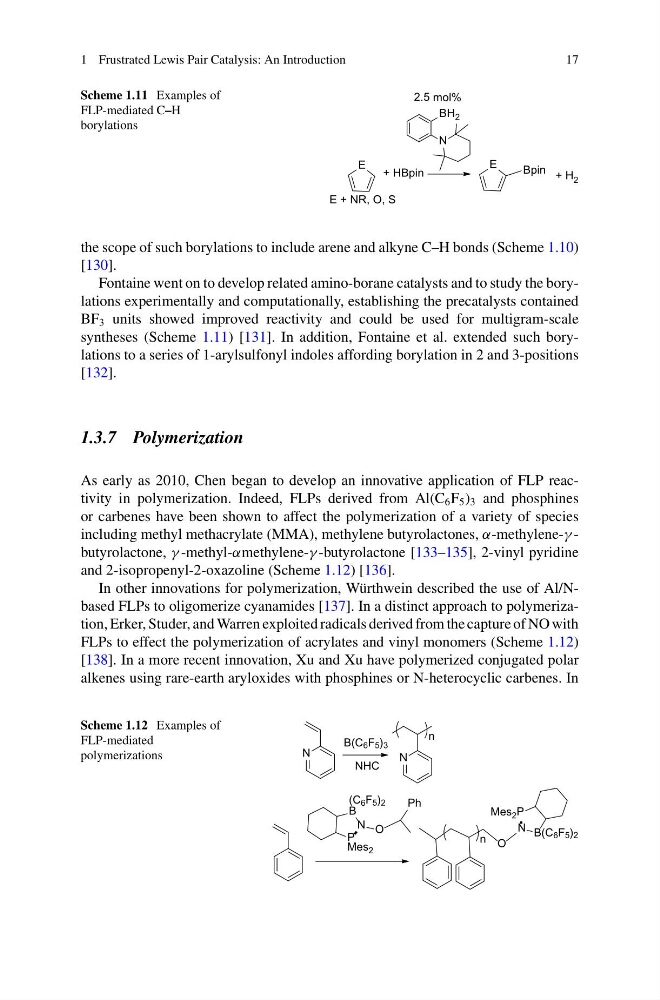
Scheme 1.11 Examples of
FLP-mediated C–H
borylations
E
+ HBpin
E
Bpin
E + NR, O, S
+ H 2
BH 2
N
2.5 mol%
the scope of such borylations to include arene and alkyne C–H bonds (Scheme 1.10)
[130].
Fontaine went on to develop related amino-borane catalysts and to study the borylations experimentally and computationally, establishing the precatalysts contained
BF 3 units showed improved reactivity and could be used for multigram-scale
syntheses (Scheme 1.11) [131]. In addition, Fontaine et al. extended such borylations to a series of 1-arylsulfonyl indoles affording borylation in 2 and 3-positions
[132].
1.3.7 Polymerization
As early as 2010, Chen began to develop an innovative application of FLP reactivity in polymerization. Indeed, FLPs derived from Al(C 6 F 5 ) 3 and phosphines
or carbenes have been shown to affect the polymerization of a variety of species
including methyl methacrylate (MMA), methylene butyrolactones, α-methylene-γ -
butyrolactone, γ -methyl-αmethylene-γ -butyrolactone [133–135], 2-vinyl pyridine
and 2-isopropenyl-2-oxazoline (Scheme 1.12) [136].
In other innovations for polymerization, Würthwein described the use of Al/Nbased FLPs to oligomerize cyanamides [137]. In a distinct approach to polymerization, Erker, Studer, and Warren exploited radicals derived from the capture of NO with
FLPs to effect the polymerization of acrylates and vinyl monomers (Scheme 1.12)
[138]. In a more recent innovation, Xu and Xu have polymerized conjugated polar
alkenes using rare-earth aryloxides with phosphines or N-heterocyclic carbenes. In
Scheme 1.12 Examples of
FLP-mediated
polymerizations
N
N
n
B(C 6 F 5 ) 3
NHC
n
P
Mes 2
N
(C 6 F 5 ) 2
B
O
Ph
O
Mes 2 P
N B(C 6 F 5 ) 2
17
Scheme 1.11 Examples of
FLP-mediated C–H
borylations
E
+ HBpin
E
Bpin
E + NR, O, S
+ H 2
BH 2
N
2.5 mol%
the scope of such borylations to include arene and alkyne C–H bonds (Scheme 1.10)
[130].
Fontaine went on to develop related amino-borane catalysts and to study the borylations experimentally and computationally, establishing the precatalysts contained
BF 3 units showed improved reactivity and could be used for multigram-scale
syntheses (Scheme 1.11) [131]. In addition, Fontaine et al. extended such borylations to a series of 1-arylsulfonyl indoles affording borylation in 2 and 3-positions
[132].
1.3.7 Polymerization
As early as 2010, Chen began to develop an innovative application of FLP reactivity in polymerization. Indeed, FLPs derived from Al(C 6 F 5 ) 3 and phosphines
or carbenes have been shown to affect the polymerization of a variety of species
including methyl methacrylate (MMA), methylene butyrolactones, α-methylene-γ -
butyrolactone, γ -methyl-αmethylene-γ -butyrolactone [133–135], 2-vinyl pyridine
and 2-isopropenyl-2-oxazoline (Scheme 1.12) [136].
In other innovations for polymerization, Würthwein described the use of Al/Nbased FLPs to oligomerize cyanamides [137]. In a distinct approach to polymerization, Erker, Studer, and Warren exploited radicals derived from the capture of NO with
FLPs to effect the polymerization of acrylates and vinyl monomers (Scheme 1.12)
[138]. In a more recent innovation, Xu and Xu have polymerized conjugated polar
alkenes using rare-earth aryloxides with phosphines or N-heterocyclic carbenes. In
Scheme 1.12 Examples of
FLP-mediated
polymerizations
N
N
n
B(C 6 F 5 ) 3
NHC
n
P
Mes 2
N
(C 6 F 5 ) 2
B
O
Ph
O
Mes 2 P
N B(C 6 F 5 ) 2