

16
D. W. Stephan
Scheme 1.10 Examples of
FLP-mediated
hydroarylations
N
tBu 10 mol%
B(C 6 F 5 ) 3
R
R
Me
N
tBu
N tBu
+
5 mol%
E
X
X
R
(4-XC 6 H 4 ) 2 E
+
RCCH
P
Ph
Ph
O
Ph
N
[B(C 6 F 5 ) 4 ] 2
Ph
Ph
N
H
Ph
Ph
Ph
C 6 F 5
P
F
C 6 F 5
C 6 F 5
[B(C6F5)4]
+ HNPh 2
1 mol%
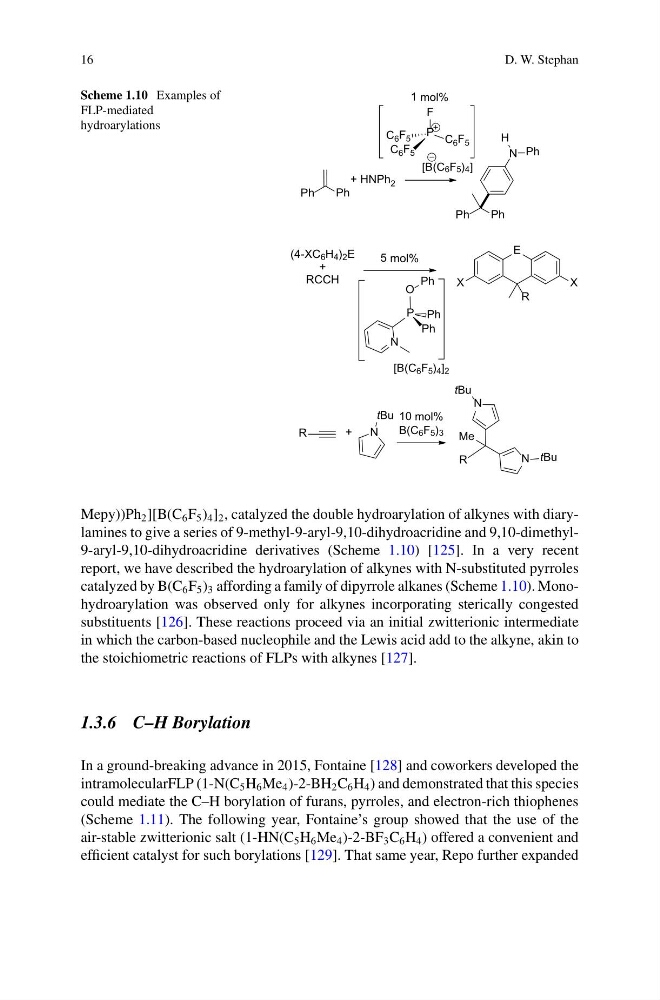
Mepy))Ph 2 ][B(C 6 F 5 ) 4 ] 2 , catalyzed the double hydroarylation of alkynes with diarylamines to give a series of 9-methyl-9-aryl-9,10-dihydroacridine and 9,10-dimethyl9-aryl-9,10-dihydroacridine derivatives (Scheme 1.10) [125]. In a very recent
report, we have described the hydroarylation of alkynes with N-substituted pyrroles
catalyzed by B(C 6 F 5 ) 3 affording a family of dipyrrole alkanes (Scheme 1.10). Monohydroarylation was observed only for alkynes incorporating sterically congested
substituents [126]. These reactions proceed via an initial zwitterionic intermediate
in which the carbon-based nucleophile and the Lewis acid add to the alkyne, akin to
the stoichiometric reactions of FLPs with alkynes [127].
1.3.6 C–H Borylation
In a ground-breaking advance in 2015, Fontaine [128] and coworkers developed the
intramolecularFLP (1-N(C 5 H 6 Me 4 )-2-BH 2 C 6 H 4 ) and demonstrated that this species
could mediate the C–H borylation of furans, pyrroles, and electron-rich thiophenes
(Scheme 1.11). The following year, Fontaine’s group showed that the use of the
air-stable zwitterionic salt (1-HN(C 5 H 6 Me 4 )-2-BF 3 C 6 H 4 ) offered a convenient and
efficient catalyst for such borylations [129]. That same year, Repo further expanded
D. W. Stephan
Scheme 1.10 Examples of
FLP-mediated
hydroarylations
N
tBu 10 mol%
B(C 6 F 5 ) 3
R
R
Me
N
tBu
N tBu
+
5 mol%
E
X
X
R
(4-XC 6 H 4 ) 2 E
+
RCCH
P
Ph
Ph
O
Ph
N
[B(C 6 F 5 ) 4 ] 2
Ph
Ph
N
H
Ph
Ph
Ph
C 6 F 5
P
F
C 6 F 5
C 6 F 5
[B(C6F5)4]
+ HNPh 2
1 mol%
Mepy))Ph 2 ][B(C 6 F 5 ) 4 ] 2 , catalyzed the double hydroarylation of alkynes with diarylamines to give a series of 9-methyl-9-aryl-9,10-dihydroacridine and 9,10-dimethyl9-aryl-9,10-dihydroacridine derivatives (Scheme 1.10) [125]. In a very recent
report, we have described the hydroarylation of alkynes with N-substituted pyrroles
catalyzed by B(C 6 F 5 ) 3 affording a family of dipyrrole alkanes (Scheme 1.10). Monohydroarylation was observed only for alkynes incorporating sterically congested
substituents [126]. These reactions proceed via an initial zwitterionic intermediate
in which the carbon-based nucleophile and the Lewis acid add to the alkyne, akin to
the stoichiometric reactions of FLPs with alkynes [127].
1.3.6 C–H Borylation
In a ground-breaking advance in 2015, Fontaine [128] and coworkers developed the
intramolecularFLP (1-N(C 5 H 6 Me 4 )-2-BH 2 C 6 H 4 ) and demonstrated that this species
could mediate the C–H borylation of furans, pyrroles, and electron-rich thiophenes
(Scheme 1.11). The following year, Fontaine’s group showed that the use of the
air-stable zwitterionic salt (1-HN(C 5 H 6 Me 4 )-2-BF 3 C 6 H 4 ) offered a convenient and
efficient catalyst for such borylations [129]. That same year, Repo further expanded