

270
A. R. Jupp
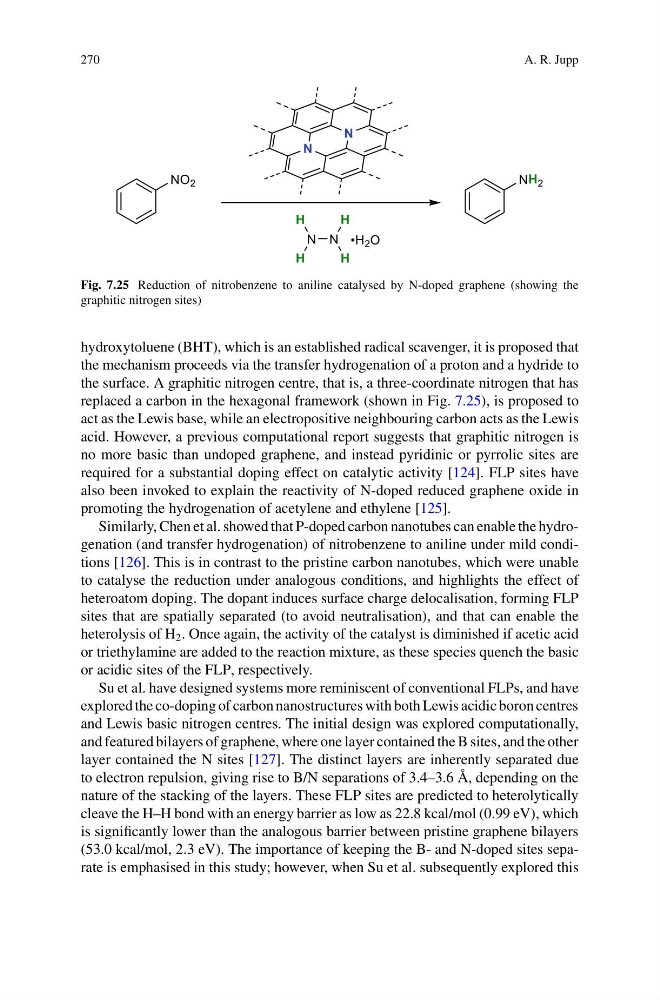
Fig. 7.25 Reduction of nitrobenzene to aniline catalysed by N-doped graphene (showing the
graphitic nitrogen sites)
hydroxytoluene (BHT), which is an established radical scavenger, it is proposed that
the mechanism proceeds via the transfer hydrogenation of a proton and a hydride to
the surface. A graphitic nitrogen centre, that is, a three-coordinate nitrogen that has
replaced a carbon in the hexagonal framework (shown in Fig. 7.25), is proposed to
act as the Lewis base, while an electropositive neighbouring carbon acts as the Lewis
acid. However, a previous computational report suggests that graphitic nitrogen is
no more basic than undoped graphene, and instead pyridinic or pyrrolic sites are
required for a substantial doping effect on catalytic activity [124]. FLP sites have
also been invoked to explain the reactivity of N-doped reduced graphene oxide in
promoting the hydrogenation of acetylene and ethylene [125].
Similarly, Chen et al. showed that P-doped carbon nanotubes can enable the hydrogenation (and transfer hydrogenation) of nitrobenzene to aniline under mild conditions [126]. This is in contrast to the pristine carbon nanotubes, which were unable
to catalyse the reduction under analogous conditions, and highlights the effect of
heteroatom doping. The dopant induces surface charge delocalisation, forming FLP
sites that are spatially separated (to avoid neutralisation), and that can enable the
heterolysis of H 2 . Once again, the activity of the catalyst is diminished if acetic acid
or triethylamine are added to the reaction mixture, as these species quench the basic
or acidic sites of the FLP, respectively.
Su et al. have designed systems more reminiscent of conventional FLPs, and have
explored the co-doping of carbon nanostructures with both Lewis acidic boron centres
and Lewis basic nitrogen centres. The initial design was explored computationally,
and featured bilayers of graphene, where one layer contained the B sites, and the other
layer contained the N sites [127]. The distinct layers are inherently separated due
to electron repulsion, giving rise to B/N separations of 3.4–3.6 Å, depending on the
nature of the stacking of the layers. These FLP sites are predicted to heterolytically
cleave the H–H bond with an energy barrier as low as 22.8 kcal/mol (0.99 eV), which
is significantly lower than the analogous barrier between pristine graphene bilayers
(53.0 kcal/mol, 2.3 eV). The importance of keeping the B- and N-doped sites separate is emphasised in this study; however, when Su et al. subsequently explored this
A. R. Jupp
Fig. 7.25 Reduction of nitrobenzene to aniline catalysed by N-doped graphene (showing the
graphitic nitrogen sites)
hydroxytoluene (BHT), which is an established radical scavenger, it is proposed that
the mechanism proceeds via the transfer hydrogenation of a proton and a hydride to
the surface. A graphitic nitrogen centre, that is, a three-coordinate nitrogen that has
replaced a carbon in the hexagonal framework (shown in Fig. 7.25), is proposed to
act as the Lewis base, while an electropositive neighbouring carbon acts as the Lewis
acid. However, a previous computational report suggests that graphitic nitrogen is
no more basic than undoped graphene, and instead pyridinic or pyrrolic sites are
required for a substantial doping effect on catalytic activity [124]. FLP sites have
also been invoked to explain the reactivity of N-doped reduced graphene oxide in
promoting the hydrogenation of acetylene and ethylene [125].
Similarly, Chen et al. showed that P-doped carbon nanotubes can enable the hydrogenation (and transfer hydrogenation) of nitrobenzene to aniline under mild conditions [126]. This is in contrast to the pristine carbon nanotubes, which were unable
to catalyse the reduction under analogous conditions, and highlights the effect of
heteroatom doping. The dopant induces surface charge delocalisation, forming FLP
sites that are spatially separated (to avoid neutralisation), and that can enable the
heterolysis of H 2 . Once again, the activity of the catalyst is diminished if acetic acid
or triethylamine are added to the reaction mixture, as these species quench the basic
or acidic sites of the FLP, respectively.
Su et al. have designed systems more reminiscent of conventional FLPs, and have
explored the co-doping of carbon nanostructures with both Lewis acidic boron centres
and Lewis basic nitrogen centres. The initial design was explored computationally,
and featured bilayers of graphene, where one layer contained the B sites, and the other
layer contained the N sites [127]. The distinct layers are inherently separated due
to electron repulsion, giving rise to B/N separations of 3.4–3.6 Å, depending on the
nature of the stacking of the layers. These FLP sites are predicted to heterolytically
cleave the H–H bond with an energy barrier as low as 22.8 kcal/mol (0.99 eV), which
is significantly lower than the analogous barrier between pristine graphene bilayers
(53.0 kcal/mol, 2.3 eV). The importance of keeping the B- and N-doped sites separate is emphasised in this study; however, when Su et al. subsequently explored this