

7 Heterogeneous Catalysis by Frustrated Lewis Pairs
271
topic experimentally, they took a different approach [128]. Ultra-dispersed nanodiamond was thermally treated with a boron- and nitrogen-containing ionic liquid, and
the nature of the product depended on the temperature (400 vs. 600 °C), but both
materials featured a carbon lattice doped with adjacent B and N centres. The sample
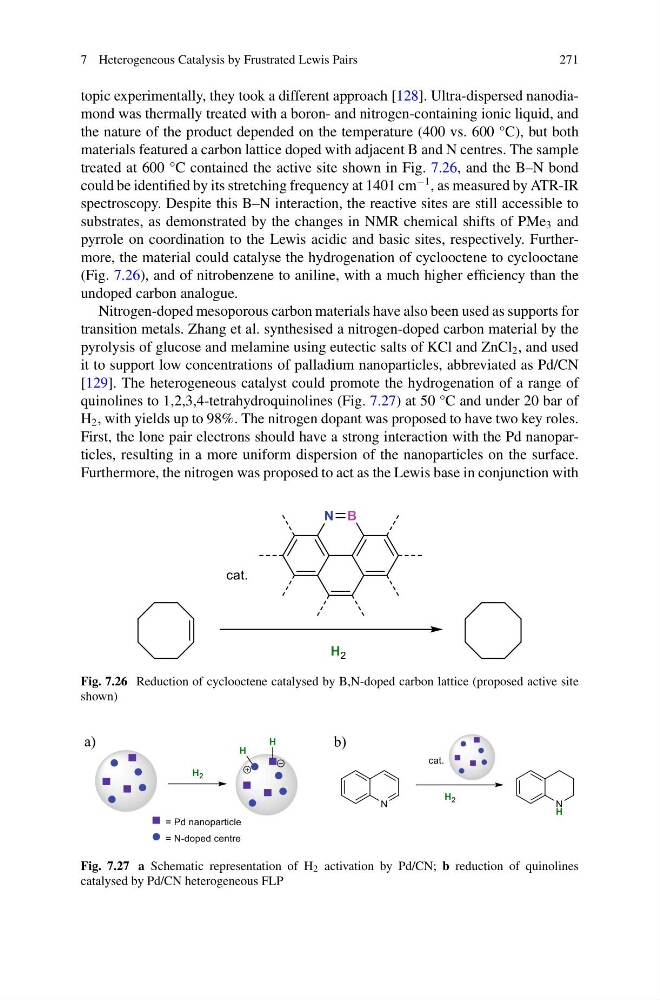
treated at 600 °C contained the active site shown in Fig. 7.26, and the B–N bond
could be identified by its stretching frequency at 1401 cm
−1 , as measured by ATR-IR
spectroscopy. Despite this B–N interaction, the reactive sites are still accessible to
substrates, as demonstrated by the changes in NMR chemical shifts of PMe 3 and
pyrrole on coordination to the Lewis acidic and basic sites, respectively. Furthermore, the material could catalyse the hydrogenation of cyclooctene to cyclooctane
(Fig. 7.26), and of nitrobenzene to aniline, with a much higher efficiency than the
undoped carbon analogue.
Nitrogen-doped mesoporous carbon materials have also been used as supports for
transition metals. Zhang et al. synthesised a nitrogen-doped carbon material by the
pyrolysis of glucose and melamine using eutectic salts of KCl and ZnCl 2 , and used
it to support low concentrations of palladium nanoparticles, abbreviated as Pd/CN
[129]. The heterogeneous catalyst could promote the hydrogenation of a range of
quinolines to 1,2,3,4-tetrahydroquinolines (Fig. 7.27) at 50 °C and under 20 bar of
H 2 , with yields up to 98%. The nitrogen dopant was proposed to have two key roles.
First, the lone pair electrons should have a strong interaction with the Pd nanoparticles, resulting in a more uniform dispersion of the nanoparticles on the surface.
Furthermore, the nitrogen was proposed to act as the Lewis base in conjunction with
Fig. 7.26 Reduction of cyclooctene catalysed by B,N-doped carbon lattice (proposed active site
shown)
a)
b)
Fig. 7.27 a Schematic representation of H 2 activation by Pd/CN; b reduction of quinolines
catalysed by Pd/CN heterogeneous FLP
271
topic experimentally, they took a different approach [128]. Ultra-dispersed nanodiamond was thermally treated with a boron- and nitrogen-containing ionic liquid, and
the nature of the product depended on the temperature (400 vs. 600 °C), but both
materials featured a carbon lattice doped with adjacent B and N centres. The sample
treated at 600 °C contained the active site shown in Fig. 7.26, and the B–N bond
could be identified by its stretching frequency at 1401 cm
−1 , as measured by ATR-IR
spectroscopy. Despite this B–N interaction, the reactive sites are still accessible to
substrates, as demonstrated by the changes in NMR chemical shifts of PMe 3 and
pyrrole on coordination to the Lewis acidic and basic sites, respectively. Furthermore, the material could catalyse the hydrogenation of cyclooctene to cyclooctane
(Fig. 7.26), and of nitrobenzene to aniline, with a much higher efficiency than the
undoped carbon analogue.
Nitrogen-doped mesoporous carbon materials have also been used as supports for
transition metals. Zhang et al. synthesised a nitrogen-doped carbon material by the
pyrolysis of glucose and melamine using eutectic salts of KCl and ZnCl 2 , and used
it to support low concentrations of palladium nanoparticles, abbreviated as Pd/CN
[129]. The heterogeneous catalyst could promote the hydrogenation of a range of
quinolines to 1,2,3,4-tetrahydroquinolines (Fig. 7.27) at 50 °C and under 20 bar of
H 2 , with yields up to 98%. The nitrogen dopant was proposed to have two key roles.
First, the lone pair electrons should have a strong interaction with the Pd nanoparticles, resulting in a more uniform dispersion of the nanoparticles on the surface.
Furthermore, the nitrogen was proposed to act as the Lewis base in conjunction with
Fig. 7.26 Reduction of cyclooctene catalysed by B,N-doped carbon lattice (proposed active site
shown)
a)
b)
Fig. 7.27 a Schematic representation of H 2 activation by Pd/CN; b reduction of quinolines
catalysed by Pd/CN heterogeneous FLP