

268
A. R. Jupp
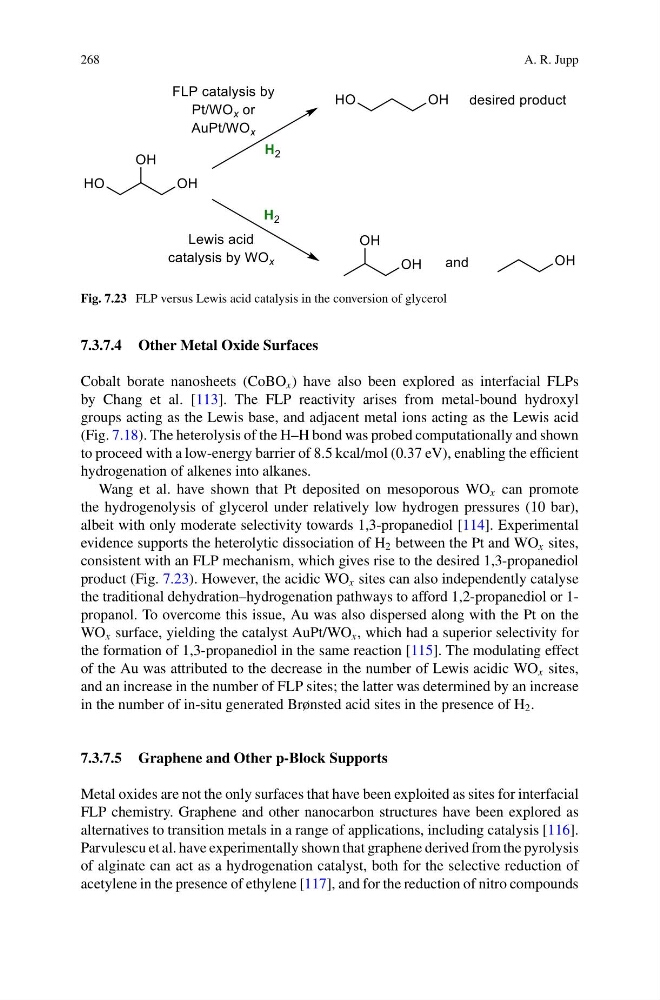
Fig. 7.23 FLP versus Lewis acid catalysis in the conversion of glycerol
7.3.7.4 Other Metal Oxide Surfaces
Cobalt borate nanosheets (CoBO x ) have also been explored as interfacial FLPs
by Chang et al. [113]. The FLP reactivity arises from metal-bound hydroxyl
groups acting as the Lewis base, and adjacent metal ions acting as the Lewis acid
(Fig. 7.18). The heterolysis of the H–H bond was probed computationally and shown
to proceed with a low-energy barrier of 8.5 kcal/mol (0.37 eV), enabling the efficient
hydrogenation of alkenes into alkanes.
Wang et al. have shown that Pt deposited on mesoporous WO x can promote
the hydrogenolysis of glycerol under relatively low hydrogen pressures (10 bar),
albeit with only moderate selectivity towards 1,3-propanediol [114]. Experimental
evidence supports the heterolytic dissociation of H 2 between the Pt and WO x sites,
consistent with an FLP mechanism, which gives rise to the desired 1,3-propanediol
product (Fig. 7.23). However, the acidic WO x sites can also independently catalyse
the traditional dehydration–hydrogenation pathways to afford 1,2-propanediol or 1propanol. To overcome this issue, Au was also dispersed along with the Pt on the
WO x surface, yielding the catalyst AuPt/WO x , which had a superior selectivity for
the formation of 1,3-propanediol in the same reaction [115]. The modulating effect
of the Au was attributed to the decrease in the number of Lewis acidic WO x sites,
and an increase in the number of FLP sites; the latter was determined by an increase
in the number of in-situ generated Brønsted acid sites in the presence of H 2 .
7.3.7.5 Graphene and Other p-Block Supports
Metal oxides are not the only surfaces that have been exploited as sites for interfacial
FLP chemistry. Graphene and other nanocarbon structures have been explored as
alternatives to transition metals in a range of applications, including catalysis [116].
Parvulescu et al. have experimentally shown that graphene derived from the pyrolysis
of alginate can act as a hydrogenation catalyst, both for the selective reduction of
acetylene in the presence of ethylene [117], and for the reduction of nitro compounds
A. R. Jupp
Fig. 7.23 FLP versus Lewis acid catalysis in the conversion of glycerol
7.3.7.4 Other Metal Oxide Surfaces
Cobalt borate nanosheets (CoBO x ) have also been explored as interfacial FLPs
by Chang et al. [113]. The FLP reactivity arises from metal-bound hydroxyl
groups acting as the Lewis base, and adjacent metal ions acting as the Lewis acid
(Fig. 7.18). The heterolysis of the H–H bond was probed computationally and shown
to proceed with a low-energy barrier of 8.5 kcal/mol (0.37 eV), enabling the efficient
hydrogenation of alkenes into alkanes.
Wang et al. have shown that Pt deposited on mesoporous WO x can promote
the hydrogenolysis of glycerol under relatively low hydrogen pressures (10 bar),
albeit with only moderate selectivity towards 1,3-propanediol [114]. Experimental
evidence supports the heterolytic dissociation of H 2 between the Pt and WO x sites,
consistent with an FLP mechanism, which gives rise to the desired 1,3-propanediol
product (Fig. 7.23). However, the acidic WO x sites can also independently catalyse
the traditional dehydration–hydrogenation pathways to afford 1,2-propanediol or 1propanol. To overcome this issue, Au was also dispersed along with the Pt on the
WO x surface, yielding the catalyst AuPt/WO x , which had a superior selectivity for
the formation of 1,3-propanediol in the same reaction [115]. The modulating effect
of the Au was attributed to the decrease in the number of Lewis acidic WO x sites,
and an increase in the number of FLP sites; the latter was determined by an increase
in the number of in-situ generated Brønsted acid sites in the presence of H 2 .
7.3.7.5 Graphene and Other p-Block Supports
Metal oxides are not the only surfaces that have been exploited as sites for interfacial
FLP chemistry. Graphene and other nanocarbon structures have been explored as
alternatives to transition metals in a range of applications, including catalysis [116].
Parvulescu et al. have experimentally shown that graphene derived from the pyrolysis
of alginate can act as a hydrogenation catalyst, both for the selective reduction of
acetylene in the presence of ethylene [117], and for the reduction of nitro compounds