

7 Heterogeneous Catalysis by Frustrated Lewis Pairs
267
to the strong adsorption of the substrate to the Lewis acidic surface defects. The catalyst could also promote the reduction of alkynes to alkenes and alkanes, although
with limited ability at controlling conversion and/or selectivity.
A more detailed computational analysis of the formation and behaviour of the
surface FLP sites on defected ceria was carried out using ab initio MD simulations
and static DFT studies [111]. The principal conclusion is that the formation of stable
FLP sites on the (110) surface is dependent on the number of oxygen vacancies, where
FLP sites featuring three or more oxygen vacancies are thermodynamically stable.
The FLP sites with fewer vacancies are less stable under vacuum, but can be accessed
dynamically under experimentally relevant conditions. It was also predicted that the
active CeO 2 surface FLPs are capable of coupling methane to ethane and ethylene
via relatively low activation energies, although this was not validated experimentally.
The defect-enriched CeO 2 surface is also capable of binding and activating CO 2
[112]. The Lewis basic O site on the surface can interact with the electrophilic C
atom of CO 2 , and the two O atoms of CO 2 interact with two adjacent Lewis acidic
Ce centres, as modelled by DFT computations. Several geometries for the adsorption of CO 2 were calculated, but in all cases the bound substrate is activated, with
elongated C=O bond distances and an O=C=O bond angle that deviates significantly
from linearity. The ability of defected CeO 2 nanorods to activate and transform CO 2
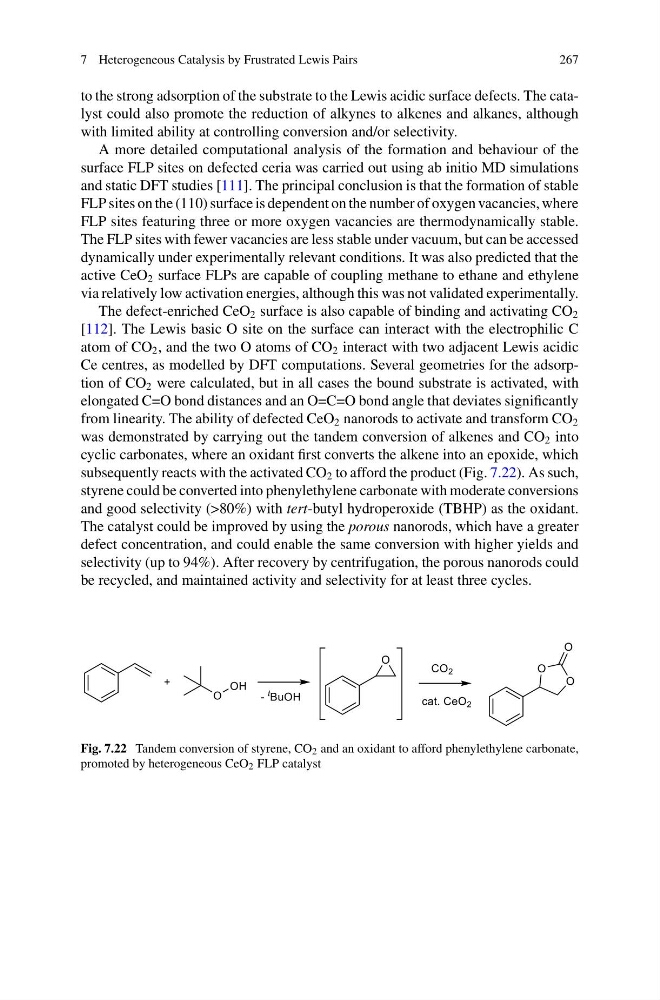
was demonstrated by carrying out the tandem conversion of alkenes and CO 2 into
cyclic carbonates, where an oxidant first converts the alkene into an epoxide, which
subsequently reacts with the activated CO 2 to afford the product (Fig. 7.22). As such,
styrene could be converted into phenylethylene carbonate with moderate conversions
and good selectivity (>80%) with tert-butyl hydroperoxide (TBHP) as the oxidant.
The catalyst could be improved by using the porous nanorods, which have a greater
defect concentration, and could enable the same conversion with higher yields and
selectivity (up to 94%). After recovery by centrifugation, the porous nanorods could
be recycled, and maintained activity and selectivity for at least three cycles.
Fig. 7.22 Tandem conversion of styrene, CO 2 and an oxidant to afford phenylethylene carbonate,
promoted by heterogeneous CeO 2 FLP catalyst
267
to the strong adsorption of the substrate to the Lewis acidic surface defects. The catalyst could also promote the reduction of alkynes to alkenes and alkanes, although
with limited ability at controlling conversion and/or selectivity.
A more detailed computational analysis of the formation and behaviour of the
surface FLP sites on defected ceria was carried out using ab initio MD simulations
and static DFT studies [111]. The principal conclusion is that the formation of stable
FLP sites on the (110) surface is dependent on the number of oxygen vacancies, where
FLP sites featuring three or more oxygen vacancies are thermodynamically stable.
The FLP sites with fewer vacancies are less stable under vacuum, but can be accessed
dynamically under experimentally relevant conditions. It was also predicted that the
active CeO 2 surface FLPs are capable of coupling methane to ethane and ethylene
via relatively low activation energies, although this was not validated experimentally.
The defect-enriched CeO 2 surface is also capable of binding and activating CO 2
[112]. The Lewis basic O site on the surface can interact with the electrophilic C
atom of CO 2 , and the two O atoms of CO 2 interact with two adjacent Lewis acidic
Ce centres, as modelled by DFT computations. Several geometries for the adsorption of CO 2 were calculated, but in all cases the bound substrate is activated, with
elongated C=O bond distances and an O=C=O bond angle that deviates significantly
from linearity. The ability of defected CeO 2 nanorods to activate and transform CO 2
was demonstrated by carrying out the tandem conversion of alkenes and CO 2 into
cyclic carbonates, where an oxidant first converts the alkene into an epoxide, which
subsequently reacts with the activated CO 2 to afford the product (Fig. 7.22). As such,
styrene could be converted into phenylethylene carbonate with moderate conversions
and good selectivity (>80%) with tert-butyl hydroperoxide (TBHP) as the oxidant.
The catalyst could be improved by using the porous nanorods, which have a greater
defect concentration, and could enable the same conversion with higher yields and
selectivity (up to 94%). After recovery by centrifugation, the porous nanorods could
be recycled, and maintained activity and selectivity for at least three cycles.
Fig. 7.22 Tandem conversion of styrene, CO 2 and an oxidant to afford phenylethylene carbonate,
promoted by heterogeneous CeO 2 FLP catalyst