

266
A. R. Jupp
although at a much lower MeOH/CO selectivity than previously observed (<15%
vs. >50%). The optimum rh-In 2 O 3–x (OH) y also exhibited excellent stability, with no
significant change in production rate or selectivity over more than 100 h of continuous testing, and no obvious oxidation state or structural changes were observed
by PXRD, XPS or transmission electron microscopy (TEM) after the run. The rhIn 2 O 3–x (OH) y nanocrystals outperformed the c-In 2 O 3–x (OH) y material in all of the
experiments in this study, which was attributed to the increased acidity and basicity
of surface FLP sites on the defected (110) surface of the rhombohedral polymorph
over those on the (111) surface of the cubic structure. The authors subsequently
showed that rh-In 2 O 3–x (OH) y can split H 2 at room temperature, and propose that this
activation proceeds via heterolysis of the H–H bond instead of homolysis [108].
7.3.7.3 CeO 2
The ability of defect-laden CeO 2 to enable heterolytic FLP catalysis has been
explored by Chang et al.; they demonstrated that porous nanorods of ceria with
high concentrations of surface oxygen vacancies can catalyse the hydrogenation of
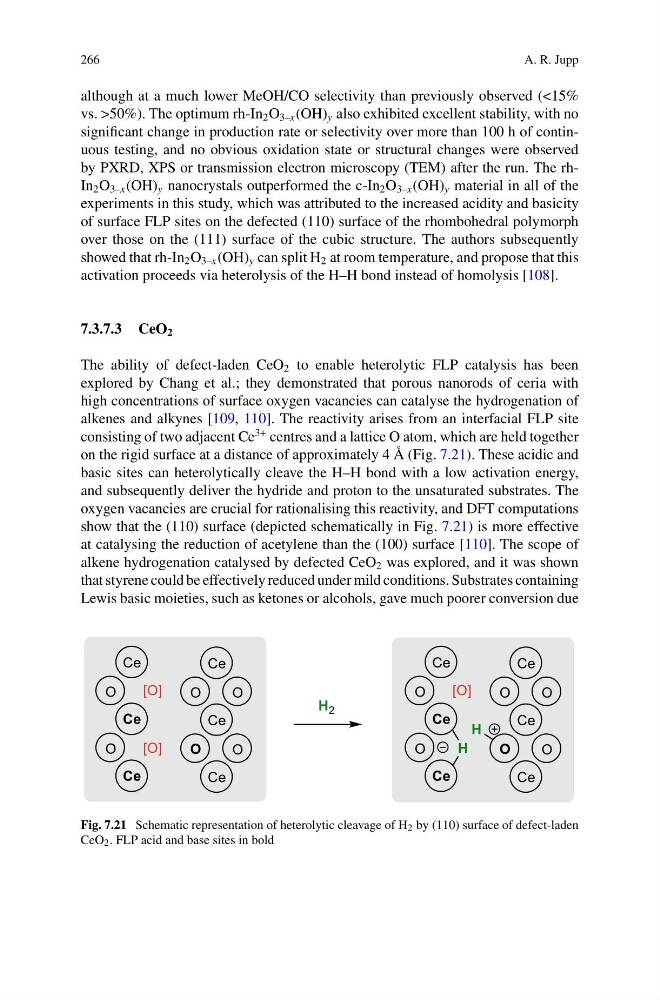
alkenes and alkynes [109, 110]. The reactivity arises from an interfacial FLP site
consisting of two adjacent Ce
3+ centres and a lattice O atom, which are held together
on the rigid surface at a distance of approximately 4 Å (Fig. 7.21). These acidic and
basic sites can heterolytically cleave the H–H bond with a low activation energy,
and subsequently deliver the hydride and proton to the unsaturated substrates. The
oxygen vacancies are crucial for rationalising this reactivity, and DFT computations
show that the (110) surface (depicted schematically in Fig. 7.21) is more effective
at catalysing the reduction of acetylene than the (100) surface [110]. The scope of
alkene hydrogenation catalysed by defected CeO 2 was explored, and it was shown
that styrene could be effectively reduced under mild conditions. Substrates containing
Lewis basic moieties, such as ketones or alcohols, gave much poorer conversion due
Fig. 7.21 Schematic representation of heterolytic cleavage of H 2 by (110) surface of defect-laden
CeO 2 . FLP acid and base sites in bold
A. R. Jupp
although at a much lower MeOH/CO selectivity than previously observed (<15%
vs. >50%). The optimum rh-In 2 O 3–x (OH) y also exhibited excellent stability, with no
significant change in production rate or selectivity over more than 100 h of continuous testing, and no obvious oxidation state or structural changes were observed
by PXRD, XPS or transmission electron microscopy (TEM) after the run. The rhIn 2 O 3–x (OH) y nanocrystals outperformed the c-In 2 O 3–x (OH) y material in all of the
experiments in this study, which was attributed to the increased acidity and basicity
of surface FLP sites on the defected (110) surface of the rhombohedral polymorph
over those on the (111) surface of the cubic structure. The authors subsequently
showed that rh-In 2 O 3–x (OH) y can split H 2 at room temperature, and propose that this
activation proceeds via heterolysis of the H–H bond instead of homolysis [108].
7.3.7.3 CeO 2
The ability of defect-laden CeO 2 to enable heterolytic FLP catalysis has been
explored by Chang et al.; they demonstrated that porous nanorods of ceria with
high concentrations of surface oxygen vacancies can catalyse the hydrogenation of
alkenes and alkynes [109, 110]. The reactivity arises from an interfacial FLP site
consisting of two adjacent Ce
3+ centres and a lattice O atom, which are held together
on the rigid surface at a distance of approximately 4 Å (Fig. 7.21). These acidic and
basic sites can heterolytically cleave the H–H bond with a low activation energy,
and subsequently deliver the hydride and proton to the unsaturated substrates. The
oxygen vacancies are crucial for rationalising this reactivity, and DFT computations
show that the (110) surface (depicted schematically in Fig. 7.21) is more effective
at catalysing the reduction of acetylene than the (100) surface [110]. The scope of
alkene hydrogenation catalysed by defected CeO 2 was explored, and it was shown
that styrene could be effectively reduced under mild conditions. Substrates containing
Lewis basic moieties, such as ketones or alcohols, gave much poorer conversion due
Fig. 7.21 Schematic representation of heterolytic cleavage of H 2 by (110) surface of defect-laden
CeO 2 . FLP acid and base sites in bold