

7 Heterogeneous Catalysis by Frustrated Lewis Pairs
265
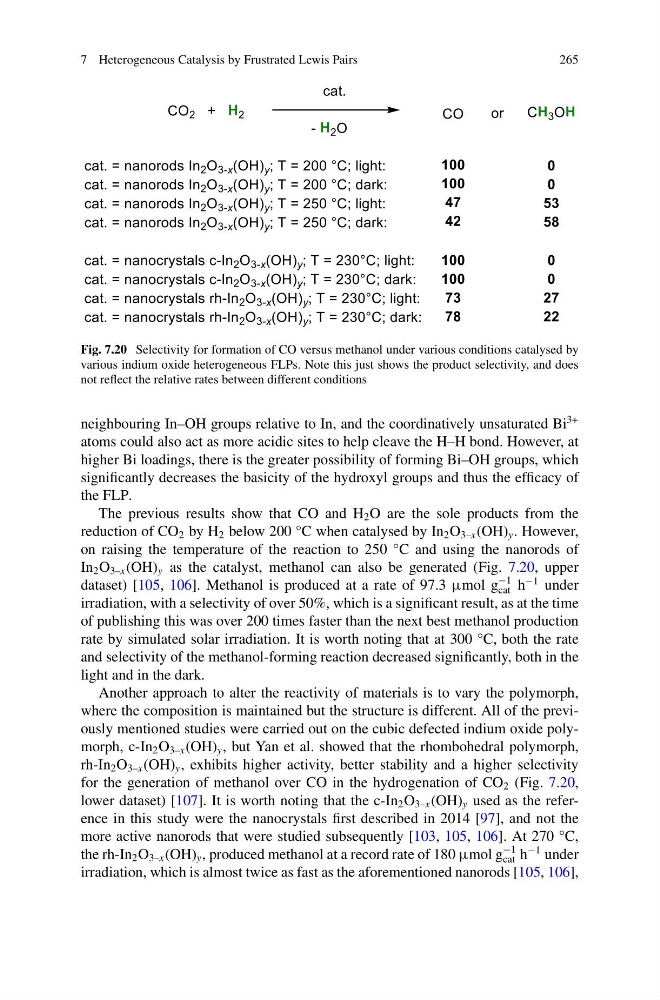
Fig. 7.20 Selectivity for formation of CO versus methanol under various conditions catalysed by
various indium oxide heterogeneous FLPs. Note this just shows the product selectivity, and does
not reflect the relative rates between different conditions
neighbouring In–OH groups relative to In, and the coordinatively unsaturated Bi
3+
atoms could also act as more acidic sites to help cleave the H–H bond. However, at
higher Bi loadings, there is the greater possibility of forming Bi–OH groups, which
significantly decreases the basicity of the hydroxyl groups and thus the efficacy of
the FLP.
The previous results show that CO and H 2 O are the sole products from the
reduction of CO 2 by H 2 below 200 °C when catalysed by In 2 O 3–x (OH) y . However,
on raising the temperature of the reaction to 250 °C and using the nanorods of
In 2 O 3–x (OH) y as the catalyst, methanol can also be generated (Fig. 7.20, upper
dataset) [105, 106]. Methanol is produced at a rate of 97.3 μmol g
−1
cat h
−1 under
irradiation, with a selectivity of over 50%, which is a significant result, as at the time
of publishing this was over 200 times faster than the next best methanol production
rate by simulated solar irradiation. It is worth noting that at 300 °C, both the rate
and selectivity of the methanol-forming reaction decreased significantly, both in the
light and in the dark.
Another approach to alter the reactivity of materials is to vary the polymorph,
where the composition is maintained but the structure is different. All of the previously mentioned studies were carried out on the cubic defected indium oxide polymorph, c-In 2 O 3–x (OH) y , but Yan et al. showed that the rhombohedral polymorph,
rh-In 2 O 3–x (OH) y , exhibits higher activity, better stability and a higher selectivity
for the generation of methanol over CO in the hydrogenation of CO 2 (Fig. 7.20,
lower dataset) [107]. It is worth noting that the c-In 2 O 3–x (OH) y used as the reference in this study were the nanocrystals first described in 2014 [97], and not the
more active nanorods that were studied subsequently [103, 105, 106]. At 270 °C,
the rh-In 2 O 3–x (OH) y , produced methanol at a record rate of 180 μmol g
−1
cat h
−1 under
irradiation, which is almost twice as fast as the aforementioned nanorods [105, 106],
265
Fig. 7.20 Selectivity for formation of CO versus methanol under various conditions catalysed by
various indium oxide heterogeneous FLPs. Note this just shows the product selectivity, and does
not reflect the relative rates between different conditions
neighbouring In–OH groups relative to In, and the coordinatively unsaturated Bi
3+
atoms could also act as more acidic sites to help cleave the H–H bond. However, at
higher Bi loadings, there is the greater possibility of forming Bi–OH groups, which
significantly decreases the basicity of the hydroxyl groups and thus the efficacy of
the FLP.
The previous results show that CO and H 2 O are the sole products from the
reduction of CO 2 by H 2 below 200 °C when catalysed by In 2 O 3–x (OH) y . However,
on raising the temperature of the reaction to 250 °C and using the nanorods of
In 2 O 3–x (OH) y as the catalyst, methanol can also be generated (Fig. 7.20, upper
dataset) [105, 106]. Methanol is produced at a rate of 97.3 μmol g
−1
cat h
−1 under
irradiation, with a selectivity of over 50%, which is a significant result, as at the time
of publishing this was over 200 times faster than the next best methanol production
rate by simulated solar irradiation. It is worth noting that at 300 °C, both the rate
and selectivity of the methanol-forming reaction decreased significantly, both in the
light and in the dark.
Another approach to alter the reactivity of materials is to vary the polymorph,
where the composition is maintained but the structure is different. All of the previously mentioned studies were carried out on the cubic defected indium oxide polymorph, c-In 2 O 3–x (OH) y , but Yan et al. showed that the rhombohedral polymorph,
rh-In 2 O 3–x (OH) y , exhibits higher activity, better stability and a higher selectivity
for the generation of methanol over CO in the hydrogenation of CO 2 (Fig. 7.20,
lower dataset) [107]. It is worth noting that the c-In 2 O 3–x (OH) y used as the reference in this study were the nanocrystals first described in 2014 [97], and not the
more active nanorods that were studied subsequently [103, 105, 106]. At 270 °C,
the rh-In 2 O 3–x (OH) y , produced methanol at a record rate of 180 μmol g
−1
cat h
−1 under
irradiation, which is almost twice as fast as the aforementioned nanorods [105, 106],