

264
A. R. Jupp
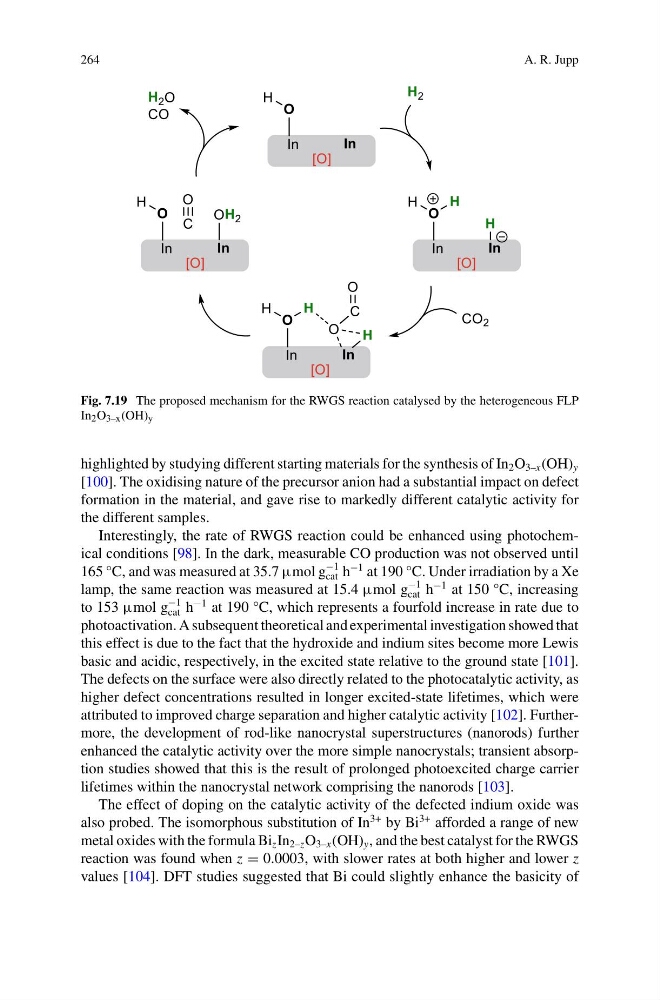
Fig. 7.19 The proposed mechanism for the RWGS reaction catalysed by the heterogeneous FLP
In 2 O 3–x (OH) y
highlighted by studying different starting materials for the synthesis of In 2 O 3–x (OH) y
[100]. The oxidising nature of the precursor anion had a substantial impact on defect
formation in the material, and gave rise to markedly different catalytic activity for
the different samples.
Interestingly, the rate of RWGS reaction could be enhanced using photochemical conditions [98]. In the dark, measurable CO production was not observed until
165 °C, and was measured at 35.7 μmol g
−1
cat h
−1 at 190 °C. Under irradiation by a Xe
lamp, the same reaction was measured at 15.4 μmol g
−1
cat h
−1 at 150 °C, increasing
to 153 μmol g
−1
cat h
−1 at 190 °C, which represents a fourfold increase in rate due to
photoactivation. A subsequent theoretical and experimental investigation showed that
this effect is due to the fact that the hydroxide and indium sites become more Lewis
basic and acidic, respectively, in the excited state relative to the ground state [101].
The defects on the surface were also directly related to the photocatalytic activity, as
higher defect concentrations resulted in longer excited-state lifetimes, which were
attributed to improved charge separation and higher catalytic activity [102]. Furthermore, the development of rod-like nanocrystal superstructures (nanorods) further
enhanced the catalytic activity over the more simple nanocrystals; transient absorption studies showed that this is the result of prolonged photoexcited charge carrier
lifetimes within the nanocrystal network comprising the nanorods [103].
The effect of doping on the catalytic activity of the defected indium oxide was
also probed. The isomorphous substitution of In
3+ by Bi
3+ afforded a range of new
metal oxides with the formula Bi z In 2–z O 3–x (OH) y , and the best catalyst for the RWGS
reaction was found when z = 0.0003, with slower rates at both higher and lower z
values [104]. DFT studies suggested that Bi could slightly enhance the basicity of
A. R. Jupp
Fig. 7.19 The proposed mechanism for the RWGS reaction catalysed by the heterogeneous FLP
In 2 O 3–x (OH) y
highlighted by studying different starting materials for the synthesis of In 2 O 3–x (OH) y
[100]. The oxidising nature of the precursor anion had a substantial impact on defect
formation in the material, and gave rise to markedly different catalytic activity for
the different samples.
Interestingly, the rate of RWGS reaction could be enhanced using photochemical conditions [98]. In the dark, measurable CO production was not observed until
165 °C, and was measured at 35.7 μmol g
−1
cat h
−1 at 190 °C. Under irradiation by a Xe
lamp, the same reaction was measured at 15.4 μmol g
−1
cat h
−1 at 150 °C, increasing
to 153 μmol g
−1
cat h
−1 at 190 °C, which represents a fourfold increase in rate due to
photoactivation. A subsequent theoretical and experimental investigation showed that
this effect is due to the fact that the hydroxide and indium sites become more Lewis
basic and acidic, respectively, in the excited state relative to the ground state [101].
The defects on the surface were also directly related to the photocatalytic activity, as
higher defect concentrations resulted in longer excited-state lifetimes, which were
attributed to improved charge separation and higher catalytic activity [102]. Furthermore, the development of rod-like nanocrystal superstructures (nanorods) further
enhanced the catalytic activity over the more simple nanocrystals; transient absorption studies showed that this is the result of prolonged photoexcited charge carrier
lifetimes within the nanocrystal network comprising the nanorods [103].
The effect of doping on the catalytic activity of the defected indium oxide was
also probed. The isomorphous substitution of In
3+ by Bi
3+ afforded a range of new
metal oxides with the formula Bi z In 2–z O 3–x (OH) y , and the best catalyst for the RWGS
reaction was found when z = 0.0003, with slower rates at both higher and lower z
values [104]. DFT studies suggested that Bi could slightly enhance the basicity of