

7 Heterogeneous Catalysis by Frustrated Lewis Pairs
247
A)
B)
HB(C 6 F 5 ) 2
Si
O O
O
OH
Si
O O
O
O
B
C 6 F 5
C 6 F 5
Si
O O
O
O
B
C 6 F 5
C 6 F 5
P
t Bu 3
Toluene60 °C, 16 h
Toluene
10
11
11
H 2 (2 bar)
Toluene65 °C, 72 h
Si
O O
O
O
B
C 6 F 5
C 6 F 5
P
t Bu 3
12
H
H
Si
O O
O
O
B
C 6 F 5
C 6 F 5
P
t Bu 3
13
D
OMe
MeOD
Toluene25 °C, 16 h
P
t Bu 3
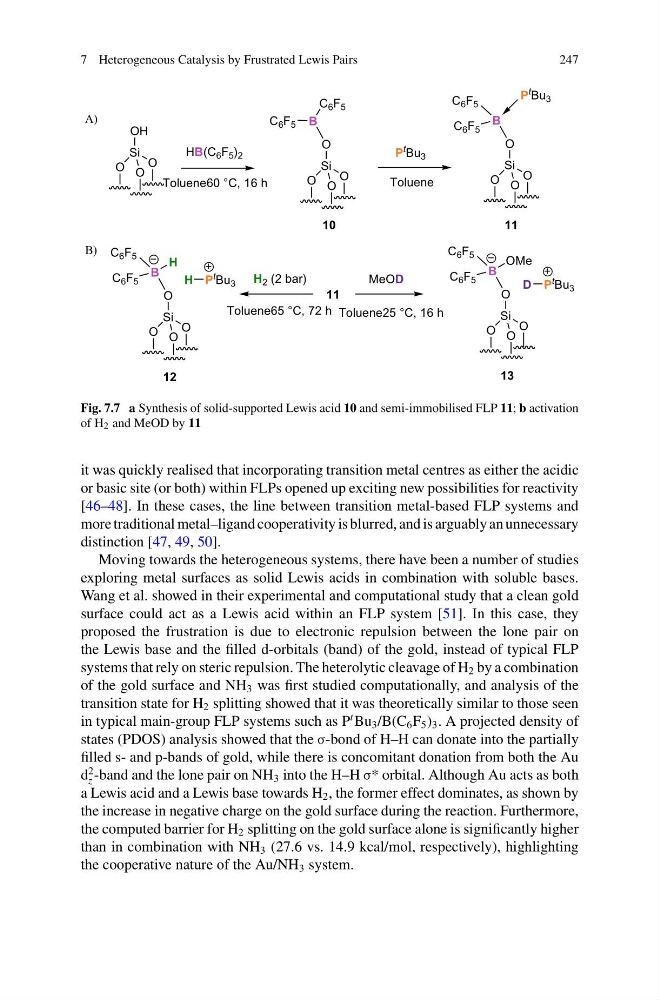
Fig. 7.7 a Synthesis of solid-supported Lewis acid 10 and semi-immobilised FLP 11; b activation
of H 2 and MeOD by 11
it was quickly realised that incorporating transition metal centres as either the acidic
or basic site (or both) within FLPs opened up exciting new possibilities for reactivity
[46–48]. In these cases, the line between transition metal-based FLP systems and
more traditional metal–ligand cooperativity is blurred, and is arguably an unnecessary
distinction [47, 49, 50].
Moving towards the heterogeneous systems, there have been a number of studies
exploring metal surfaces as solid Lewis acids in combination with soluble bases.
Wang et al. showed in their experimental and computational study that a clean gold
surface could act as a Lewis acid within an FLP system [51]. In this case, they
proposed the frustration is due to electronic repulsion between the lone pair on
the Lewis base and the filled d-orbitals (band) of the gold, instead of typical FLP
systems that rely on steric repulsion. The heterolytic cleavage of H 2 by a combination
of the gold surface and NH 3 was first studied computationally, and analysis of the
transition state for H 2 splitting showed that it was theoretically similar to those seen
in typical main-group FLP systems such as P
t Bu 3 /B(C 6 F 5 ) 3 . A projected density of
states (PDOS) analysis showed that the σ-bond of H–H can donate into the partially
filled s- and p-bands of gold, while there is concomitant donation from both the Au
d
2
z -band and the lone pair on NH 3 into the H–H σ* orbital. Although Au acts as both
a Lewis acid and a Lewis base towards H 2 , the former effect dominates, as shown by
the increase in negative charge on the gold surface during the reaction. Furthermore,
the computed barrier for H 2 splitting on the gold surface alone is significantly higher
than in combination with NH 3 (27.6 vs. 14.9 kcal/mol, respectively), highlighting
the cooperative nature of the Au/NH 3 system.
247
A)
B)
HB(C 6 F 5 ) 2
Si
O O
O
OH
Si
O O
O
O
B
C 6 F 5
C 6 F 5
Si
O O
O
O
B
C 6 F 5
C 6 F 5
P
t Bu 3
Toluene60 °C, 16 h
Toluene
10
11
11
H 2 (2 bar)
Toluene65 °C, 72 h
Si
O O
O
O
B
C 6 F 5
C 6 F 5
P
t Bu 3
12
H
H
Si
O O
O
O
B
C 6 F 5
C 6 F 5
P
t Bu 3
13
D
OMe
MeOD
Toluene25 °C, 16 h
P
t Bu 3
Fig. 7.7 a Synthesis of solid-supported Lewis acid 10 and semi-immobilised FLP 11; b activation
of H 2 and MeOD by 11
it was quickly realised that incorporating transition metal centres as either the acidic
or basic site (or both) within FLPs opened up exciting new possibilities for reactivity
[46–48]. In these cases, the line between transition metal-based FLP systems and
more traditional metal–ligand cooperativity is blurred, and is arguably an unnecessary
distinction [47, 49, 50].
Moving towards the heterogeneous systems, there have been a number of studies
exploring metal surfaces as solid Lewis acids in combination with soluble bases.
Wang et al. showed in their experimental and computational study that a clean gold
surface could act as a Lewis acid within an FLP system [51]. In this case, they
proposed the frustration is due to electronic repulsion between the lone pair on
the Lewis base and the filled d-orbitals (band) of the gold, instead of typical FLP
systems that rely on steric repulsion. The heterolytic cleavage of H 2 by a combination
of the gold surface and NH 3 was first studied computationally, and analysis of the
transition state for H 2 splitting showed that it was theoretically similar to those seen
in typical main-group FLP systems such as P
t Bu 3 /B(C 6 F 5 ) 3 . A projected density of
states (PDOS) analysis showed that the σ-bond of H–H can donate into the partially
filled s- and p-bands of gold, while there is concomitant donation from both the Au
d
2
z -band and the lone pair on NH 3 into the H–H σ* orbital. Although Au acts as both
a Lewis acid and a Lewis base towards H 2 , the former effect dominates, as shown by
the increase in negative charge on the gold surface during the reaction. Furthermore,
the computed barrier for H 2 splitting on the gold surface alone is significantly higher
than in combination with NH 3 (27.6 vs. 14.9 kcal/mol, respectively), highlighting
the cooperative nature of the Au/NH 3 system.