

246
A. R. Jupp
a)
b)
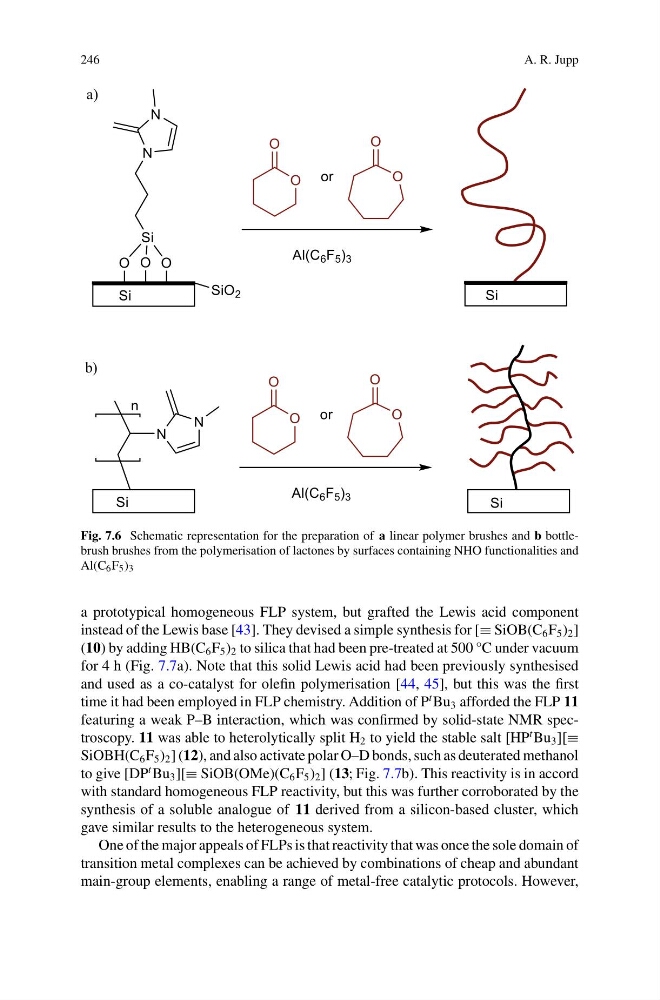
Fig. 7.6 Schematic representation for the preparation of a linear polymer brushes and b bottlebrush brushes from the polymerisation of lactones by surfaces containing NHO functionalities and
Al(C 6 F 5 ) 3
a prototypical homogeneous FLP system, but grafted the Lewis acid component
instead of the Lewis base [43]. They devised a simple synthesis for [≡ SiOB(C 6 F 5 ) 2 ]
(10) by adding HB(C 6 F 5 ) 2 to silica that had been pre-treated at 500 °C under vacuum
for 4 h (Fig. 7.7a). Note that this solid Lewis acid had been previously synthesised
and used as a co-catalyst for olefin polymerisation [44, 45], but this was the first
time it had been employed in FLP chemistry. Addition of P
t Bu 3 afforded the FLP 11
featuring a weak P–B interaction, which was confirmed by solid-state NMR spectroscopy. 11 was able to heterolytically split H 2 to yield the stable salt [HP
t Bu 3 ][≡
SiOBH(C 6 F 5 ) 2 ] (12), and also activate polar O–D bonds, such as deuterated methanol
to give [DP
t Bu 3 ][≡ SiOB(OMe)(C 6 F 5 ) 2 ] (13; Fig. 7.7b). This reactivity is in accord
with standard homogeneous FLP reactivity, but this was further corroborated by the
synthesis of a soluble analogue of 11 derived from a silicon-based cluster, which
gave similar results to the heterogeneous system.
One of the major appeals of FLPs is that reactivity that was once the sole domain of
transition metal complexes can be achieved by combinations of cheap and abundant
main-group elements, enabling a range of metal-free catalytic protocols. However,
A. R. Jupp
a)
b)
Fig. 7.6 Schematic representation for the preparation of a linear polymer brushes and b bottlebrush brushes from the polymerisation of lactones by surfaces containing NHO functionalities and
Al(C 6 F 5 ) 3
a prototypical homogeneous FLP system, but grafted the Lewis acid component
instead of the Lewis base [43]. They devised a simple synthesis for [≡ SiOB(C 6 F 5 ) 2 ]
(10) by adding HB(C 6 F 5 ) 2 to silica that had been pre-treated at 500 °C under vacuum
for 4 h (Fig. 7.7a). Note that this solid Lewis acid had been previously synthesised
and used as a co-catalyst for olefin polymerisation [44, 45], but this was the first
time it had been employed in FLP chemistry. Addition of P
t Bu 3 afforded the FLP 11
featuring a weak P–B interaction, which was confirmed by solid-state NMR spectroscopy. 11 was able to heterolytically split H 2 to yield the stable salt [HP
t Bu 3 ][≡
SiOBH(C 6 F 5 ) 2 ] (12), and also activate polar O–D bonds, such as deuterated methanol
to give [DP
t Bu 3 ][≡ SiOB(OMe)(C 6 F 5 ) 2 ] (13; Fig. 7.7b). This reactivity is in accord
with standard homogeneous FLP reactivity, but this was further corroborated by the
synthesis of a soluble analogue of 11 derived from a silicon-based cluster, which
gave similar results to the heterogeneous system.
One of the major appeals of FLPs is that reactivity that was once the sole domain of
transition metal complexes can be achieved by combinations of cheap and abundant
main-group elements, enabling a range of metal-free catalytic protocols. However,