

248
A. R. Jupp
a)
b)
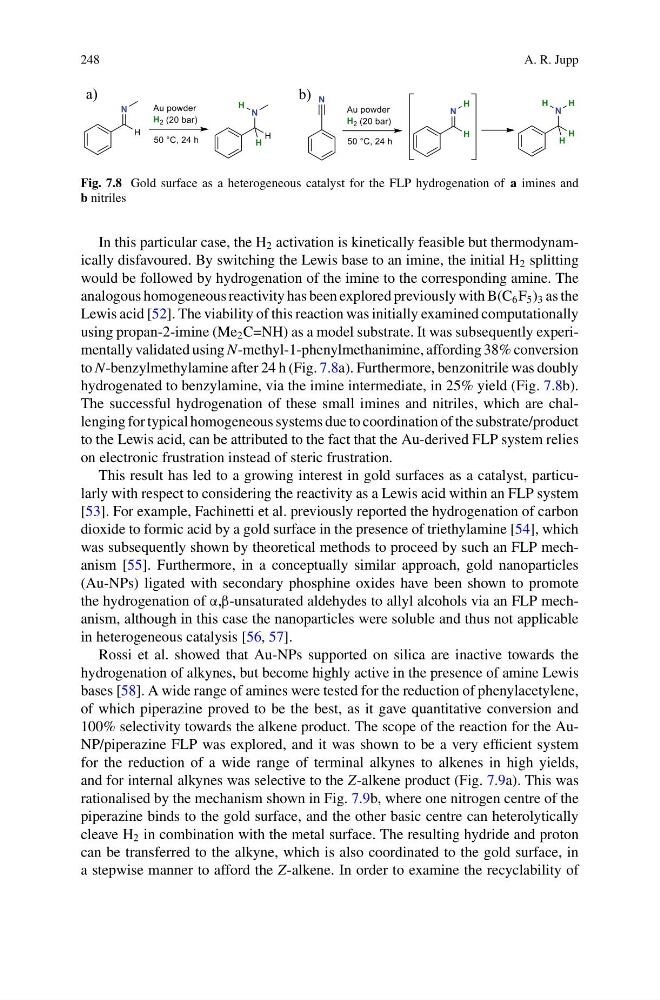
Fig. 7.8 Gold surface as a heterogeneous catalyst for the FLP hydrogenation of a imines and
b nitriles
In this particular case, the H 2 activation is kinetically feasible but thermodynamically disfavoured. By switching the Lewis base to an imine, the initial H 2 splitting
would be followed by hydrogenation of the imine to the corresponding amine. The
analogous homogeneous reactivity has been explored previously with B(C 6 F 5 ) 3 as the
Lewis acid [52]. The viability of this reaction was initially examined computationally
using propan-2-imine (Me 2 C=NH) as a model substrate. It was subsequently experimentally validated using N-methyl-1-phenylmethanimine, affording 38% conversion
to N-benzylmethylamine after 24 h (Fig. 7.8a). Furthermore, benzonitrile was doubly
hydrogenated to benzylamine, via the imine intermediate, in 25% yield (Fig. 7.8b).
The successful hydrogenation of these small imines and nitriles, which are challenging for typical homogeneous systems due to coordination of the substrate/product
to the Lewis acid, can be attributed to the fact that the Au-derived FLP system relies
on electronic frustration instead of steric frustration.
This result has led to a growing interest in gold surfaces as a catalyst, particularly with respect to considering the reactivity as a Lewis acid within an FLP system
[53]. For example, Fachinetti et al. previously reported the hydrogenation of carbon
dioxide to formic acid by a gold surface in the presence of triethylamine [54], which
was subsequently shown by theoretical methods to proceed by such an FLP mechanism [55]. Furthermore, in a conceptually similar approach, gold nanoparticles
(Au-NPs) ligated with secondary phosphine oxides have been shown to promote
the hydrogenation of α,β-unsaturated aldehydes to allyl alcohols via an FLP mechanism, although in this case the nanoparticles were soluble and thus not applicable
in heterogeneous catalysis [56, 57].
Rossi et al. showed that Au-NPs supported on silica are inactive towards the
hydrogenation of alkynes, but become highly active in the presence of amine Lewis
bases [58]. A wide range of amines were tested for the reduction of phenylacetylene,
of which piperazine proved to be the best, as it gave quantitative conversion and
100% selectivity towards the alkene product. The scope of the reaction for the AuNP/piperazine FLP was explored, and it was shown to be a very efficient system
for the reduction of a wide range of terminal alkynes to alkenes in high yields,
and for internal alkynes was selective to the Z-alkene product (Fig. 7.9a). This was
rationalised by the mechanism shown in Fig. 7.9b, where one nitrogen centre of the
piperazine binds to the gold surface, and the other basic centre can heterolytically
cleave H 2 in combination with the metal surface. The resulting hydride and proton
can be transferred to the alkyne, which is also coordinated to the gold surface, in
a stepwise manner to afford the Z-alkene. In order to examine the recyclability of
A. R. Jupp
a)
b)
Fig. 7.8 Gold surface as a heterogeneous catalyst for the FLP hydrogenation of a imines and
b nitriles
In this particular case, the H 2 activation is kinetically feasible but thermodynamically disfavoured. By switching the Lewis base to an imine, the initial H 2 splitting
would be followed by hydrogenation of the imine to the corresponding amine. The
analogous homogeneous reactivity has been explored previously with B(C 6 F 5 ) 3 as the
Lewis acid [52]. The viability of this reaction was initially examined computationally
using propan-2-imine (Me 2 C=NH) as a model substrate. It was subsequently experimentally validated using N-methyl-1-phenylmethanimine, affording 38% conversion
to N-benzylmethylamine after 24 h (Fig. 7.8a). Furthermore, benzonitrile was doubly
hydrogenated to benzylamine, via the imine intermediate, in 25% yield (Fig. 7.8b).
The successful hydrogenation of these small imines and nitriles, which are challenging for typical homogeneous systems due to coordination of the substrate/product
to the Lewis acid, can be attributed to the fact that the Au-derived FLP system relies
on electronic frustration instead of steric frustration.
This result has led to a growing interest in gold surfaces as a catalyst, particularly with respect to considering the reactivity as a Lewis acid within an FLP system
[53]. For example, Fachinetti et al. previously reported the hydrogenation of carbon
dioxide to formic acid by a gold surface in the presence of triethylamine [54], which
was subsequently shown by theoretical methods to proceed by such an FLP mechanism [55]. Furthermore, in a conceptually similar approach, gold nanoparticles
(Au-NPs) ligated with secondary phosphine oxides have been shown to promote
the hydrogenation of α,β-unsaturated aldehydes to allyl alcohols via an FLP mechanism, although in this case the nanoparticles were soluble and thus not applicable
in heterogeneous catalysis [56, 57].
Rossi et al. showed that Au-NPs supported on silica are inactive towards the
hydrogenation of alkynes, but become highly active in the presence of amine Lewis
bases [58]. A wide range of amines were tested for the reduction of phenylacetylene,
of which piperazine proved to be the best, as it gave quantitative conversion and
100% selectivity towards the alkene product. The scope of the reaction for the AuNP/piperazine FLP was explored, and it was shown to be a very efficient system
for the reduction of a wide range of terminal alkynes to alkenes in high yields,
and for internal alkynes was selective to the Z-alkene product (Fig. 7.9a). This was
rationalised by the mechanism shown in Fig. 7.9b, where one nitrogen centre of the
piperazine binds to the gold surface, and the other basic centre can heterolytically
cleave H 2 in combination with the metal surface. The resulting hydride and proton
can be transferred to the alkyne, which is also coordinated to the gold surface, in
a stepwise manner to afford the Z-alkene. In order to examine the recyclability of