

6 Lewis Acidic Boranes in Frustrated Lewis Pair Chemistry
223
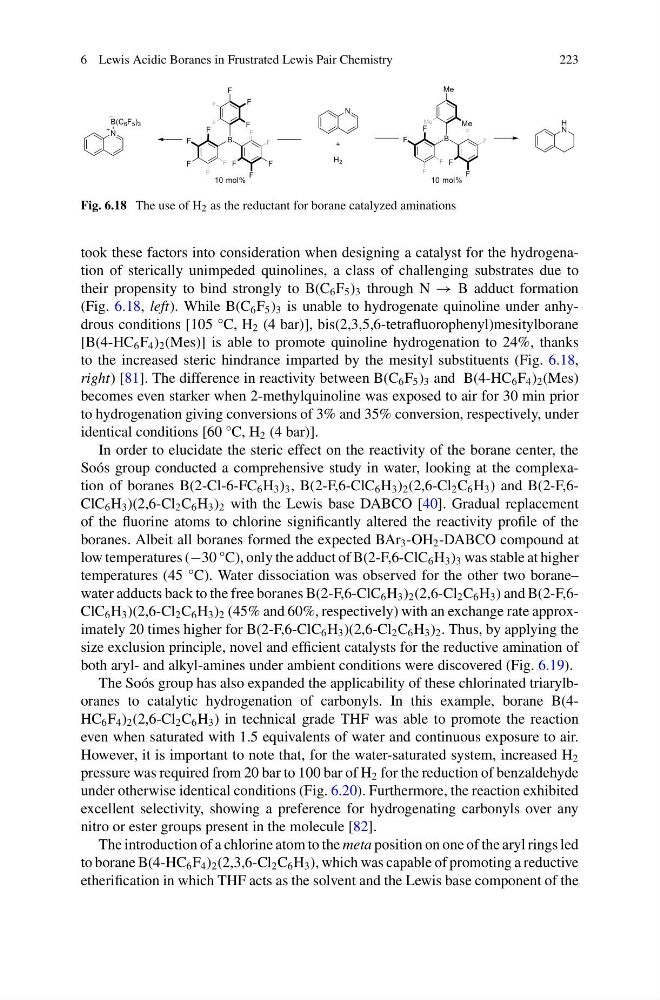
Fig. 6.18 The use of H 2 as the reductant for borane catalyzed aminations
took these factors into consideration when designing a catalyst for the hydrogenation of sterically unimpeded quinolines, a class of challenging substrates due to
their propensity to bind strongly to B(C 6 F 5 ) 3 through N → B adduct formation
(Fig. 6.18, left). While B(C 6 F 5 ) 3 is unable to hydrogenate quinoline under anhydrous conditions [105 °C, H 2 (4 bar)], bis(2,3,5,6-tetrafluorophenyl)mesitylborane
[B(4-HC 6 F 4 ) 2 (Mes)] is able to promote quinoline hydrogenation to 24%, thanks
to the increased steric hindrance imparted by the mesityl substituents (Fig. 6.18,
right) [81]. The difference in reactivity between B(C 6 F 5 ) 3 and B(4-HC 6 F 4 ) 2 (Mes)
becomes even starker when 2-methylquinoline was exposed to air for 30 min prior
to hydrogenation giving conversions of 3% and 35% conversion, respectively, under
identical conditions [60 °C, H 2 (4 bar)].
In order to elucidate the steric effect on the reactivity of the borane center, the
Soós group conducted a comprehensive study in water, looking at the complexation of boranes B(2-Cl-6-FC 6 H 3 ) 3 , B(2-F,6-ClC 6 H 3 ) 2 (2,6-Cl 2 C 6 H 3 ) and B(2-F,6ClC 6 H 3 )(2,6-Cl 2 C 6 H 3 ) 2 with the Lewis base DABCO [40]. Gradual replacement
of the fluorine atoms to chlorine significantly altered the reactivity profile of the
boranes. Albeit all boranes formed the expected BAr 3 -OH 2 -DABCO compound at
low temperatures (−30 °C), only the adduct of B(2-F,6-ClC 6 H 3 ) 3 was stable at higher
temperatures (45 °C). Water dissociation was observed for the other two borane–
water adducts back to the free boranes B(2-F,6-ClC 6 H 3 ) 2 (2,6-Cl 2 C 6 H 3 ) and B(2-F,6ClC 6 H 3 )(2,6-Cl 2 C 6 H 3 ) 2 (45% and 60%, respectively) with an exchange rate approximately 20 times higher for B(2-F,6-ClC 6 H 3 )(2,6-Cl 2 C 6 H 3 ) 2 . Thus, by applying the
size exclusion principle, novel and efficient catalysts for the reductive amination of
both aryl- and alkyl-amines under ambient conditions were discovered (Fig. 6.19).
The Soós group has also expanded the applicability of these chlorinated triarylboranes to catalytic hydrogenation of carbonyls. In this example, borane B(4HC 6 F 4 ) 2 (2,6-Cl 2 C 6 H 3 ) in technical grade THF was able to promote the reaction
even when saturated with 1.5 equivalents of water and continuous exposure to air.
However, it is important to note that, for the water-saturated system, increased H 2
pressure was required from 20 bar to 100 bar of H 2 for the reduction of benzaldehyde
under otherwise identical conditions (Fig. 6.20). Furthermore, the reaction exhibited
excellent selectivity, showing a preference for hydrogenating carbonyls over any
nitro or ester groups present in the molecule [82].
The introduction of a chlorine atom to the meta position on one of the aryl rings led
to borane B(4-HC 6 F 4 ) 2 (2,3,6-Cl 2 C 6 H 3 ), which was capable of promoting a reductive
etherification in which THF acts as the solvent and the Lewis base component of the
223
Fig. 6.18 The use of H 2 as the reductant for borane catalyzed aminations
took these factors into consideration when designing a catalyst for the hydrogenation of sterically unimpeded quinolines, a class of challenging substrates due to
their propensity to bind strongly to B(C 6 F 5 ) 3 through N → B adduct formation
(Fig. 6.18, left). While B(C 6 F 5 ) 3 is unable to hydrogenate quinoline under anhydrous conditions [105 °C, H 2 (4 bar)], bis(2,3,5,6-tetrafluorophenyl)mesitylborane
[B(4-HC 6 F 4 ) 2 (Mes)] is able to promote quinoline hydrogenation to 24%, thanks
to the increased steric hindrance imparted by the mesityl substituents (Fig. 6.18,
right) [81]. The difference in reactivity between B(C 6 F 5 ) 3 and B(4-HC 6 F 4 ) 2 (Mes)
becomes even starker when 2-methylquinoline was exposed to air for 30 min prior
to hydrogenation giving conversions of 3% and 35% conversion, respectively, under
identical conditions [60 °C, H 2 (4 bar)].
In order to elucidate the steric effect on the reactivity of the borane center, the
Soós group conducted a comprehensive study in water, looking at the complexation of boranes B(2-Cl-6-FC 6 H 3 ) 3 , B(2-F,6-ClC 6 H 3 ) 2 (2,6-Cl 2 C 6 H 3 ) and B(2-F,6ClC 6 H 3 )(2,6-Cl 2 C 6 H 3 ) 2 with the Lewis base DABCO [40]. Gradual replacement
of the fluorine atoms to chlorine significantly altered the reactivity profile of the
boranes. Albeit all boranes formed the expected BAr 3 -OH 2 -DABCO compound at
low temperatures (−30 °C), only the adduct of B(2-F,6-ClC 6 H 3 ) 3 was stable at higher
temperatures (45 °C). Water dissociation was observed for the other two borane–
water adducts back to the free boranes B(2-F,6-ClC 6 H 3 ) 2 (2,6-Cl 2 C 6 H 3 ) and B(2-F,6ClC 6 H 3 )(2,6-Cl 2 C 6 H 3 ) 2 (45% and 60%, respectively) with an exchange rate approximately 20 times higher for B(2-F,6-ClC 6 H 3 )(2,6-Cl 2 C 6 H 3 ) 2 . Thus, by applying the
size exclusion principle, novel and efficient catalysts for the reductive amination of
both aryl- and alkyl-amines under ambient conditions were discovered (Fig. 6.19).
The Soós group has also expanded the applicability of these chlorinated triarylboranes to catalytic hydrogenation of carbonyls. In this example, borane B(4HC 6 F 4 ) 2 (2,6-Cl 2 C 6 H 3 ) in technical grade THF was able to promote the reaction
even when saturated with 1.5 equivalents of water and continuous exposure to air.
However, it is important to note that, for the water-saturated system, increased H 2
pressure was required from 20 bar to 100 bar of H 2 for the reduction of benzaldehyde
under otherwise identical conditions (Fig. 6.20). Furthermore, the reaction exhibited
excellent selectivity, showing a preference for hydrogenating carbonyls over any
nitro or ester groups present in the molecule [82].
The introduction of a chlorine atom to the meta position on one of the aryl rings led
to borane B(4-HC 6 F 4 ) 2 (2,3,6-Cl 2 C 6 H 3 ), which was capable of promoting a reductive
etherification in which THF acts as the solvent and the Lewis base component of the