

6 Lewis Acidic Boranes in Frustrated Lewis Pair Chemistry
221
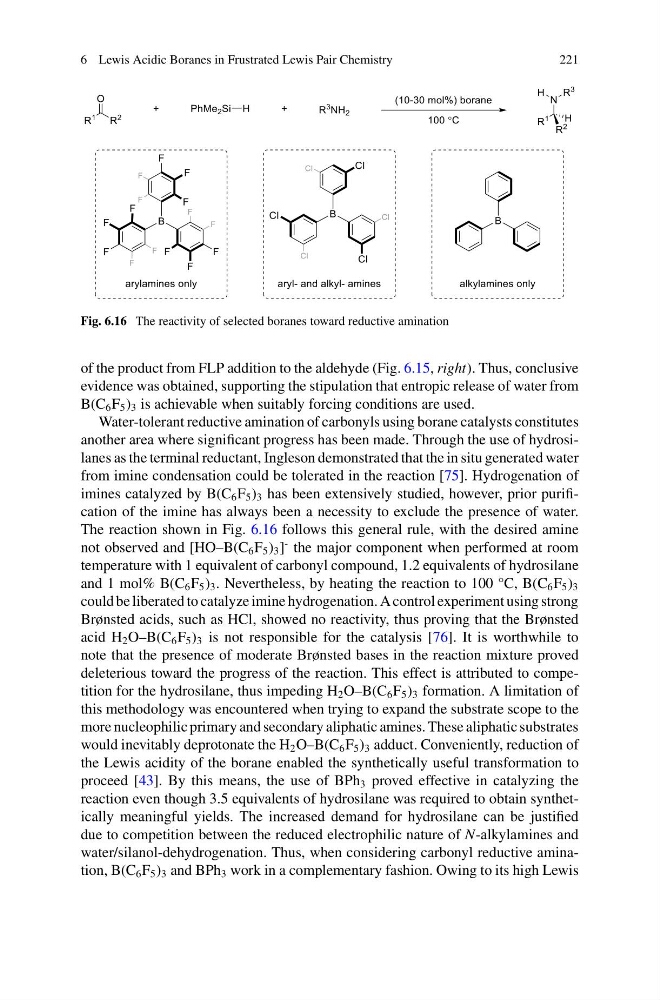
Fig. 6.16 The reactivity of selected boranes toward reductive amination
of the product from FLP addition to the aldehyde (Fig. 6.15, right). Thus, conclusive
evidence was obtained, supporting the stipulation that entropic release of water from
B(C 6 F 5 ) 3 is achievable when suitably forcing conditions are used.
Water-tolerant reductive amination of carbonyls using borane catalysts constitutes
another area where significant progress has been made. Through the use of hydrosilanes as the terminal reductant, Ingleson demonstrated that the in situ generated water
from imine condensation could be tolerated in the reaction [75]. Hydrogenation of
imines catalyzed by B(C 6 F 5 ) 3 has been extensively studied, however, prior purification of the imine has always been a necessity to exclude the presence of water.
The reaction shown in Fig. 6.16 follows this general rule, with the desired amine
not observed and [HO–B(C 6 F 5 ) 3 ]
- the major component when performed at room
temperature with 1 equivalent of carbonyl compound, 1.2 equivalents of hydrosilane
and 1 mol% B(C 6 F 5 ) 3 . Nevertheless, by heating the reaction to 100 °C, B(C 6 F 5 ) 3
could be liberated to catalyze imine hydrogenation. A control experiment using strong
Brønsted acids, such as HCl, showed no reactivity, thus proving that the Brønsted
acid H 2 O–B(C 6 F 5 ) 3 is not responsible for the catalysis [76]. It is worthwhile to
note that the presence of moderate Brønsted bases in the reaction mixture proved
deleterious toward the progress of the reaction. This effect is attributed to competition for the hydrosilane, thus impeding H 2 O–B(C 6 F 5 ) 3 formation. A limitation of
this methodology was encountered when trying to expand the substrate scope to the
more nucleophilic primary and secondary aliphatic amines. These aliphatic substrates
would inevitably deprotonate the H 2 O–B(C 6 F 5 ) 3 adduct. Conveniently, reduction of
the Lewis acidity of the borane enabled the synthetically useful transformation to
proceed [43]. By this means, the use of BPh 3 proved effective in catalyzing the
reaction even though 3.5 equivalents of hydrosilane was required to obtain synthetically meaningful yields. The increased demand for hydrosilane can be justified
due to competition between the reduced electrophilic nature of N-alkylamines and
water/silanol-dehydrogenation. Thus, when considering carbonyl reductive amination, B(C 6 F 5 ) 3 and BPh 3 work in a complementary fashion. Owing to its high Lewis
221
Fig. 6.16 The reactivity of selected boranes toward reductive amination
of the product from FLP addition to the aldehyde (Fig. 6.15, right). Thus, conclusive
evidence was obtained, supporting the stipulation that entropic release of water from
B(C 6 F 5 ) 3 is achievable when suitably forcing conditions are used.
Water-tolerant reductive amination of carbonyls using borane catalysts constitutes
another area where significant progress has been made. Through the use of hydrosilanes as the terminal reductant, Ingleson demonstrated that the in situ generated water
from imine condensation could be tolerated in the reaction [75]. Hydrogenation of
imines catalyzed by B(C 6 F 5 ) 3 has been extensively studied, however, prior purification of the imine has always been a necessity to exclude the presence of water.
The reaction shown in Fig. 6.16 follows this general rule, with the desired amine
not observed and [HO–B(C 6 F 5 ) 3 ]
- the major component when performed at room
temperature with 1 equivalent of carbonyl compound, 1.2 equivalents of hydrosilane
and 1 mol% B(C 6 F 5 ) 3 . Nevertheless, by heating the reaction to 100 °C, B(C 6 F 5 ) 3
could be liberated to catalyze imine hydrogenation. A control experiment using strong
Brønsted acids, such as HCl, showed no reactivity, thus proving that the Brønsted
acid H 2 O–B(C 6 F 5 ) 3 is not responsible for the catalysis [76]. It is worthwhile to
note that the presence of moderate Brønsted bases in the reaction mixture proved
deleterious toward the progress of the reaction. This effect is attributed to competition for the hydrosilane, thus impeding H 2 O–B(C 6 F 5 ) 3 formation. A limitation of
this methodology was encountered when trying to expand the substrate scope to the
more nucleophilic primary and secondary aliphatic amines. These aliphatic substrates
would inevitably deprotonate the H 2 O–B(C 6 F 5 ) 3 adduct. Conveniently, reduction of
the Lewis acidity of the borane enabled the synthetically useful transformation to
proceed [43]. By this means, the use of BPh 3 proved effective in catalyzing the
reaction even though 3.5 equivalents of hydrosilane was required to obtain synthetically meaningful yields. The increased demand for hydrosilane can be justified
due to competition between the reduced electrophilic nature of N-alkylamines and
water/silanol-dehydrogenation. Thus, when considering carbonyl reductive amination, B(C 6 F 5 ) 3 and BPh 3 work in a complementary fashion. Owing to its high Lewis