

220
T. A. Gazis et al.
adducts, protodeboronation of the analogous alcohol borane adduct also results in
C 6 F 5 H elimination. Consequently, the borane catalyst is poisoned and destroyed. For
a long time, the FLP-catalyzed reduction of carbonyl compounds seemed impossible.
Initial attempts with stoichiometric reactions were met with limited success, with only
a few examples in non-donor solvents reported prior to 2014 [65, 66]. Intramolecular
FLP systems have met with much the same fate, due to the irreversible capture of
the carbonyl by the FLP [2]. Thus, aldehydes and ketones were noticeably missing
from the long list of functional groups B(C 6 F 5 ) 3 could hydrogenate catalytically.
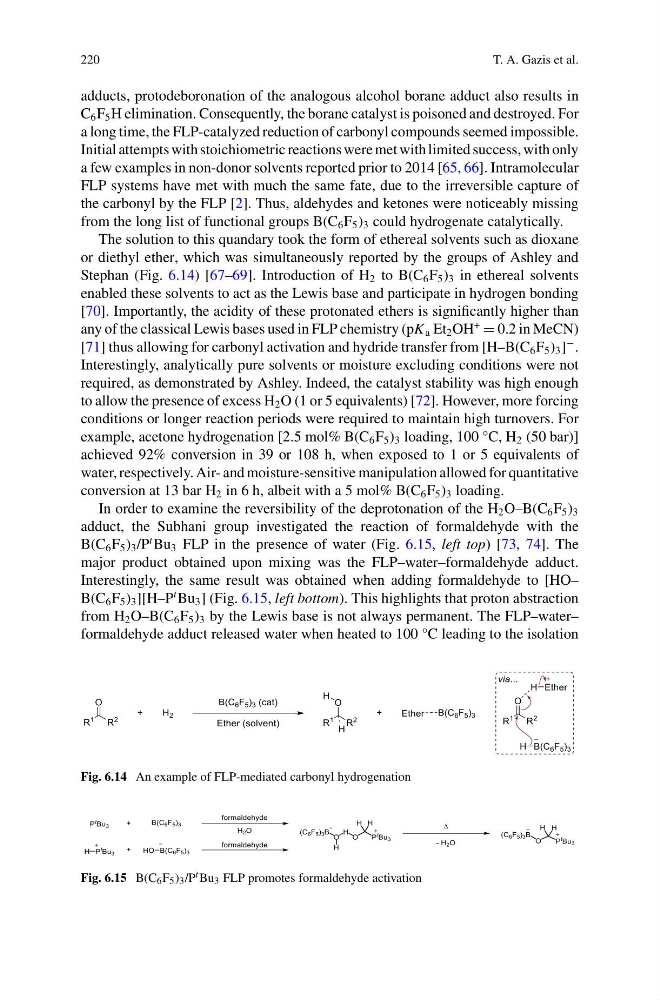
The solution to this quandary took the form of ethereal solvents such as dioxane
or diethyl ether, which was simultaneously reported by the groups of Ashley and
Stephan (Fig. 6.14) [67–69]. Introduction of H 2 to B(C 6 F 5 ) 3 in ethereal solvents
enabled these solvents to act as the Lewis base and participate in hydrogen bonding
[70]. Importantly, the acidity of these protonated ethers is significantly higher than
any of the classical Lewis bases used in FLP chemistry (pK a Et 2 OH
+
= 0.2 in MeCN)
[71] thus allowing for carbonyl activation and hydride transfer from [H–B(C 6 F 5 ) 3 ]
− .
Interestingly, analytically pure solvents or moisture excluding conditions were not
required, as demonstrated by Ashley. Indeed, the catalyst stability was high enough
to allow the presence of excess H 2 O (1 or 5 equivalents) [72]. However, more forcing
conditions or longer reaction periods were required to maintain high turnovers. For
example, acetone hydrogenation [2.5 mol% B(C 6 F 5 ) 3 loading, 100 °C, H 2 (50 bar)]
achieved 92% conversion in 39 or 108 h, when exposed to 1 or 5 equivalents of
water, respectively. Air- and moisture-sensitive manipulation allowed for quantitative
conversion at 13 bar H 2 in 6 h, albeit with a 5 mol% B(C 6 F 5 ) 3 loading.
In order to examine the reversibility of the deprotonation of the H 2 O–B(C 6 F 5 ) 3
adduct, the Subhani group investigated the reaction of formaldehyde with the
B(C 6 F 5 ) 3 /P
t Bu 3 FLP in the presence of water (Fig. 6.15, left top) [73, 74]. The
major product obtained upon mixing was the FLP–water–formaldehyde adduct.
Interestingly, the same result was obtained when adding formaldehyde to [HO–
B(C 6 F 5 ) 3 ][H–P
t Bu 3 ] (Fig. 6.15, left bottom). This highlights that proton abstraction
from H 2 O–B(C 6 F 5 ) 3 by the Lewis base is not always permanent. The FLP–water–
formaldehyde adduct released water when heated to 100 °C leading to the isolation
Fig. 6.14 An example of FLP-mediated carbonyl hydrogenation
Fig. 6.15 B(C 6 F 5 ) 3 /P t Bu 3 FLP promotes formaldehyde activation
T. A. Gazis et al.
adducts, protodeboronation of the analogous alcohol borane adduct also results in
C 6 F 5 H elimination. Consequently, the borane catalyst is poisoned and destroyed. For
a long time, the FLP-catalyzed reduction of carbonyl compounds seemed impossible.
Initial attempts with stoichiometric reactions were met with limited success, with only
a few examples in non-donor solvents reported prior to 2014 [65, 66]. Intramolecular
FLP systems have met with much the same fate, due to the irreversible capture of
the carbonyl by the FLP [2]. Thus, aldehydes and ketones were noticeably missing
from the long list of functional groups B(C 6 F 5 ) 3 could hydrogenate catalytically.
The solution to this quandary took the form of ethereal solvents such as dioxane
or diethyl ether, which was simultaneously reported by the groups of Ashley and
Stephan (Fig. 6.14) [67–69]. Introduction of H 2 to B(C 6 F 5 ) 3 in ethereal solvents
enabled these solvents to act as the Lewis base and participate in hydrogen bonding
[70]. Importantly, the acidity of these protonated ethers is significantly higher than
any of the classical Lewis bases used in FLP chemistry (pK a Et 2 OH
+
= 0.2 in MeCN)
[71] thus allowing for carbonyl activation and hydride transfer from [H–B(C 6 F 5 ) 3 ]
− .
Interestingly, analytically pure solvents or moisture excluding conditions were not
required, as demonstrated by Ashley. Indeed, the catalyst stability was high enough
to allow the presence of excess H 2 O (1 or 5 equivalents) [72]. However, more forcing
conditions or longer reaction periods were required to maintain high turnovers. For
example, acetone hydrogenation [2.5 mol% B(C 6 F 5 ) 3 loading, 100 °C, H 2 (50 bar)]
achieved 92% conversion in 39 or 108 h, when exposed to 1 or 5 equivalents of
water, respectively. Air- and moisture-sensitive manipulation allowed for quantitative
conversion at 13 bar H 2 in 6 h, albeit with a 5 mol% B(C 6 F 5 ) 3 loading.
In order to examine the reversibility of the deprotonation of the H 2 O–B(C 6 F 5 ) 3
adduct, the Subhani group investigated the reaction of formaldehyde with the
B(C 6 F 5 ) 3 /P
t Bu 3 FLP in the presence of water (Fig. 6.15, left top) [73, 74]. The
major product obtained upon mixing was the FLP–water–formaldehyde adduct.
Interestingly, the same result was obtained when adding formaldehyde to [HO–
B(C 6 F 5 ) 3 ][H–P
t Bu 3 ] (Fig. 6.15, left bottom). This highlights that proton abstraction
from H 2 O–B(C 6 F 5 ) 3 by the Lewis base is not always permanent. The FLP–water–
formaldehyde adduct released water when heated to 100 °C leading to the isolation
Fig. 6.14 An example of FLP-mediated carbonyl hydrogenation
Fig. 6.15 B(C 6 F 5 ) 3 /P t Bu 3 FLP promotes formaldehyde activation