

6 Lewis Acidic Boranes in Frustrated Lewis Pair Chemistry
219
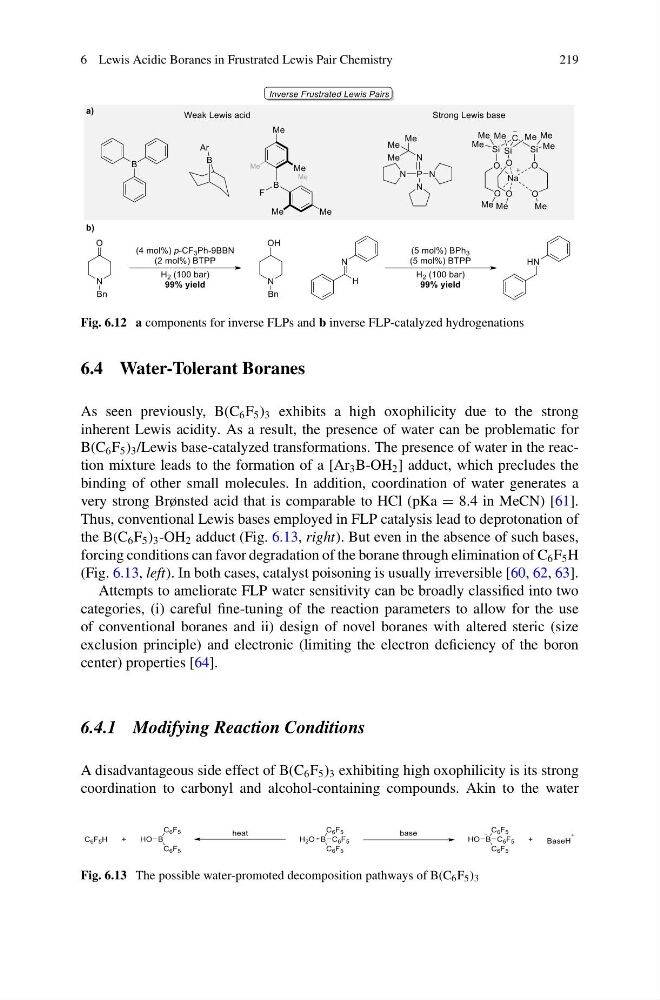
Fig. 6.12 a components for inverse FLPs and b inverse FLP-catalyzed hydrogenations
6.4 Water-Tolerant Boranes
As seen previously, B(C 6 F 5 ) 3 exhibits a high oxophilicity due to the strong
inherent Lewis acidity. As a result, the presence of water can be problematic for
B(C 6 F 5 ) 3 /Lewis base-catalyzed transformations. The presence of water in the reaction mixture leads to the formation of a [Ar 3 B-OH 2 ] adduct, which precludes the
binding of other small molecules. In addition, coordination of water generates a
very strong Brønsted acid that is comparable to HCl (pKa = 8.4 in MeCN) [61].
Thus, conventional Lewis bases employed in FLP catalysis lead to deprotonation of
the B(C 6 F 5 ) 3 -OH 2 adduct (Fig. 6.13, right). But even in the absence of such bases,
forcing conditions can favor degradation of the borane through elimination of C 6 F 5 H
(Fig. 6.13, left). In both cases, catalyst poisoning is usually irreversible [60, 62, 63].
Attempts to ameliorate FLP water sensitivity can be broadly classified into two
categories, (i) careful fine-tuning of the reaction parameters to allow for the use
of conventional boranes and ii) design of novel boranes with altered steric (size
exclusion principle) and electronic (limiting the electron deficiency of the boron
center) properties [64].
6.4.1 Modifying Reaction Conditions
A disadvantageous side effect of B(C 6 F 5 ) 3 exhibiting high oxophilicity is its strong
coordination to carbonyl and alcohol-containing compounds. Akin to the water
Fig. 6.13 The possible water-promoted decomposition pathways of B(C 6 F 5 ) 3
219
Fig. 6.12 a components for inverse FLPs and b inverse FLP-catalyzed hydrogenations
6.4 Water-Tolerant Boranes
As seen previously, B(C 6 F 5 ) 3 exhibits a high oxophilicity due to the strong
inherent Lewis acidity. As a result, the presence of water can be problematic for
B(C 6 F 5 ) 3 /Lewis base-catalyzed transformations. The presence of water in the reaction mixture leads to the formation of a [Ar 3 B-OH 2 ] adduct, which precludes the
binding of other small molecules. In addition, coordination of water generates a
very strong Brønsted acid that is comparable to HCl (pKa = 8.4 in MeCN) [61].
Thus, conventional Lewis bases employed in FLP catalysis lead to deprotonation of
the B(C 6 F 5 ) 3 -OH 2 adduct (Fig. 6.13, right). But even in the absence of such bases,
forcing conditions can favor degradation of the borane through elimination of C 6 F 5 H
(Fig. 6.13, left). In both cases, catalyst poisoning is usually irreversible [60, 62, 63].
Attempts to ameliorate FLP water sensitivity can be broadly classified into two
categories, (i) careful fine-tuning of the reaction parameters to allow for the use
of conventional boranes and ii) design of novel boranes with altered steric (size
exclusion principle) and electronic (limiting the electron deficiency of the boron
center) properties [64].
6.4.1 Modifying Reaction Conditions
A disadvantageous side effect of B(C 6 F 5 ) 3 exhibiting high oxophilicity is its strong
coordination to carbonyl and alcohol-containing compounds. Akin to the water
Fig. 6.13 The possible water-promoted decomposition pathways of B(C 6 F 5 ) 3