

6 Lewis Acidic Boranes in Frustrated Lewis Pair Chemistry
217
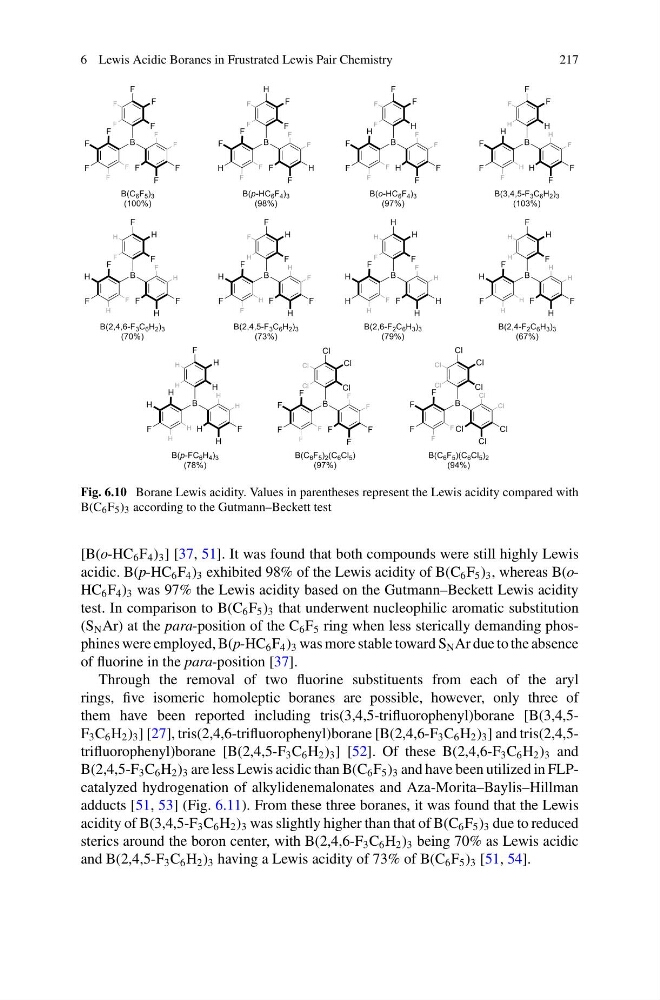
Fig. 6.10 Borane Lewis acidity. Values in parentheses represent the Lewis acidity compared with
B(C 6 F 5 ) 3 according to the Gutmann–Beckett test
[B(o-HC 6 F 4 ) 3 ] [37, 51]. It was found that both compounds were still highly Lewis
acidic. B(p-HC 6 F 4 ) 3 exhibited 98% of the Lewis acidity of B(C 6 F 5 ) 3 , whereas B(oHC 6 F 4 ) 3 was 97% the Lewis acidity based on the Gutmann–Beckett Lewis acidity
test. In comparison to B(C 6 F 5 ) 3 that underwent nucleophilic aromatic substitution
(S N Ar) at the para-position of the C 6 F 5 ring when less sterically demanding phosphines were employed, B(p-HC 6 F 4 ) 3 was more stable toward S N Ar due to the absence
of fluorine in the para-position [37].
Through the removal of two fluorine substituents from each of the aryl
rings, five isomeric homoleptic boranes are possible, however, only three of
them have been reported including tris(3,4,5-trifluorophenyl)borane [B(3,4,5F 3 C 6 H 2 ) 3 ] [27], tris(2,4,6-trifluorophenyl)borane [B(2,4,6-F 3 C 6 H 2 ) 3 ] and tris(2,4,5trifluorophenyl)borane [B(2,4,5-F 3 C 6 H 2 ) 3 ] [52]. Of these B(2,4,6-F 3 C 6 H 2 ) 3 and
B(2,4,5-F 3 C 6 H 2 ) 3 are less Lewis acidic than B(C 6 F 5 ) 3 and have been utilized in FLPcatalyzed hydrogenation of alkylidenemalonates and Aza-Morita–Baylis–Hillman
adducts [51, 53] (Fig. 6.11). From these three boranes, it was found that the Lewis
acidity of B(3,4,5-F 3 C 6 H 2 ) 3 was slightly higher than that of B(C 6 F 5 ) 3 due to reduced
sterics around the boron center, with B(2,4,6-F 3 C 6 H 2 ) 3 being 70% as Lewis acidic
and B(2,4,5-F 3 C 6 H 2 ) 3 having a Lewis acidity of 73% of B(C 6 F 5 ) 3 [51, 54].
217
Fig. 6.10 Borane Lewis acidity. Values in parentheses represent the Lewis acidity compared with
B(C 6 F 5 ) 3 according to the Gutmann–Beckett test
[B(o-HC 6 F 4 ) 3 ] [37, 51]. It was found that both compounds were still highly Lewis
acidic. B(p-HC 6 F 4 ) 3 exhibited 98% of the Lewis acidity of B(C 6 F 5 ) 3 , whereas B(oHC 6 F 4 ) 3 was 97% the Lewis acidity based on the Gutmann–Beckett Lewis acidity
test. In comparison to B(C 6 F 5 ) 3 that underwent nucleophilic aromatic substitution
(S N Ar) at the para-position of the C 6 F 5 ring when less sterically demanding phosphines were employed, B(p-HC 6 F 4 ) 3 was more stable toward S N Ar due to the absence
of fluorine in the para-position [37].
Through the removal of two fluorine substituents from each of the aryl
rings, five isomeric homoleptic boranes are possible, however, only three of
them have been reported including tris(3,4,5-trifluorophenyl)borane [B(3,4,5F 3 C 6 H 2 ) 3 ] [27], tris(2,4,6-trifluorophenyl)borane [B(2,4,6-F 3 C 6 H 2 ) 3 ] and tris(2,4,5trifluorophenyl)borane [B(2,4,5-F 3 C 6 H 2 ) 3 ] [52]. Of these B(2,4,6-F 3 C 6 H 2 ) 3 and
B(2,4,5-F 3 C 6 H 2 ) 3 are less Lewis acidic than B(C 6 F 5 ) 3 and have been utilized in FLPcatalyzed hydrogenation of alkylidenemalonates and Aza-Morita–Baylis–Hillman
adducts [51, 53] (Fig. 6.11). From these three boranes, it was found that the Lewis
acidity of B(3,4,5-F 3 C 6 H 2 ) 3 was slightly higher than that of B(C 6 F 5 ) 3 due to reduced
sterics around the boron center, with B(2,4,6-F 3 C 6 H 2 ) 3 being 70% as Lewis acidic
and B(2,4,5-F 3 C 6 H 2 ) 3 having a Lewis acidity of 73% of B(C 6 F 5 ) 3 [51, 54].