

216
T. A. Gazis et al.
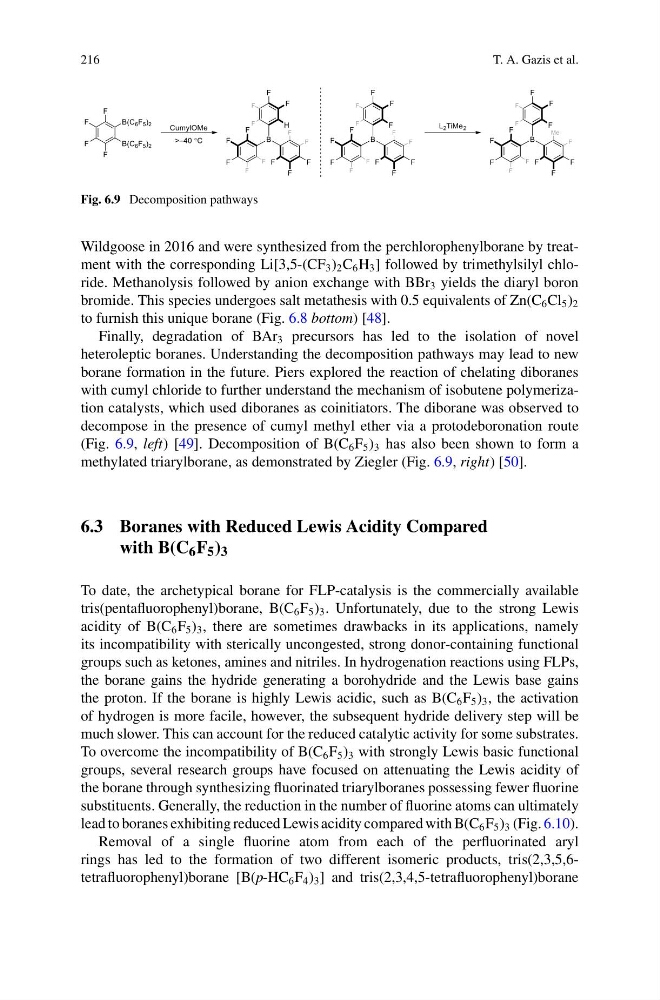
Fig. 6.9 Decomposition pathways
Wildgoose in 2016 and were synthesized from the perchlorophenylborane by treatment with the corresponding Li[3,5-(CF 3 ) 2 C 6 H 3 ] followed by trimethylsilyl chloride. Methanolysis followed by anion exchange with BBr 3 yields the diaryl boron
bromide. This species undergoes salt metathesis with 0.5 equivalents of Zn(C 6 Cl 5 ) 2
to furnish this unique borane (Fig. 6.8 bottom) [48].
Finally, degradation of BAr 3 precursors has led to the isolation of novel
heteroleptic boranes. Understanding the decomposition pathways may lead to new
borane formation in the future. Piers explored the reaction of chelating diboranes
with cumyl chloride to further understand the mechanism of isobutene polymerization catalysts, which used diboranes as coinitiators. The diborane was observed to
decompose in the presence of cumyl methyl ether via a protodeboronation route
(Fig. 6.9, left) [49]. Decomposition of B(C 6 F 5 ) 3 has also been shown to form a
methylated triarylborane, as demonstrated by Ziegler (Fig. 6.9, right) [50].
6.3 Boranes with Reduced Lewis Acidity Compared
with B(C 6 F 5 ) 3
To date, the archetypical borane for FLP-catalysis is the commercially available
tris(pentafluorophenyl)borane, B(C 6 F 5 ) 3 . Unfortunately, due to the strong Lewis
acidity of B(C 6 F 5 ) 3 , there are sometimes drawbacks in its applications, namely
its incompatibility with sterically uncongested, strong donor-containing functional
groups such as ketones, amines and nitriles. In hydrogenation reactions using FLPs,
the borane gains the hydride generating a borohydride and the Lewis base gains
the proton. If the borane is highly Lewis acidic, such as B(C 6 F 5 ) 3 , the activation
of hydrogen is more facile, however, the subsequent hydride delivery step will be
much slower. This can account for the reduced catalytic activity for some substrates.
To overcome the incompatibility of B(C 6 F 5 ) 3 with strongly Lewis basic functional
groups, several research groups have focused on attenuating the Lewis acidity of
the borane through synthesizing fluorinated triarylboranes possessing fewer fluorine
substituents. Generally, the reduction in the number of fluorine atoms can ultimately
lead to boranes exhibiting reduced Lewis acidity compared with B(C 6 F 5 ) 3 (Fig. 6.10).
Removal of a single fluorine atom from each of the perfluorinated aryl
rings has led to the formation of two different isomeric products, tris(2,3,5,6tetrafluorophenyl)borane [B(p-HC 6 F 4 ) 3 ] and tris(2,3,4,5-tetrafluorophenyl)borane
T. A. Gazis et al.
Fig. 6.9 Decomposition pathways
Wildgoose in 2016 and were synthesized from the perchlorophenylborane by treatment with the corresponding Li[3,5-(CF 3 ) 2 C 6 H 3 ] followed by trimethylsilyl chloride. Methanolysis followed by anion exchange with BBr 3 yields the diaryl boron
bromide. This species undergoes salt metathesis with 0.5 equivalents of Zn(C 6 Cl 5 ) 2
to furnish this unique borane (Fig. 6.8 bottom) [48].
Finally, degradation of BAr 3 precursors has led to the isolation of novel
heteroleptic boranes. Understanding the decomposition pathways may lead to new
borane formation in the future. Piers explored the reaction of chelating diboranes
with cumyl chloride to further understand the mechanism of isobutene polymerization catalysts, which used diboranes as coinitiators. The diborane was observed to
decompose in the presence of cumyl methyl ether via a protodeboronation route
(Fig. 6.9, left) [49]. Decomposition of B(C 6 F 5 ) 3 has also been shown to form a
methylated triarylborane, as demonstrated by Ziegler (Fig. 6.9, right) [50].
6.3 Boranes with Reduced Lewis Acidity Compared
with B(C 6 F 5 ) 3
To date, the archetypical borane for FLP-catalysis is the commercially available
tris(pentafluorophenyl)borane, B(C 6 F 5 ) 3 . Unfortunately, due to the strong Lewis
acidity of B(C 6 F 5 ) 3 , there are sometimes drawbacks in its applications, namely
its incompatibility with sterically uncongested, strong donor-containing functional
groups such as ketones, amines and nitriles. In hydrogenation reactions using FLPs,
the borane gains the hydride generating a borohydride and the Lewis base gains
the proton. If the borane is highly Lewis acidic, such as B(C 6 F 5 ) 3 , the activation
of hydrogen is more facile, however, the subsequent hydride delivery step will be
much slower. This can account for the reduced catalytic activity for some substrates.
To overcome the incompatibility of B(C 6 F 5 ) 3 with strongly Lewis basic functional
groups, several research groups have focused on attenuating the Lewis acidity of
the borane through synthesizing fluorinated triarylboranes possessing fewer fluorine
substituents. Generally, the reduction in the number of fluorine atoms can ultimately
lead to boranes exhibiting reduced Lewis acidity compared with B(C 6 F 5 ) 3 (Fig. 6.10).
Removal of a single fluorine atom from each of the perfluorinated aryl
rings has led to the formation of two different isomeric products, tris(2,3,5,6tetrafluorophenyl)borane [B(p-HC 6 F 4 ) 3 ] and tris(2,3,4,5-tetrafluorophenyl)borane