

6 Lewis Acidic Boranes in Frustrated Lewis Pair Chemistry
213
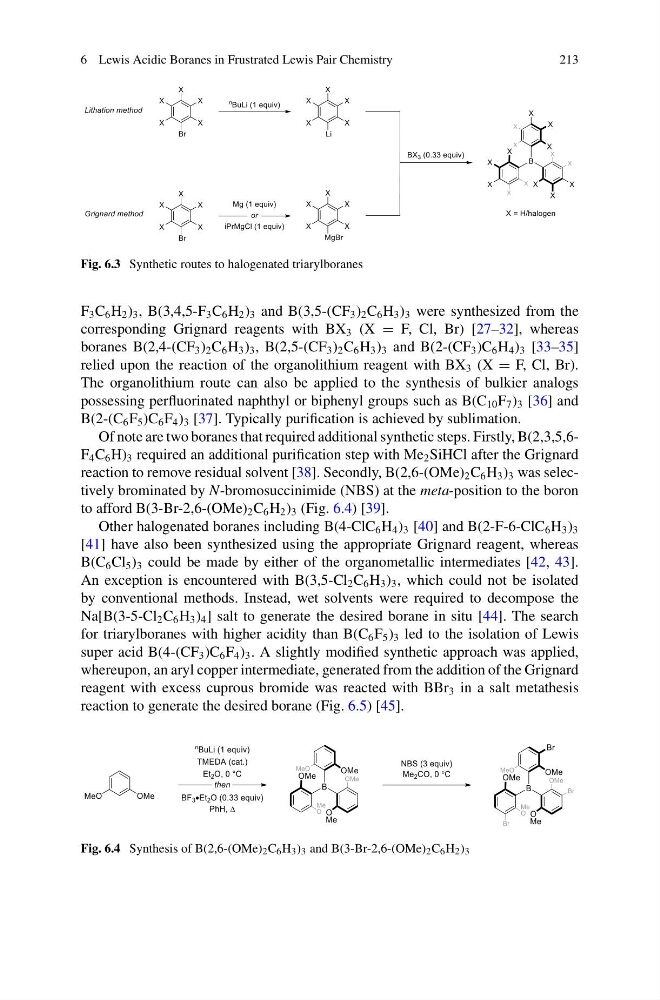
Fig. 6.3 Synthetic routes to halogenated triarylboranes
F 3 C 6 H 2 ) 3 , B(3,4,5-F 3 C 6 H 2 ) 3 and B(3,5-(CF 3 ) 2 C 6 H 3 ) 3 were synthesized from the
corresponding Grignard reagents with BX 3 (X = F, Cl, Br) [27–32], whereas
boranes B(2,4-(CF 3 ) 2 C 6 H 3 ) 3 , B(2,5-(CF 3 ) 2 C 6 H 3 ) 3 and B(2-(CF 3 )C 6 H 4 ) 3 [33–35]
relied upon the reaction of the organolithium reagent with BX 3 (X = F, Cl, Br).
The organolithium route can also be applied to the synthesis of bulkier analogs
possessing perfluorinated naphthyl or biphenyl groups such as B(C 10 F 7 ) 3 [36] and
B(2-(C 6 F 5 )C 6 F 4 ) 3 [37]. Typically purification is achieved by sublimation.
Of note are two boranes that required additional synthetic steps. Firstly, B(2,3,5,6F 4 C 6 H) 3 required an additional purification step with Me 2 SiHCl after the Grignard
reaction to remove residual solvent [38]. Secondly, B(2,6-(OMe) 2 C 6 H 3 ) 3 was selectively brominated by N-bromosuccinimide (NBS) at the meta-position to the boron
to afford B(3-Br-2,6-(OMe) 2 C 6 H 2 ) 3 (Fig. 6.4) [39].
Other halogenated boranes including B(4-ClC 6 H 4 ) 3 [40] and B(2-F-6-ClC 6 H 3 ) 3
[41] have also been synthesized using the appropriate Grignard reagent, whereas
B(C 6 Cl 5 ) 3 could be made by either of the organometallic intermediates [42, 43].
An exception is encountered with B(3,5-Cl 2 C 6 H 3 ) 3 , which could not be isolated
by conventional methods. Instead, wet solvents were required to decompose the
Na[B(3-5-Cl 2 C 6 H 3 ) 4 ] salt to generate the desired borane in situ [44]. The search
for triarylboranes with higher acidity than B(C 6 F 5 ) 3 led to the isolation of Lewis
super acid B(4-(CF 3 )C 6 F 4 ) 3 . A slightly modified synthetic approach was applied,
whereupon, an aryl copper intermediate, generated from the addition of the Grignard
reagent with excess cuprous bromide was reacted with BBr 3 in a salt metathesis
reaction to generate the desired borane (Fig. 6.5) [45].
Fig. 6.4 Synthesis of B(2,6-(OMe) 2 C 6 H 3 ) 3 and B(3-Br-2,6-(OMe) 2 C 6 H 2 ) 3
213
Fig. 6.3 Synthetic routes to halogenated triarylboranes
F 3 C 6 H 2 ) 3 , B(3,4,5-F 3 C 6 H 2 ) 3 and B(3,5-(CF 3 ) 2 C 6 H 3 ) 3 were synthesized from the
corresponding Grignard reagents with BX 3 (X = F, Cl, Br) [27–32], whereas
boranes B(2,4-(CF 3 ) 2 C 6 H 3 ) 3 , B(2,5-(CF 3 ) 2 C 6 H 3 ) 3 and B(2-(CF 3 )C 6 H 4 ) 3 [33–35]
relied upon the reaction of the organolithium reagent with BX 3 (X = F, Cl, Br).
The organolithium route can also be applied to the synthesis of bulkier analogs
possessing perfluorinated naphthyl or biphenyl groups such as B(C 10 F 7 ) 3 [36] and
B(2-(C 6 F 5 )C 6 F 4 ) 3 [37]. Typically purification is achieved by sublimation.
Of note are two boranes that required additional synthetic steps. Firstly, B(2,3,5,6F 4 C 6 H) 3 required an additional purification step with Me 2 SiHCl after the Grignard
reaction to remove residual solvent [38]. Secondly, B(2,6-(OMe) 2 C 6 H 3 ) 3 was selectively brominated by N-bromosuccinimide (NBS) at the meta-position to the boron
to afford B(3-Br-2,6-(OMe) 2 C 6 H 2 ) 3 (Fig. 6.4) [39].
Other halogenated boranes including B(4-ClC 6 H 4 ) 3 [40] and B(2-F-6-ClC 6 H 3 ) 3
[41] have also been synthesized using the appropriate Grignard reagent, whereas
B(C 6 Cl 5 ) 3 could be made by either of the organometallic intermediates [42, 43].
An exception is encountered with B(3,5-Cl 2 C 6 H 3 ) 3 , which could not be isolated
by conventional methods. Instead, wet solvents were required to decompose the
Na[B(3-5-Cl 2 C 6 H 3 ) 4 ] salt to generate the desired borane in situ [44]. The search
for triarylboranes with higher acidity than B(C 6 F 5 ) 3 led to the isolation of Lewis
super acid B(4-(CF 3 )C 6 F 4 ) 3 . A slightly modified synthetic approach was applied,
whereupon, an aryl copper intermediate, generated from the addition of the Grignard
reagent with excess cuprous bromide was reacted with BBr 3 in a salt metathesis
reaction to generate the desired borane (Fig. 6.5) [45].
Fig. 6.4 Synthesis of B(2,6-(OMe) 2 C 6 H 3 ) 3 and B(3-Br-2,6-(OMe) 2 C 6 H 2 ) 3