

212
T. A. Gazis et al.
Ar F B
Ar
F
Ar F
Ar
F
B
O Ar
F
Ar F
P
Et
Et
Et
O
P
Et Et
Et
+
Ar
F B Ar
F
Ar F
Ar
F
B
O Ar
F
Ar
F
+
O
H
Me
H
H
Me
H
AN = 2.21 x (δ sample − 41.0)
Relative acidity =
ΔH LA→crotonaldehyde
ΔH BBr 3 →crotonaldehyde
Gutmann-Beckett Method
Childs Method
COF 2 + F
COF 3
(experimentally observed)
COF 3
(LA)
+
(LA)F + COF 2
(DFT calculation)
(LA) + F
(LA)F
(overall FIA calculation)
Fluoride Ion Affinity (FIA)
+
Hydride Ion Affinity (HIA)
H
B
Et Et
Et
Ar
F B Ar F
Ar F
H
B
Ar
F
Ar
F
Ar F
Et B Et
Et
+
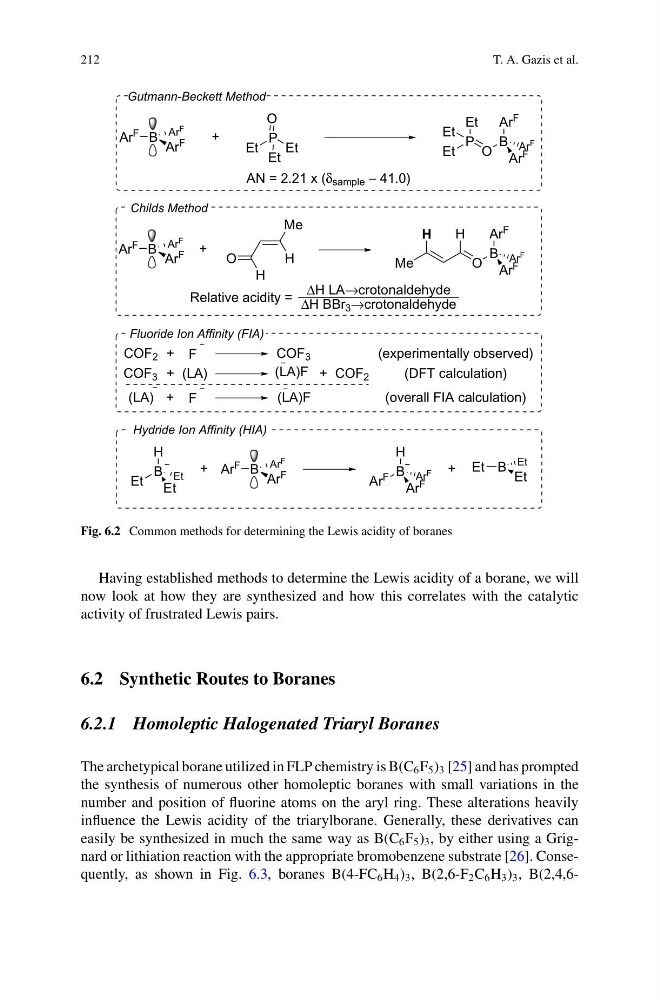
Fig. 6.2 Common methods for determining the Lewis acidity of boranes
Having established methods to determine the Lewis acidity of a borane, we will
now look at how they are synthesized and how this correlates with the catalytic
activity of frustrated Lewis pairs.
6.2 Synthetic Routes to Boranes
6.2.1 Homoleptic Halogenated Triaryl Boranes
The archetypical borane utilized in FLP chemistry is B(C 6 F 5 ) 3 [25] and has prompted
the synthesis of numerous other homoleptic boranes with small variations in the
number and position of fluorine atoms on the aryl ring. These alterations heavily
influence the Lewis acidity of the triarylborane. Generally, these derivatives can
easily be synthesized in much the same way as B(C 6 F 5 ) 3 , by either using a Grignard or lithiation reaction with the appropriate bromobenzene substrate [26]. Consequently, as shown in Fig. 6.3, boranes B(4-FC 6 H 4 ) 3 , B(2,6-F 2 C 6 H 3 ) 3 , B(2,4,6-
T. A. Gazis et al.
Ar F B
Ar
F
Ar F
Ar
F
B
O Ar
F
Ar F
P
Et
Et
Et
O
P
Et Et
Et
+
Ar
F B Ar
F
Ar F
Ar
F
B
O Ar
F
Ar
F
+
O
H
Me
H
H
Me
H
AN = 2.21 x (δ sample − 41.0)
Relative acidity =
ΔH LA→crotonaldehyde
ΔH BBr 3 →crotonaldehyde
Gutmann-Beckett Method
Childs Method
COF 2 + F
COF 3
(experimentally observed)
COF 3
(LA)
+
(LA)F + COF 2
(DFT calculation)
(LA) + F
(LA)F
(overall FIA calculation)
Fluoride Ion Affinity (FIA)
+
Hydride Ion Affinity (HIA)
H
B
Et Et
Et
Ar
F B Ar F
Ar F
H
B
Ar
F
Ar
F
Ar F
Et B Et
Et
+
Fig. 6.2 Common methods for determining the Lewis acidity of boranes
Having established methods to determine the Lewis acidity of a borane, we will
now look at how they are synthesized and how this correlates with the catalytic
activity of frustrated Lewis pairs.
6.2 Synthetic Routes to Boranes
6.2.1 Homoleptic Halogenated Triaryl Boranes
The archetypical borane utilized in FLP chemistry is B(C 6 F 5 ) 3 [25] and has prompted
the synthesis of numerous other homoleptic boranes with small variations in the
number and position of fluorine atoms on the aryl ring. These alterations heavily
influence the Lewis acidity of the triarylborane. Generally, these derivatives can
easily be synthesized in much the same way as B(C 6 F 5 ) 3 , by either using a Grignard or lithiation reaction with the appropriate bromobenzene substrate [26]. Consequently, as shown in Fig. 6.3, boranes B(4-FC 6 H 4 ) 3 , B(2,6-F 2 C 6 H 3 ) 3 , B(2,4,6-