

1 Frustrated Lewis Pair Catalysis: An Introduction
13
1.3.2 Transfer Hydrogenation
The ability of strong Lewis acids to abstract hydride from carbons α to the N of
amines has been known for some time. This was exploited to develop a strategy
for a B(C 6 F 5 ) 3 -mediated catalytic transfer hydrogenation of imines, enamines,
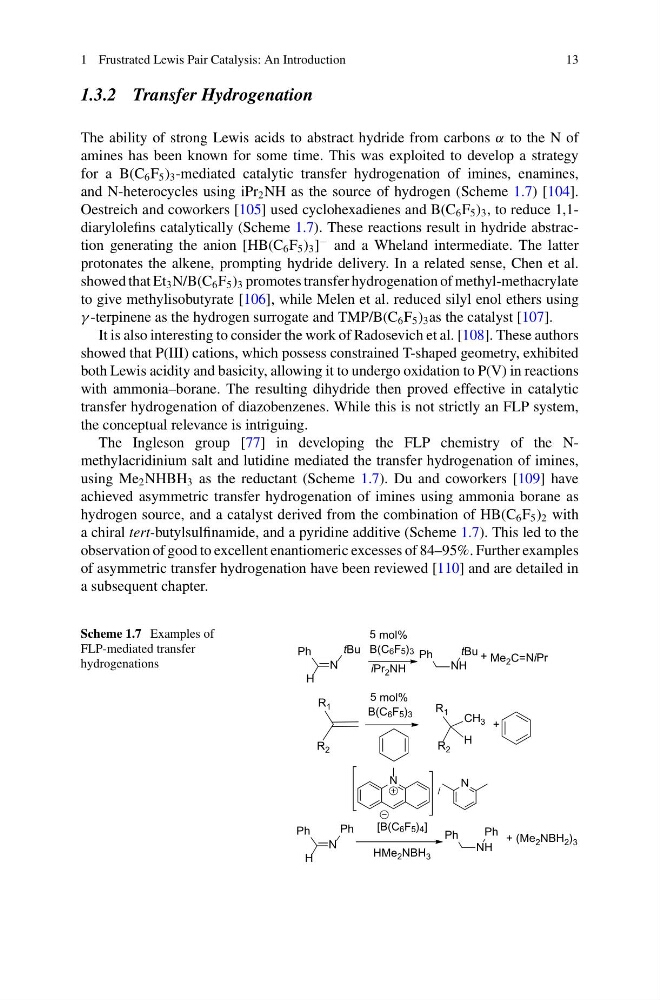
and N-heterocycles using iPr 2 NH as the source of hydrogen (Scheme 1.7) [104].
Oestreich and coworkers [105] used cyclohexadienes and B(C 6 F 5 ) 3 , to reduce 1,1diarylolefins catalytically (Scheme 1.7). These reactions result in hydride abstraction generating the anion [HB(C 6 F 5 ) 3 ]
− and a Wheland intermediate. The latter
protonates the alkene, prompting hydride delivery. In a related sense, Chen et al.
showed that Et 3 N/B(C 6 F 5 ) 3 promotes transfer hydrogenation of methyl-methacrylate
to give methylisobutyrate [106], while Melen et al. reduced silyl enol ethers using
γ -terpinene as the hydrogen surrogate and TMP/B(C 6 F 5 ) 3 as the catalyst [107].
It is also interesting to consider the work of Radosevich et al. [108]. These authors
showed that P(III) cations, which possess constrained T-shaped geometry, exhibited
both Lewis acidity and basicity, allowing it to undergo oxidation to P(V) in reactions
with ammonia–borane. The resulting dihydride then proved effective in catalytic
transfer hydrogenation of diazobenzenes. While this is not strictly an FLP system,
the conceptual relevance is intriguing.
The Ingleson group [77] in developing the FLP chemistry of the Nmethylacridinium salt and lutidine mediated the transfer hydrogenation of imines,
using Me 2 NHBH 3 as the reductant (Scheme 1.7). Du and coworkers [109] have
achieved asymmetric transfer hydrogenation of imines using ammonia borane as
hydrogen source, and a catalyst derived from the combination of HB(C 6 F 5 ) 2 with
a chiral tert-butylsulfinamide, and a pyridine additive (Scheme 1.7). This led to the
observation of good to excellent enantiomeric excesses of 84–95%. Further examples
of asymmetric transfer hydrogenation have been reviewed [110] and are detailed in
a subsequent chapter.
Scheme 1.7 Examples of
FLP-mediated transfer
hydrogenations
iPr 2 NH
B(C6F5)3
5 mol%
Ph
H
N
tBu
Ph
NH
tBu + Me 2 C=NiPr
R 1
R 2
R 1
R 2
CH 3
H
B(C 6 F 5 ) 3
5 mol%
+
HMe 2 NBH 3
Ph
H
N
Ph
Ph
NH
Ph + (Me 2 NBH 2 ) 3
N
[B(C 6 F 5 ) 4 ]
N
/
13
1.3.2 Transfer Hydrogenation
The ability of strong Lewis acids to abstract hydride from carbons α to the N of
amines has been known for some time. This was exploited to develop a strategy
for a B(C 6 F 5 ) 3 -mediated catalytic transfer hydrogenation of imines, enamines,
and N-heterocycles using iPr 2 NH as the source of hydrogen (Scheme 1.7) [104].
Oestreich and coworkers [105] used cyclohexadienes and B(C 6 F 5 ) 3 , to reduce 1,1diarylolefins catalytically (Scheme 1.7). These reactions result in hydride abstraction generating the anion [HB(C 6 F 5 ) 3 ]
− and a Wheland intermediate. The latter
protonates the alkene, prompting hydride delivery. In a related sense, Chen et al.
showed that Et 3 N/B(C 6 F 5 ) 3 promotes transfer hydrogenation of methyl-methacrylate
to give methylisobutyrate [106], while Melen et al. reduced silyl enol ethers using
γ -terpinene as the hydrogen surrogate and TMP/B(C 6 F 5 ) 3 as the catalyst [107].
It is also interesting to consider the work of Radosevich et al. [108]. These authors
showed that P(III) cations, which possess constrained T-shaped geometry, exhibited
both Lewis acidity and basicity, allowing it to undergo oxidation to P(V) in reactions
with ammonia–borane. The resulting dihydride then proved effective in catalytic
transfer hydrogenation of diazobenzenes. While this is not strictly an FLP system,
the conceptual relevance is intriguing.
The Ingleson group [77] in developing the FLP chemistry of the Nmethylacridinium salt and lutidine mediated the transfer hydrogenation of imines,
using Me 2 NHBH 3 as the reductant (Scheme 1.7). Du and coworkers [109] have
achieved asymmetric transfer hydrogenation of imines using ammonia borane as
hydrogen source, and a catalyst derived from the combination of HB(C 6 F 5 ) 2 with
a chiral tert-butylsulfinamide, and a pyridine additive (Scheme 1.7). This led to the
observation of good to excellent enantiomeric excesses of 84–95%. Further examples
of asymmetric transfer hydrogenation have been reviewed [110] and are detailed in
a subsequent chapter.
Scheme 1.7 Examples of
FLP-mediated transfer
hydrogenations
iPr 2 NH
B(C6F5)3
5 mol%
Ph
H
N
tBu
Ph
NH
tBu + Me 2 C=NiPr
R 1
R 2
R 1
R 2
CH 3
H
B(C 6 F 5 ) 3
5 mol%
+
HMe 2 NBH 3
Ph
H
N
Ph
Ph
NH
Ph + (Me 2 NBH 2 ) 3
N
[B(C 6 F 5 ) 4 ]
N
/