

12
D. W. Stephan
1.3.1 Hydrosilylation
The first description of hydrosilylation of ketones and aldehydes mediated by
B(C 6 F 5 ) 3 was reported by Parks and Piers in 1996 [94]. While one might have
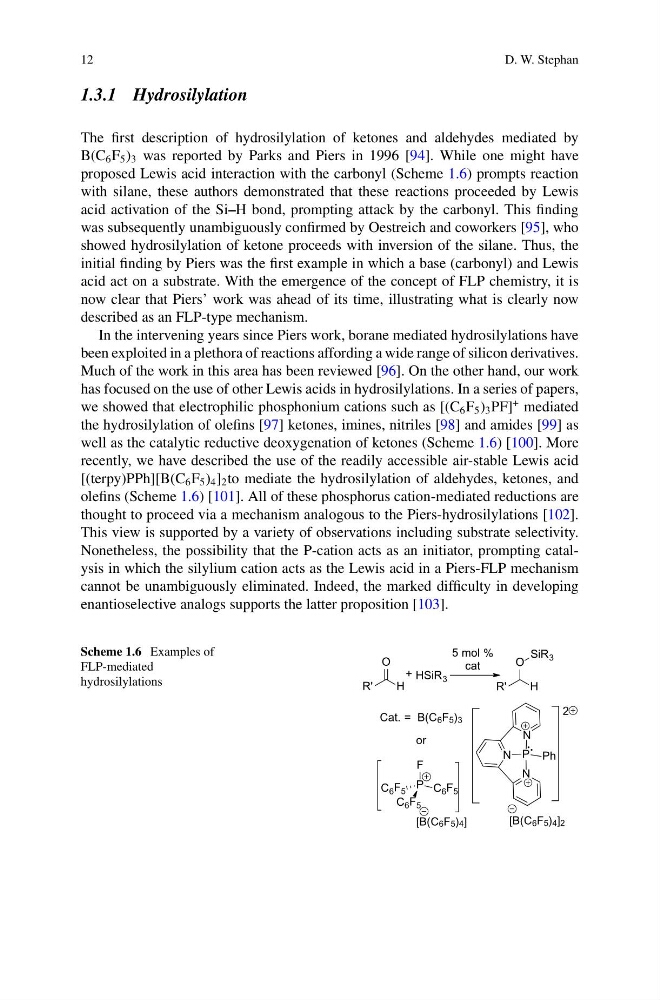
proposed Lewis acid interaction with the carbonyl (Scheme 1.6) prompts reaction
with silane, these authors demonstrated that these reactions proceeded by Lewis
acid activation of the Si–H bond, prompting attack by the carbonyl. This finding
was subsequently unambiguously confirmed by Oestreich and coworkers [95], who
showed hydrosilylation of ketone proceeds with inversion of the silane. Thus, the
initial finding by Piers was the first example in which a base (carbonyl) and Lewis
acid act on a substrate. With the emergence of the concept of FLP chemistry, it is
now clear that Piers’ work was ahead of its time, illustrating what is clearly now
described as an FLP-type mechanism.
In the intervening years since Piers work, borane mediated hydrosilylations have
been exploited in a plethora of reactions affording a wide range of silicon derivatives.
Much of the work in this area has been reviewed [96]. On the other hand, our work
has focused on the use of other Lewis acids in hydrosilylations. In a series of papers,
we showed that electrophilic phosphonium cations such as [(C 6 F 5 ) 3 PF]
+ mediated
the hydrosilylation of olefins [97] ketones, imines, nitriles [98] and amides [99] as
well as the catalytic reductive deoxygenation of ketones (Scheme 1.6) [100]. More
recently, we have described the use of the readily accessible air-stable Lewis acid
[(terpy)PPh][B(C 6 F 5 ) 4 ] 2 to mediate the hydrosilylation of aldehydes, ketones, and
olefins (Scheme 1.6) [101]. All of these phosphorus cation-mediated reductions are
thought to proceed via a mechanism analogous to the Piers-hydrosilylations [102].
This view is supported by a variety of observations including substrate selectivity.
Nonetheless, the possibility that the P-cation acts as an initiator, prompting catalysis in which the silylium cation acts as the Lewis acid in a Piers-FLP mechanism
cannot be unambiguously eliminated. Indeed, the marked difficulty in developing
enantioselective analogs supports the latter proposition [103].
Scheme 1.6 Examples of
FLP-mediated
hydrosilylations
R'
H
O
R'
H
O
SiR 3
5 mol %
cat
+ HSiR 3
Cat. = B(C 6 F 5 ) 3
or
P
C 6 F 5
C 6 F 5
C 6 F 5
F
[B(C6F5)4]
P
N
Ph
N
N
[B(C 6 F 5 ) 4 ] 2
2
D. W. Stephan
1.3.1 Hydrosilylation
The first description of hydrosilylation of ketones and aldehydes mediated by
B(C 6 F 5 ) 3 was reported by Parks and Piers in 1996 [94]. While one might have
proposed Lewis acid interaction with the carbonyl (Scheme 1.6) prompts reaction
with silane, these authors demonstrated that these reactions proceeded by Lewis
acid activation of the Si–H bond, prompting attack by the carbonyl. This finding
was subsequently unambiguously confirmed by Oestreich and coworkers [95], who
showed hydrosilylation of ketone proceeds with inversion of the silane. Thus, the
initial finding by Piers was the first example in which a base (carbonyl) and Lewis
acid act on a substrate. With the emergence of the concept of FLP chemistry, it is
now clear that Piers’ work was ahead of its time, illustrating what is clearly now
described as an FLP-type mechanism.
In the intervening years since Piers work, borane mediated hydrosilylations have
been exploited in a plethora of reactions affording a wide range of silicon derivatives.
Much of the work in this area has been reviewed [96]. On the other hand, our work
has focused on the use of other Lewis acids in hydrosilylations. In a series of papers,
we showed that electrophilic phosphonium cations such as [(C 6 F 5 ) 3 PF]
+ mediated
the hydrosilylation of olefins [97] ketones, imines, nitriles [98] and amides [99] as
well as the catalytic reductive deoxygenation of ketones (Scheme 1.6) [100]. More
recently, we have described the use of the readily accessible air-stable Lewis acid
[(terpy)PPh][B(C 6 F 5 ) 4 ] 2 to mediate the hydrosilylation of aldehydes, ketones, and
olefins (Scheme 1.6) [101]. All of these phosphorus cation-mediated reductions are
thought to proceed via a mechanism analogous to the Piers-hydrosilylations [102].
This view is supported by a variety of observations including substrate selectivity.
Nonetheless, the possibility that the P-cation acts as an initiator, prompting catalysis in which the silylium cation acts as the Lewis acid in a Piers-FLP mechanism
cannot be unambiguously eliminated. Indeed, the marked difficulty in developing
enantioselective analogs supports the latter proposition [103].
Scheme 1.6 Examples of
FLP-mediated
hydrosilylations
R'
H
O
R'
H
O
SiR 3
5 mol %
cat
+ HSiR 3
Cat. = B(C 6 F 5 ) 3
or
P
C 6 F 5
C 6 F 5
C 6 F 5
F
[B(C6F5)4]
P
N
Ph
N
N
[B(C 6 F 5 ) 4 ] 2
2