

14
D. W. Stephan
1.3.3 Hydroboration
In 2008, we showed that an FLP reacts stoichiometrically with HBcat [111], however,
it was not until a 2015 study that this finding was extended to catalysis. Fan
et al.showed the bulky borane ((CF) 3 C 6 H 2 ) 2 BMe yields an FLP with pyridine.
However, it is interesting that this borane could also be used as a catalyst to mediate
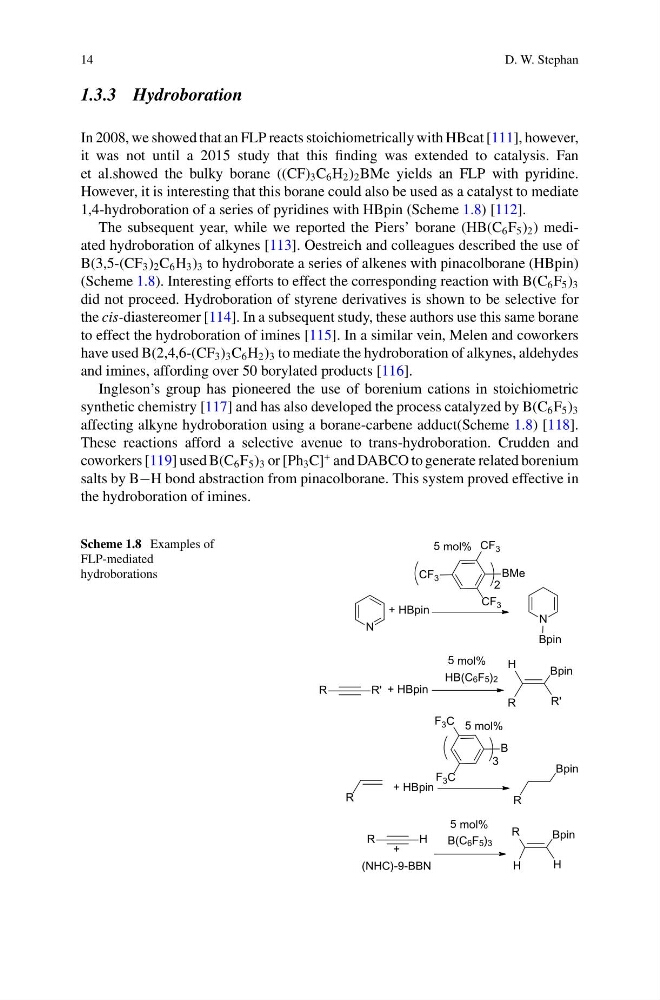
1,4-hydroboration of a series of pyridines with HBpin (Scheme 1.8) [112].
The subsequent year, while we reported the Piers’ borane (HB(C 6 F 5 ) 2 ) mediated hydroboration of alkynes [113]. Oestreich and colleagues described the use of
B(3,5-(CF 3 ) 2 C 6 H 3 ) 3 to hydroborate a series of alkenes with pinacolborane (HBpin)
(Scheme 1.8). Interesting efforts to effect the corresponding reaction with B(C 6 F 5 ) 3
did not proceed. Hydroboration of styrene derivatives is shown to be selective for
the cis-diastereomer [114]. In a subsequent study, these authors use this same borane
to effect the hydroboration of imines [115]. In a similar vein, Melen and coworkers
have used B(2,4,6-(CF 3 ) 3 C 6 H 2 ) 3 to mediate the hydroboration of alkynes, aldehydes
and imines, affording over 50 borylated products [116].
Ingleson’s group has pioneered the use of borenium cations in stoichiometric
synthetic chemistry [117] and has also developed the process catalyzed by B(C 6 F 5 ) 3
affecting alkyne hydroboration using a borane-carbene adduct(Scheme 1.8) [118].
These reactions afford a selective avenue to trans-hydroboration. Crudden and
coworkers [119] used B(C 6 F 5 ) 3 or [Ph 3 C]
+ and DABCO to generate related borenium
salts by B−H bond abstraction from pinacolborane. This system proved effective in
the hydroboration of imines.
Scheme 1.8 Examples of
FLP-mediated
hydroborations
N
+ HBpin
BMe
CF 3
CF 3
CF 3
N
Bpin
2
B
3
F 3 C
F 3 C
R
+ HBpin
R
Bpin
R
+ HBpin
R
Bpin
R'
R'
H
HB(C6F5)2
5 mol%
5 mol%
5 mol%
R
+
(NHC)-9-BBN
R
Bpin
H
H
H
B(C 6 F 5 ) 3
5 mol%
D. W. Stephan
1.3.3 Hydroboration
In 2008, we showed that an FLP reacts stoichiometrically with HBcat [111], however,
it was not until a 2015 study that this finding was extended to catalysis. Fan
et al.showed the bulky borane ((CF) 3 C 6 H 2 ) 2 BMe yields an FLP with pyridine.
However, it is interesting that this borane could also be used as a catalyst to mediate
1,4-hydroboration of a series of pyridines with HBpin (Scheme 1.8) [112].
The subsequent year, while we reported the Piers’ borane (HB(C 6 F 5 ) 2 ) mediated hydroboration of alkynes [113]. Oestreich and colleagues described the use of
B(3,5-(CF 3 ) 2 C 6 H 3 ) 3 to hydroborate a series of alkenes with pinacolborane (HBpin)
(Scheme 1.8). Interesting efforts to effect the corresponding reaction with B(C 6 F 5 ) 3
did not proceed. Hydroboration of styrene derivatives is shown to be selective for
the cis-diastereomer [114]. In a subsequent study, these authors use this same borane
to effect the hydroboration of imines [115]. In a similar vein, Melen and coworkers
have used B(2,4,6-(CF 3 ) 3 C 6 H 2 ) 3 to mediate the hydroboration of alkynes, aldehydes
and imines, affording over 50 borylated products [116].
Ingleson’s group has pioneered the use of borenium cations in stoichiometric
synthetic chemistry [117] and has also developed the process catalyzed by B(C 6 F 5 ) 3
affecting alkyne hydroboration using a borane-carbene adduct(Scheme 1.8) [118].
These reactions afford a selective avenue to trans-hydroboration. Crudden and
coworkers [119] used B(C 6 F 5 ) 3 or [Ph 3 C]
+ and DABCO to generate related borenium
salts by B−H bond abstraction from pinacolborane. This system proved effective in
the hydroboration of imines.
Scheme 1.8 Examples of
FLP-mediated
hydroborations
N
+ HBpin
BMe
CF 3
CF 3
CF 3
N
Bpin
2
B
3
F 3 C
F 3 C
R
+ HBpin
R
Bpin
R
+ HBpin
R
Bpin
R'
R'
H
HB(C6F5)2
5 mol%
5 mol%
5 mol%
R
+
(NHC)-9-BBN
R
Bpin
H
H
H
B(C 6 F 5 ) 3
5 mol%