

200
M. Heshmat et al.
Trans conformation of HNBH
Cis conformation of HNBH
LA
LB
LA
LB
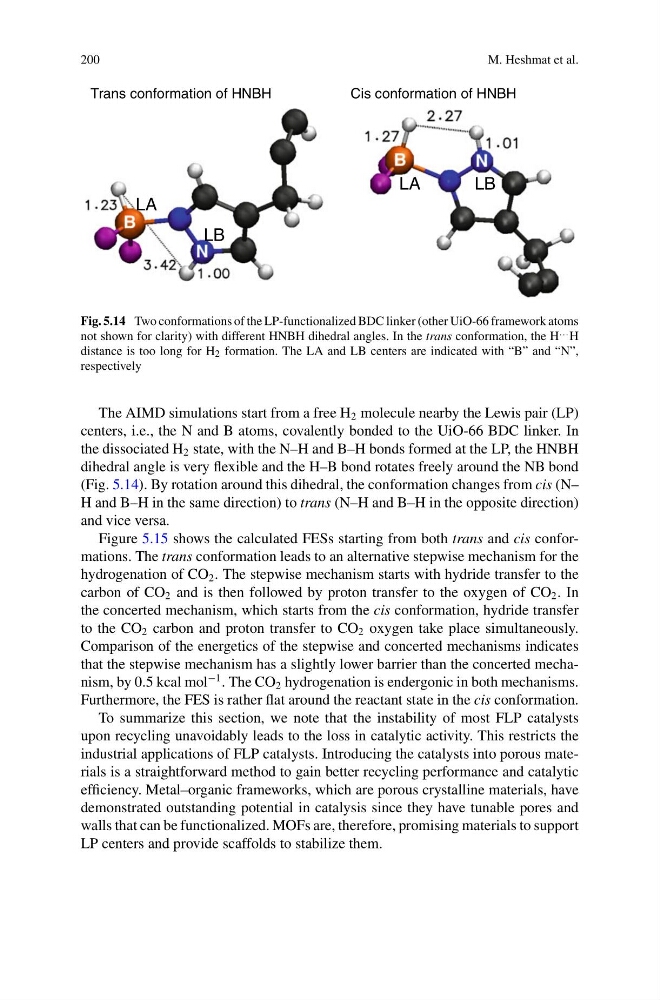
Fig. 5.14 Two conformations of the LP-functionalized BDC linker (other UiO-66 framework atoms
not shown for clarity) with different HNBH dihedral angles. In the trans conformation, the H … H
distance is too long for H 2 formation. The LA and LB centers are indicated with “B” and “N”,
respectively
The AIMD simulations start from a free H 2 molecule nearby the Lewis pair (LP)
centers, i.e., the N and B atoms, covalently bonded to the UiO-66 BDC linker. In
the dissociated H 2 state, with the N–H and B–H bonds formed at the LP, the HNBH
dihedral angle is very flexible and the H–B bond rotates freely around the NB bond
(Fig. 5.14). By rotation around this dihedral, the conformation changes from cis (N–
H and B–H in the same direction) to trans (N–H and B–H in the opposite direction)
and vice versa.
Figure 5.15 shows the calculated FESs starting from both trans and cis conformations. The trans conformation leads to an alternative stepwise mechanism for the
hydrogenation of CO 2 . The stepwise mechanism starts with hydride transfer to the
carbon of CO 2 and is then followed by proton transfer to the oxygen of CO 2 . In
the concerted mechanism, which starts from the cis conformation, hydride transfer
to the CO 2 carbon and proton transfer to CO 2 oxygen take place simultaneously.
Comparison of the energetics of the stepwise and concerted mechanisms indicates
that the stepwise mechanism has a slightly lower barrier than the concerted mechanism, by 0.5 kcal mol
−1 . The CO 2 hydrogenation is endergonic in both mechanisms.
Furthermore, the FES is rather flat around the reactant state in the cis conformation.
To summarize this section, we note that the instability of most FLP catalysts
upon recycling unavoidably leads to the loss in catalytic activity. This restricts the
industrial applications of FLP catalysts. Introducing the catalysts into porous materials is a straightforward method to gain better recycling performance and catalytic
efficiency. Metal–organic frameworks, which are porous crystalline materials, have
demonstrated outstanding potential in catalysis since they have tunable pores and
walls that can be functionalized. MOFs are, therefore, promising materials to support
LP centers and provide scaffolds to stabilize them.
M. Heshmat et al.
Trans conformation of HNBH
Cis conformation of HNBH
LA
LB
LA
LB
Fig. 5.14 Two conformations of the LP-functionalized BDC linker (other UiO-66 framework atoms
not shown for clarity) with different HNBH dihedral angles. In the trans conformation, the H … H
distance is too long for H 2 formation. The LA and LB centers are indicated with “B” and “N”,
respectively
The AIMD simulations start from a free H 2 molecule nearby the Lewis pair (LP)
centers, i.e., the N and B atoms, covalently bonded to the UiO-66 BDC linker. In
the dissociated H 2 state, with the N–H and B–H bonds formed at the LP, the HNBH
dihedral angle is very flexible and the H–B bond rotates freely around the NB bond
(Fig. 5.14). By rotation around this dihedral, the conformation changes from cis (N–
H and B–H in the same direction) to trans (N–H and B–H in the opposite direction)
and vice versa.
Figure 5.15 shows the calculated FESs starting from both trans and cis conformations. The trans conformation leads to an alternative stepwise mechanism for the
hydrogenation of CO 2 . The stepwise mechanism starts with hydride transfer to the
carbon of CO 2 and is then followed by proton transfer to the oxygen of CO 2 . In
the concerted mechanism, which starts from the cis conformation, hydride transfer
to the CO 2 carbon and proton transfer to CO 2 oxygen take place simultaneously.
Comparison of the energetics of the stepwise and concerted mechanisms indicates
that the stepwise mechanism has a slightly lower barrier than the concerted mechanism, by 0.5 kcal mol
−1 . The CO 2 hydrogenation is endergonic in both mechanisms.
Furthermore, the FES is rather flat around the reactant state in the cis conformation.
To summarize this section, we note that the instability of most FLP catalysts
upon recycling unavoidably leads to the loss in catalytic activity. This restricts the
industrial applications of FLP catalysts. Introducing the catalysts into porous materials is a straightforward method to gain better recycling performance and catalytic
efficiency. Metal–organic frameworks, which are porous crystalline materials, have
demonstrated outstanding potential in catalysis since they have tunable pores and
walls that can be functionalized. MOFs are, therefore, promising materials to support
LP centers and provide scaffolds to stabilize them.