

5 Mechanistic Insight into the Hydrogen Activation by Frustrated Lewis Pairs
201
C
B
A
-48.0
-33.1
-54.0
H C(CO2) Å
H B Å
-49.5
-44.0
-38.5
-33.0
-27.5
-22.0
-16.5
-11.0
-5.5
-55.0
0.0
a
b
c
D
E
F
-50.4
-29.0
-43.5
H C(CO2) Å
H
O(CO2) Å
-50.0
-45.0
-40.0
-35.0
-30.0
-25.0
-20.0
-15.0
-10.0
-5.0
0.0
d
e
f
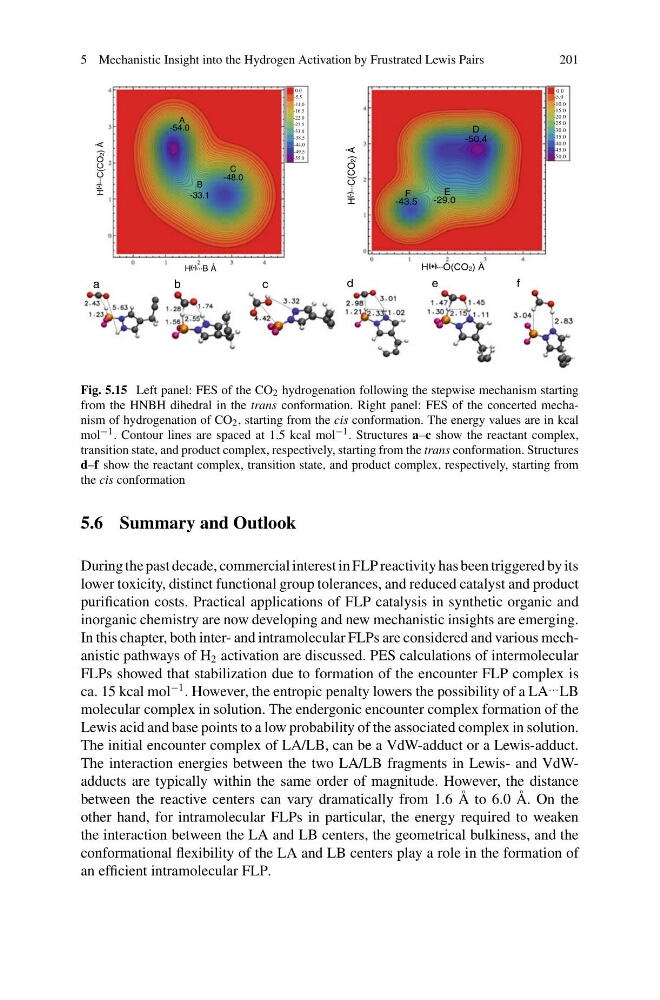
Fig. 5.15 Left panel: FES of the CO 2 hydrogenation following the stepwise mechanism starting
from the HNBH dihedral in the trans conformation. Right panel: FES of the concerted mechanism of hydrogenation of CO 2 , starting from the cis conformation. The energy values are in kcal
mol −1 . Contour lines are spaced at 1.5 kcal mol −1 . Structures a–c show the reactant complex,
transition state, and product complex, respectively, starting from the trans conformation. Structures
d–f show the reactant complex, transition state, and product complex, respectively, starting from
the cis conformation
5.6 Summary and Outlook
During the past decade, commercial interest in FLP reactivity has been triggered by its
lower toxicity, distinct functional group tolerances, and reduced catalyst and product
purification costs. Practical applications of FLP catalysis in synthetic organic and
inorganic chemistry are now developing and new mechanistic insights are emerging.
In this chapter, both inter- and intramolecular FLPs are considered and various mechanistic pathways of H 2 activation are discussed. PES calculations of intermolecular
FLPs showed that stabilization due to formation of the encounter FLP complex is
ca. 15 kcal mol
−1 . However, the entropic penalty lowers the possibility of a LA
… LB
molecular complex in solution. The endergonic encounter complex formation of the
Lewis acid and base points to a low probability of the associated complex in solution.
The initial encounter complex of LA/LB, can be a VdW-adduct or a Lewis-adduct.
The interaction energies between the two LA/LB fragments in Lewis- and VdWadducts are typically within the same order of magnitude. However, the distance
between the reactive centers can vary dramatically from 1.6 Å to 6.0 Å. On the
other hand, for intramolecular FLPs in particular, the energy required to weaken
the interaction between the LA and LB centers, the geometrical bulkiness, and the
conformational flexibility of the LA and LB centers play a role in the formation of
an efficient intramolecular FLP.
201
C
B
A
-48.0
-33.1
-54.0
H C(CO2) Å
H B Å
-49.5
-44.0
-38.5
-33.0
-27.5
-22.0
-16.5
-11.0
-5.5
-55.0
0.0
a
b
c
D
E
F
-50.4
-29.0
-43.5
H C(CO2) Å
H
O(CO2) Å
-50.0
-45.0
-40.0
-35.0
-30.0
-25.0
-20.0
-15.0
-10.0
-5.0
0.0
d
e
f
Fig. 5.15 Left panel: FES of the CO 2 hydrogenation following the stepwise mechanism starting
from the HNBH dihedral in the trans conformation. Right panel: FES of the concerted mechanism of hydrogenation of CO 2 , starting from the cis conformation. The energy values are in kcal
mol −1 . Contour lines are spaced at 1.5 kcal mol −1 . Structures a–c show the reactant complex,
transition state, and product complex, respectively, starting from the trans conformation. Structures
d–f show the reactant complex, transition state, and product complex, respectively, starting from
the cis conformation
5.6 Summary and Outlook
During the past decade, commercial interest in FLP reactivity has been triggered by its
lower toxicity, distinct functional group tolerances, and reduced catalyst and product
purification costs. Practical applications of FLP catalysis in synthetic organic and
inorganic chemistry are now developing and new mechanistic insights are emerging.
In this chapter, both inter- and intramolecular FLPs are considered and various mechanistic pathways of H 2 activation are discussed. PES calculations of intermolecular
FLPs showed that stabilization due to formation of the encounter FLP complex is
ca. 15 kcal mol
−1 . However, the entropic penalty lowers the possibility of a LA
… LB
molecular complex in solution. The endergonic encounter complex formation of the
Lewis acid and base points to a low probability of the associated complex in solution.
The initial encounter complex of LA/LB, can be a VdW-adduct or a Lewis-adduct.
The interaction energies between the two LA/LB fragments in Lewis- and VdWadducts are typically within the same order of magnitude. However, the distance
between the reactive centers can vary dramatically from 1.6 Å to 6.0 Å. On the
other hand, for intramolecular FLPs in particular, the energy required to weaken
the interaction between the LA and LB centers, the geometrical bulkiness, and the
conformational flexibility of the LA and LB centers play a role in the formation of
an efficient intramolecular FLP.