

5 Mechanistic Insight into the Hydrogen Activation by Frustrated Lewis Pairs
199
5.5.2 AIMD Simulations on LP-Functionalized MOFs
Unraveling the reaction path was the aim of a recent metadynamics/AIMD study, in
which Heshmat and coworkers studied the reaction of CO 2 + H 2 → HCOOH, inside
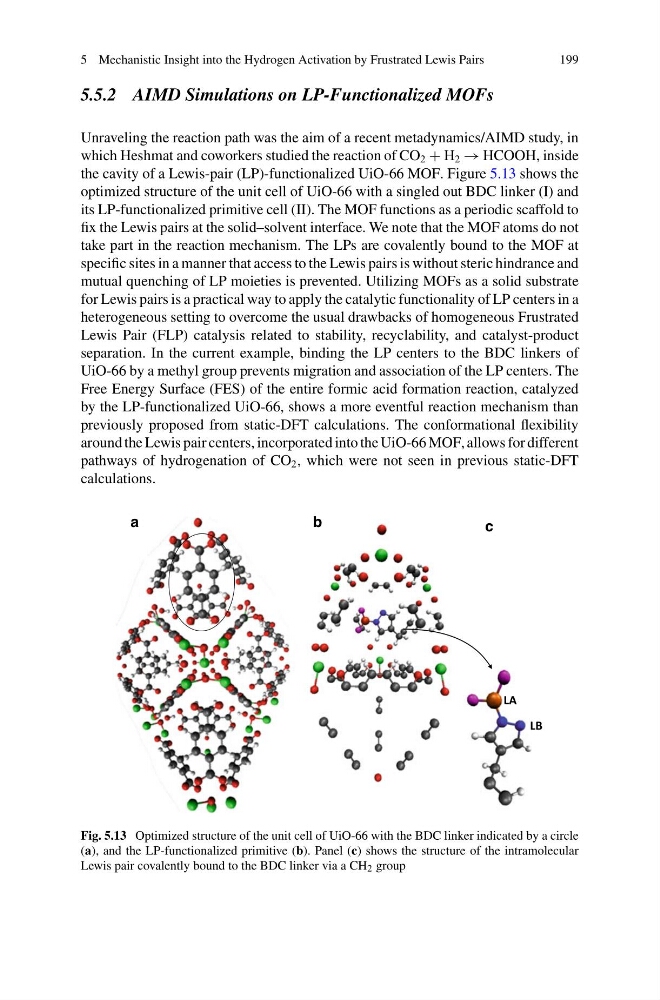
the cavity of a Lewis-pair (LP)-functionalized UiO-66 MOF. Figure 5.13 shows the
optimized structure of the unit cell of UiO-66 with a singled out BDC linker (I) and
its LP-functionalized primitive cell (II). The MOF functions as a periodic scaffold to
fix the Lewis pairs at the solid–solvent interface. We note that the MOF atoms do not
take part in the reaction mechanism. The LPs are covalently bound to the MOF at
specific sites in a manner that access to the Lewis pairs is without steric hindrance and
mutual quenching of LP moieties is prevented. Utilizing MOFs as a solid substrate
for Lewis pairs is a practical way to apply the catalytic functionality of LP centers in a
heterogeneous setting to overcome the usual drawbacks of homogeneous Frustrated
Lewis Pair (FLP) catalysis related to stability, recyclability, and catalyst-product
separation. In the current example, binding the LP centers to the BDC linkers of
UiO-66 by a methyl group prevents migration and association of the LP centers. The
Free Energy Surface (FES) of the entire formic acid formation reaction, catalyzed
by the LP-functionalized UiO-66, shows a more eventful reaction mechanism than
previously proposed from static-DFT calculations. The conformational flexibility
around the Lewis pair centers, incorporated into the UiO-66 MOF, allows for different
pathways of hydrogenation of CO 2 , which were not seen in previous static-DFT
calculations.
a
b
c
Fig. 5.13 Optimized structure of the unit cell of UiO-66 with the BDC linker indicated by a circle
(a), and the LP-functionalized primitive (b). Panel (c) shows the structure of the intramolecular
Lewis pair covalently bound to the BDC linker via a CH 2 group
199
5.5.2 AIMD Simulations on LP-Functionalized MOFs
Unraveling the reaction path was the aim of a recent metadynamics/AIMD study, in
which Heshmat and coworkers studied the reaction of CO 2 + H 2 → HCOOH, inside
the cavity of a Lewis-pair (LP)-functionalized UiO-66 MOF. Figure 5.13 shows the
optimized structure of the unit cell of UiO-66 with a singled out BDC linker (I) and
its LP-functionalized primitive cell (II). The MOF functions as a periodic scaffold to
fix the Lewis pairs at the solid–solvent interface. We note that the MOF atoms do not
take part in the reaction mechanism. The LPs are covalently bound to the MOF at
specific sites in a manner that access to the Lewis pairs is without steric hindrance and
mutual quenching of LP moieties is prevented. Utilizing MOFs as a solid substrate
for Lewis pairs is a practical way to apply the catalytic functionality of LP centers in a
heterogeneous setting to overcome the usual drawbacks of homogeneous Frustrated
Lewis Pair (FLP) catalysis related to stability, recyclability, and catalyst-product
separation. In the current example, binding the LP centers to the BDC linkers of
UiO-66 by a methyl group prevents migration and association of the LP centers. The
Free Energy Surface (FES) of the entire formic acid formation reaction, catalyzed
by the LP-functionalized UiO-66, shows a more eventful reaction mechanism than
previously proposed from static-DFT calculations. The conformational flexibility
around the Lewis pair centers, incorporated into the UiO-66 MOF, allows for different
pathways of hydrogenation of CO 2 , which were not seen in previous static-DFT
calculations.
a
b
c
Fig. 5.13 Optimized structure of the unit cell of UiO-66 with the BDC linker indicated by a circle
(a), and the LP-functionalized primitive (b). Panel (c) shows the structure of the intramolecular
Lewis pair covalently bound to the BDC linker via a CH 2 group