

5 Mechanistic Insight into the Hydrogen Activation by Frustrated Lewis Pairs
197
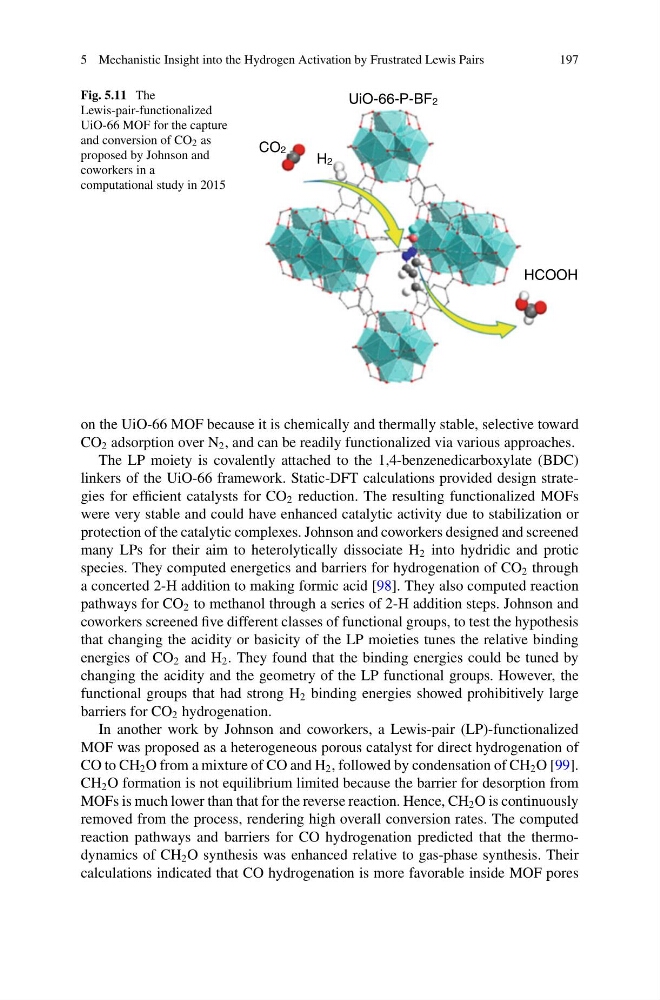
Fig. 5.11 The
Lewis-pair-functionalized
UiO-66 MOF for the capture
and conversion of CO 2 as
proposed by Johnson and
coworkers in a
computational study in 2015
HCOOH
CO2
H2
UiO-66-P-BF2
on the UiO-66 MOF because it is chemically and thermally stable, selective toward
CO 2 adsorption over N 2 , and can be readily functionalized via various approaches.
The LP moiety is covalently attached to the 1,4-benzenedicarboxylate (BDC)
linkers of the UiO-66 framework. Static-DFT calculations provided design strategies for efficient catalysts for CO 2 reduction. The resulting functionalized MOFs
were very stable and could have enhanced catalytic activity due to stabilization or
protection of the catalytic complexes. Johnson and coworkers designed and screened
many LPs for their aim to heterolytically dissociate H 2 into hydridic and protic
species. They computed energetics and barriers for hydrogenation of CO 2 through
a concerted 2-H addition to making formic acid [98]. They also computed reaction
pathways for CO 2 to methanol through a series of 2-H addition steps. Johnson and
coworkers screened five different classes of functional groups, to test the hypothesis
that changing the acidity or basicity of the LP moieties tunes the relative binding
energies of CO 2 and H 2 . They found that the binding energies could be tuned by
changing the acidity and the geometry of the LP functional groups. However, the
functional groups that had strong H 2 binding energies showed prohibitively large
barriers for CO 2 hydrogenation.
In another work by Johnson and coworkers, a Lewis-pair (LP)-functionalized
MOF was proposed as a heterogeneous porous catalyst for direct hydrogenation of
CO to CH 2 O from a mixture of CO and H 2 , followed by condensation of CH 2 O [99].
CH 2 O formation is not equilibrium limited because the barrier for desorption from
MOFs is much lower than that for the reverse reaction. Hence, CH 2 O is continuously
removed from the process, rendering high overall conversion rates. The computed
reaction pathways and barriers for CO hydrogenation predicted that the thermodynamics of CH 2 O synthesis was enhanced relative to gas-phase synthesis. Their
calculations indicated that CO hydrogenation is more favorable inside MOF pores
197
Fig. 5.11 The
Lewis-pair-functionalized
UiO-66 MOF for the capture
and conversion of CO 2 as
proposed by Johnson and
coworkers in a
computational study in 2015
HCOOH
CO2
H2
UiO-66-P-BF2
on the UiO-66 MOF because it is chemically and thermally stable, selective toward
CO 2 adsorption over N 2 , and can be readily functionalized via various approaches.
The LP moiety is covalently attached to the 1,4-benzenedicarboxylate (BDC)
linkers of the UiO-66 framework. Static-DFT calculations provided design strategies for efficient catalysts for CO 2 reduction. The resulting functionalized MOFs
were very stable and could have enhanced catalytic activity due to stabilization or
protection of the catalytic complexes. Johnson and coworkers designed and screened
many LPs for their aim to heterolytically dissociate H 2 into hydridic and protic
species. They computed energetics and barriers for hydrogenation of CO 2 through
a concerted 2-H addition to making formic acid [98]. They also computed reaction
pathways for CO 2 to methanol through a series of 2-H addition steps. Johnson and
coworkers screened five different classes of functional groups, to test the hypothesis
that changing the acidity or basicity of the LP moieties tunes the relative binding
energies of CO 2 and H 2 . They found that the binding energies could be tuned by
changing the acidity and the geometry of the LP functional groups. However, the
functional groups that had strong H 2 binding energies showed prohibitively large
barriers for CO 2 hydrogenation.
In another work by Johnson and coworkers, a Lewis-pair (LP)-functionalized
MOF was proposed as a heterogeneous porous catalyst for direct hydrogenation of
CO to CH 2 O from a mixture of CO and H 2 , followed by condensation of CH 2 O [99].
CH 2 O formation is not equilibrium limited because the barrier for desorption from
MOFs is much lower than that for the reverse reaction. Hence, CH 2 O is continuously
removed from the process, rendering high overall conversion rates. The computed
reaction pathways and barriers for CO hydrogenation predicted that the thermodynamics of CH 2 O synthesis was enhanced relative to gas-phase synthesis. Their
calculations indicated that CO hydrogenation is more favorable inside MOF pores