

196
M. Heshmat et al.
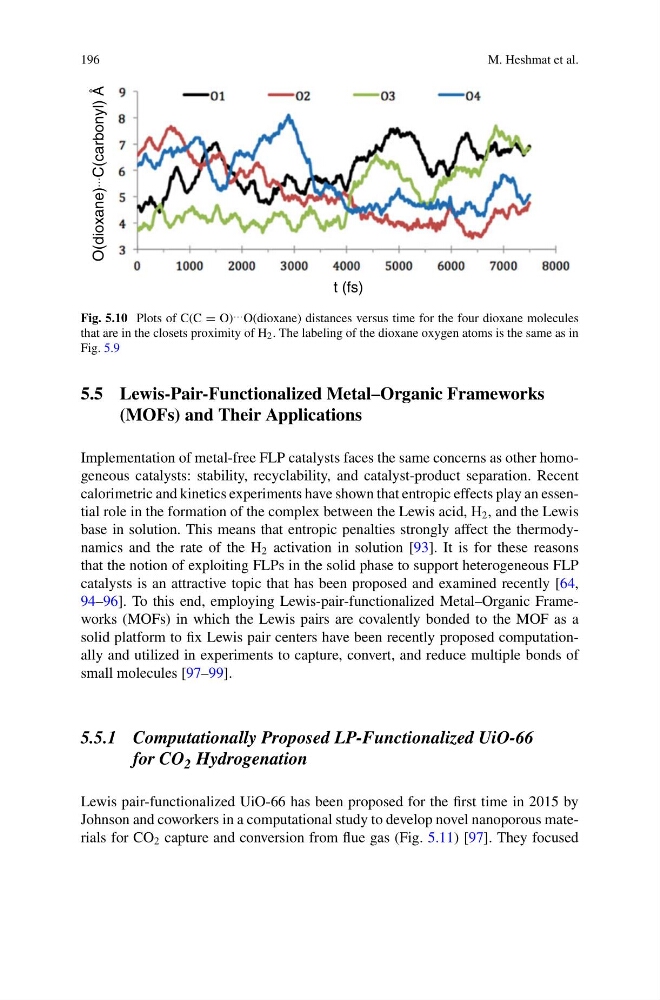
O(dioxane) C(carbonyl)
t (fs)
Fig. 5.10 Plots of C(C = O) … O(dioxane) distances versus time for the four dioxane molecules
that are in the closets proximity of H 2 . The labeling of the dioxane oxygen atoms is the same as in
Fig. 5.9
5.5 Lewis-Pair-Functionalized Metal–Organic Frameworks
(MOFs) and Their Applications
Implementation of metal-free FLP catalysts faces the same concerns as other homogeneous catalysts: stability, recyclability, and catalyst-product separation. Recent
calorimetric and kinetics experiments have shown that entropic effects play an essential role in the formation of the complex between the Lewis acid, H 2 , and the Lewis
base in solution. This means that entropic penalties strongly affect the thermodynamics and the rate of the H 2 activation in solution [93]. It is for these reasons
that the notion of exploiting FLPs in the solid phase to support heterogeneous FLP
catalysts is an attractive topic that has been proposed and examined recently [64,
94–96]. To this end, employing Lewis-pair-functionalized Metal–Organic Frameworks (MOFs) in which the Lewis pairs are covalently bonded to the MOF as a
solid platform to fix Lewis pair centers have been recently proposed computationally and utilized in experiments to capture, convert, and reduce multiple bonds of
small molecules [97–99].
5.5.1 Computationally Proposed LP-Functionalized UiO-66
for CO 2 Hydrogenation
Lewis pair-functionalized UiO-66 has been proposed for the first time in 2015 by
Johnson and coworkers in a computational study to develop novel nanoporous materials for CO 2 capture and conversion from flue gas (Fig. 5.11) [97]. They focused
M. Heshmat et al.
O(dioxane) C(carbonyl)
t (fs)
Fig. 5.10 Plots of C(C = O) … O(dioxane) distances versus time for the four dioxane molecules
that are in the closets proximity of H 2 . The labeling of the dioxane oxygen atoms is the same as in
Fig. 5.9
5.5 Lewis-Pair-Functionalized Metal–Organic Frameworks
(MOFs) and Their Applications
Implementation of metal-free FLP catalysts faces the same concerns as other homogeneous catalysts: stability, recyclability, and catalyst-product separation. Recent
calorimetric and kinetics experiments have shown that entropic effects play an essential role in the formation of the complex between the Lewis acid, H 2 , and the Lewis
base in solution. This means that entropic penalties strongly affect the thermodynamics and the rate of the H 2 activation in solution [93]. It is for these reasons
that the notion of exploiting FLPs in the solid phase to support heterogeneous FLP
catalysts is an attractive topic that has been proposed and examined recently [64,
94–96]. To this end, employing Lewis-pair-functionalized Metal–Organic Frameworks (MOFs) in which the Lewis pairs are covalently bonded to the MOF as a
solid platform to fix Lewis pair centers have been recently proposed computationally and utilized in experiments to capture, convert, and reduce multiple bonds of
small molecules [97–99].
5.5.1 Computationally Proposed LP-Functionalized UiO-66
for CO 2 Hydrogenation
Lewis pair-functionalized UiO-66 has been proposed for the first time in 2015 by
Johnson and coworkers in a computational study to develop novel nanoporous materials for CO 2 capture and conversion from flue gas (Fig. 5.11) [97]. They focused