

5 Mechanistic Insight into the Hydrogen Activation by Frustrated Lewis Pairs
195
reported continuing perturbations of the H–H bond length due to concerted interactions between O(dioxane)↔ H 2 and H 2 ↔ C(C = O). Consequently, the H–H
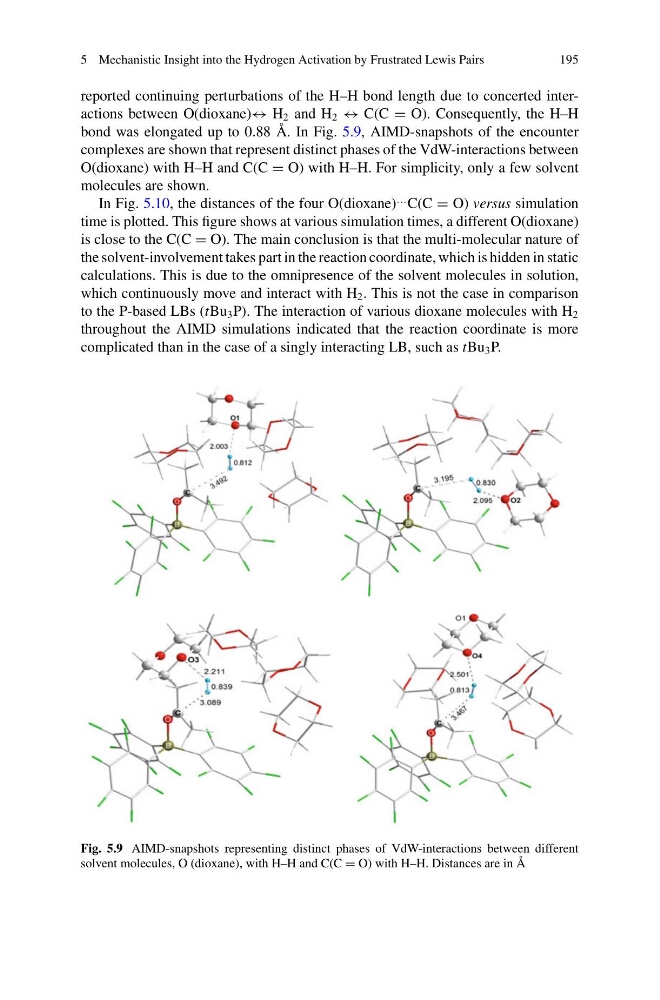
bond was elongated up to 0.88 Å. In Fig. 5.9, AIMD-snapshots of the encounter
complexes are shown that represent distinct phases of the VdW-interactions between
O(dioxane) with H–H and C(C = O) with H–H. For simplicity, only a few solvent
molecules are shown.
In Fig. 5.10, the distances of the four O(dioxane)
… C(C = O) versus simulation
time is plotted. This figure shows at various simulation times, a different O(dioxane)
is close to the C(C = O). The main conclusion is that the multi-molecular nature of
the solvent-involvement takes part in the reaction coordinate, which is hidden in static
calculations. This is due to the omnipresence of the solvent molecules in solution,
which continuously move and interact with H 2 . This is not the case in comparison
to the P-based LBs (tBu 3 P). The interaction of various dioxane molecules with H 2
throughout the AIMD simulations indicated that the reaction coordinate is more
complicated than in the case of a singly interacting LB, such as tBu 3 P.
Fig. 5.9 AIMD-snapshots representing distinct phases of VdW-interactions between different
solvent molecules, O (dioxane), with H–H and C(C = O) with H–H. Distances are in Å
195
reported continuing perturbations of the H–H bond length due to concerted interactions between O(dioxane)↔ H 2 and H 2 ↔ C(C = O). Consequently, the H–H
bond was elongated up to 0.88 Å. In Fig. 5.9, AIMD-snapshots of the encounter
complexes are shown that represent distinct phases of the VdW-interactions between
O(dioxane) with H–H and C(C = O) with H–H. For simplicity, only a few solvent
molecules are shown.
In Fig. 5.10, the distances of the four O(dioxane)
… C(C = O) versus simulation
time is plotted. This figure shows at various simulation times, a different O(dioxane)
is close to the C(C = O). The main conclusion is that the multi-molecular nature of
the solvent-involvement takes part in the reaction coordinate, which is hidden in static
calculations. This is due to the omnipresence of the solvent molecules in solution,
which continuously move and interact with H 2 . This is not the case in comparison
to the P-based LBs (tBu 3 P). The interaction of various dioxane molecules with H 2
throughout the AIMD simulations indicated that the reaction coordinate is more
complicated than in the case of a singly interacting LB, such as tBu 3 P.
Fig. 5.9 AIMD-snapshots representing distinct phases of VdW-interactions between different
solvent molecules, O (dioxane), with H–H and C(C = O) with H–H. Distances are in Å