

194
M. Heshmat et al.
P
Mes
Mes
B
C 6 F 5
C 6 F 5
P
+
Mes
Mes
- B
C 6 F 5
C 6 F 5
H
H
H 2
N
B
C 6 F 5
C 6 F 5
H 2
N
+
- B
C 6 F 5
C 6 F 5
H
H
P
tBu
tBu
B
Ph
Ph
H 2
P
+
tBu
tBu
- B
Ph
Ph
H H
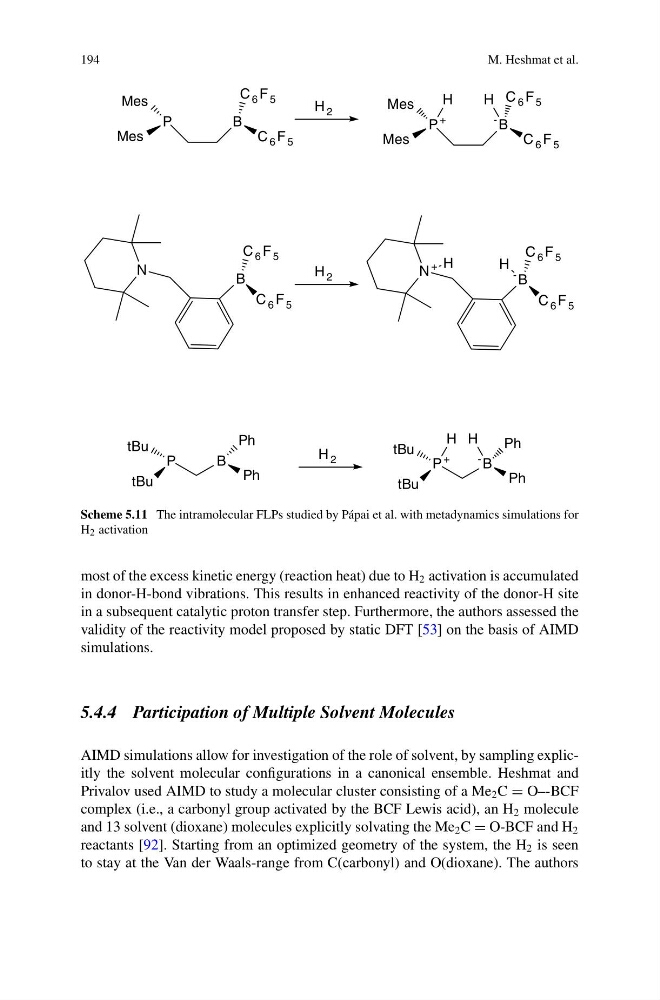
Scheme 5.11 The intramolecular FLPs studied by Pápai et al. with metadynamics simulations for
H 2 activation
most of the excess kinetic energy (reaction heat) due to H 2 activation is accumulated
in donor-H-bond vibrations. This results in enhanced reactivity of the donor-H site
in a subsequent catalytic proton transfer step. Furthermore, the authors assessed the
validity of the reactivity model proposed by static DFT [53] on the basis of AIMD
simulations.
5.4.4 Participation of Multiple Solvent Molecules
AIMD simulations allow for investigation of the role of solvent, by sampling explicitly the solvent molecular configurations in a canonical ensemble. Heshmat and
Privalov used AIMD to study a molecular cluster consisting of a Me 2 C = O–-BCF
complex (i.e., a carbonyl group activated by the BCF Lewis acid), an H 2 molecule
and 13 solvent (dioxane) molecules explicitly solvating the Me 2 C = O-BCF and H 2
reactants [92]. Starting from an optimized geometry of the system, the H 2 is seen
to stay at the Van der Waals-range from C(carbonyl) and O(dioxane). The authors
M. Heshmat et al.
P
Mes
Mes
B
C 6 F 5
C 6 F 5
P
+
Mes
Mes
- B
C 6 F 5
C 6 F 5
H
H
H 2
N
B
C 6 F 5
C 6 F 5
H 2
N
+
- B
C 6 F 5
C 6 F 5
H
H
P
tBu
tBu
B
Ph
Ph
H 2
P
+
tBu
tBu
- B
Ph
Ph
H H
Scheme 5.11 The intramolecular FLPs studied by Pápai et al. with metadynamics simulations for
H 2 activation
most of the excess kinetic energy (reaction heat) due to H 2 activation is accumulated
in donor-H-bond vibrations. This results in enhanced reactivity of the donor-H site
in a subsequent catalytic proton transfer step. Furthermore, the authors assessed the
validity of the reactivity model proposed by static DFT [53] on the basis of AIMD
simulations.
5.4.4 Participation of Multiple Solvent Molecules
AIMD simulations allow for investigation of the role of solvent, by sampling explicitly the solvent molecular configurations in a canonical ensemble. Heshmat and
Privalov used AIMD to study a molecular cluster consisting of a Me 2 C = O–-BCF
complex (i.e., a carbonyl group activated by the BCF Lewis acid), an H 2 molecule
and 13 solvent (dioxane) molecules explicitly solvating the Me 2 C = O-BCF and H 2
reactants [92]. Starting from an optimized geometry of the system, the H 2 is seen
to stay at the Van der Waals-range from C(carbonyl) and O(dioxane). The authors