

5 Mechanistic Insight into the Hydrogen Activation by Frustrated Lewis Pairs
193
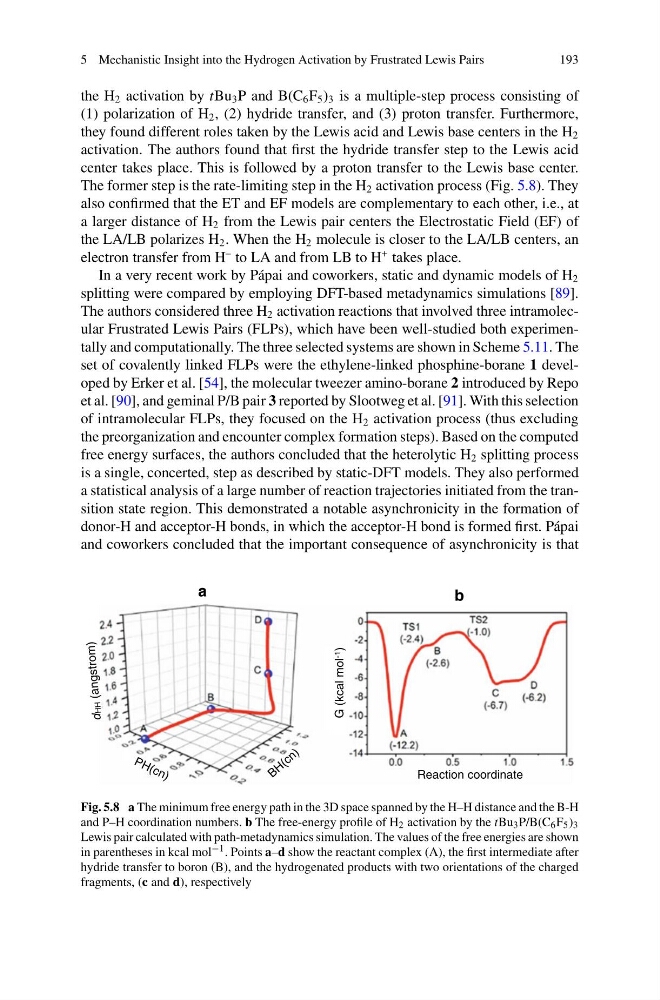
the H 2 activation by tBu 3 P and B(C 6 F 5 ) 3 is a multiple-step process consisting of
(1) polarization of H 2 , (2) hydride transfer, and (3) proton transfer. Furthermore,
they found different roles taken by the Lewis acid and Lewis base centers in the H 2
activation. The authors found that first the hydride transfer step to the Lewis acid
center takes place. This is followed by a proton transfer to the Lewis base center.
The former step is the rate-limiting step in the H 2 activation process (Fig. 5.8). They
also confirmed that the ET and EF models are complementary to each other, i.e., at
a larger distance of H 2 from the Lewis pair centers the Electrostatic Field (EF) of
the LA/LB polarizes H 2 . When the H 2 molecule is closer to the LA/LB centers, an
electron transfer from H
– to LA and from LB to H
+ takes place.
In a very recent work by Pápai and coworkers, static and dynamic models of H 2
splitting were compared by employing DFT-based metadynamics simulations [89].
The authors considered three H 2 activation reactions that involved three intramolecular Frustrated Lewis Pairs (FLPs), which have been well-studied both experimentally and computationally. The three selected systems are shown in Scheme 5.11. The
set of covalently linked FLPs were the ethylene-linked phosphine-borane 1 developed by Erker et al. [54], the molecular tweezer amino-borane 2 introduced by Repo
et al. [90], and geminal P/B pair 3 reported by Slootweg et al. [91]. With this selection
of intramolecular FLPs, they focused on the H 2 activation process (thus excluding
the preorganization and encounter complex formation steps). Based on the computed
free energy surfaces, the authors concluded that the heterolytic H 2 splitting process
is a single, concerted, step as described by static-DFT models. They also performed
a statistical analysis of a large number of reaction trajectories initiated from the transition state region. This demonstrated a notable asynchronicity in the formation of
donor-H and acceptor-H bonds, in which the acceptor-H bond is formed first. Pápai
and coworkers concluded that the important consequence of asynchronicity is that
P H ( c n )
B H ( c n )
dHH
(ang
stro
m)
Reaction coordinate
a
b
G (kcal mol -1
)
Fig. 5.8 a The minimum free energy path in the 3D space spanned by the H–H distance and the B-H
and P–H coordination numbers. b The free-energy profile of H 2 activation by the tBu 3 P/B(C 6 F 5 ) 3
Lewis pair calculated with path-metadynamics simulation. The values of the free energies are shown
in parentheses in kcal mol −1 . Points a–d show the reactant complex (A), the first intermediate after
hydride transfer to boron (B), and the hydrogenated products with two orientations of the charged
fragments, (c and d), respectively
193
the H 2 activation by tBu 3 P and B(C 6 F 5 ) 3 is a multiple-step process consisting of
(1) polarization of H 2 , (2) hydride transfer, and (3) proton transfer. Furthermore,
they found different roles taken by the Lewis acid and Lewis base centers in the H 2
activation. The authors found that first the hydride transfer step to the Lewis acid
center takes place. This is followed by a proton transfer to the Lewis base center.
The former step is the rate-limiting step in the H 2 activation process (Fig. 5.8). They
also confirmed that the ET and EF models are complementary to each other, i.e., at
a larger distance of H 2 from the Lewis pair centers the Electrostatic Field (EF) of
the LA/LB polarizes H 2 . When the H 2 molecule is closer to the LA/LB centers, an
electron transfer from H
– to LA and from LB to H
+ takes place.
In a very recent work by Pápai and coworkers, static and dynamic models of H 2
splitting were compared by employing DFT-based metadynamics simulations [89].
The authors considered three H 2 activation reactions that involved three intramolecular Frustrated Lewis Pairs (FLPs), which have been well-studied both experimentally and computationally. The three selected systems are shown in Scheme 5.11. The
set of covalently linked FLPs were the ethylene-linked phosphine-borane 1 developed by Erker et al. [54], the molecular tweezer amino-borane 2 introduced by Repo
et al. [90], and geminal P/B pair 3 reported by Slootweg et al. [91]. With this selection
of intramolecular FLPs, they focused on the H 2 activation process (thus excluding
the preorganization and encounter complex formation steps). Based on the computed
free energy surfaces, the authors concluded that the heterolytic H 2 splitting process
is a single, concerted, step as described by static-DFT models. They also performed
a statistical analysis of a large number of reaction trajectories initiated from the transition state region. This demonstrated a notable asynchronicity in the formation of
donor-H and acceptor-H bonds, in which the acceptor-H bond is formed first. Pápai
and coworkers concluded that the important consequence of asynchronicity is that
P H ( c n )
B H ( c n )
dHH
(ang
stro
m)
Reaction coordinate
a
b
G (kcal mol -1
)
Fig. 5.8 a The minimum free energy path in the 3D space spanned by the H–H distance and the B-H
and P–H coordination numbers. b The free-energy profile of H 2 activation by the tBu 3 P/B(C 6 F 5 ) 3
Lewis pair calculated with path-metadynamics simulation. The values of the free energies are shown
in parentheses in kcal mol −1 . Points a–d show the reactant complex (A), the first intermediate after
hydride transfer to boron (B), and the hydrogenated products with two orientations of the charged
fragments, (c and d), respectively