

192
M. Heshmat et al.
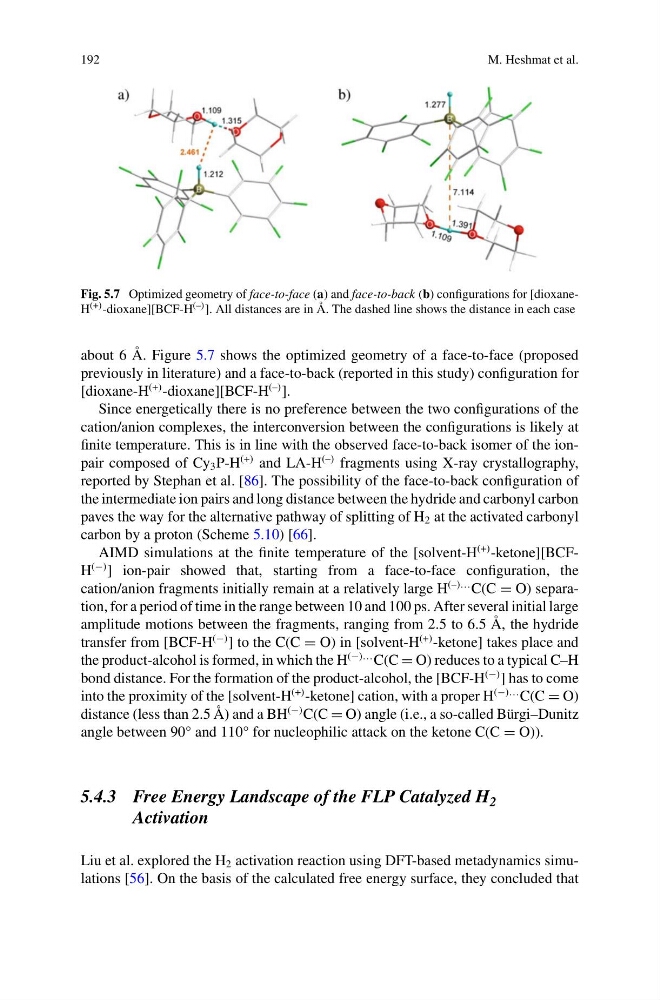
Fig. 5.7 Optimized geometry of face-to-face (a) and face-to-back (b) configurations for [dioxaneH (+) -dioxane][BCF-H (–) ]. All distances are in Å. The dashed line shows the distance in each case
about 6 Å. Figure 5.7 shows the optimized geometry of a face-to-face (proposed
previously in literature) and a face-to-back (reported in this study) configuration for
[dioxane-H
(+) -dioxane][BCF-H
(–) ].
Since energetically there is no preference between the two configurations of the
cation/anion complexes, the interconversion between the configurations is likely at
finite temperature. This is in line with the observed face-to-back isomer of the ionpair composed of Cy 3 P-H
(+) and LA-H
(–) fragments using X-ray crystallography,
reported by Stephan et al. [86]. The possibility of the face-to-back configuration of
the intermediate ion pairs and long distance between the hydride and carbonyl carbon
paves the way for the alternative pathway of splitting of H 2 at the activated carbonyl
carbon by a proton (Scheme 5.10) [66].
AIMD simulations at the finite temperature of the [solvent-H
(+) -ketone][BCFH
(−) ] ion-pair showed that, starting from a face-to-face configuration, the
cation/anion fragments initially remain at a relatively large H
(–)… C(C = O) separation, for a period of time in the range between 10 and 100 ps. After several initial large
amplitude motions between the fragments, ranging from 2.5 to 6.5 Å, the hydride
transfer from [BCF-H
(−) ] to the C(C = O) in [solvent-H
(+) -ketone] takes place and
the product-alcohol is formed, in which the H
(−)… C(C = O) reduces to a typical C–H
bond distance. For the formation of the product-alcohol, the [BCF-H
(−) ] has to come
into the proximity of the [solvent-H
(+) -ketone] cation, with a proper H
(−)… C(C = O)
distance (less than 2.5 Å) and a BH
(−) C(C = O) angle (i.e., a so-called Bürgi–Dunitz
angle between 90° and 110° for nucleophilic attack on the ketone C(C = O)).
5.4.3 Free Energy Landscape of the FLP Catalyzed H 2
Activation
Liu et al. explored the H 2 activation reaction using DFT-based metadynamics simulations [56]. On the basis of the calculated free energy surface, they concluded that
M. Heshmat et al.
Fig. 5.7 Optimized geometry of face-to-face (a) and face-to-back (b) configurations for [dioxaneH (+) -dioxane][BCF-H (–) ]. All distances are in Å. The dashed line shows the distance in each case
about 6 Å. Figure 5.7 shows the optimized geometry of a face-to-face (proposed
previously in literature) and a face-to-back (reported in this study) configuration for
[dioxane-H
(+) -dioxane][BCF-H
(–) ].
Since energetically there is no preference between the two configurations of the
cation/anion complexes, the interconversion between the configurations is likely at
finite temperature. This is in line with the observed face-to-back isomer of the ionpair composed of Cy 3 P-H
(+) and LA-H
(–) fragments using X-ray crystallography,
reported by Stephan et al. [86]. The possibility of the face-to-back configuration of
the intermediate ion pairs and long distance between the hydride and carbonyl carbon
paves the way for the alternative pathway of splitting of H 2 at the activated carbonyl
carbon by a proton (Scheme 5.10) [66].
AIMD simulations at the finite temperature of the [solvent-H
(+) -ketone][BCFH
(−) ] ion-pair showed that, starting from a face-to-face configuration, the
cation/anion fragments initially remain at a relatively large H
(–)… C(C = O) separation, for a period of time in the range between 10 and 100 ps. After several initial large
amplitude motions between the fragments, ranging from 2.5 to 6.5 Å, the hydride
transfer from [BCF-H
(−) ] to the C(C = O) in [solvent-H
(+) -ketone] takes place and
the product-alcohol is formed, in which the H
(−)… C(C = O) reduces to a typical C–H
bond distance. For the formation of the product-alcohol, the [BCF-H
(−) ] has to come
into the proximity of the [solvent-H
(+) -ketone] cation, with a proper H
(−)… C(C = O)
distance (less than 2.5 Å) and a BH
(−) C(C = O) angle (i.e., a so-called Bürgi–Dunitz
angle between 90° and 110° for nucleophilic attack on the ketone C(C = O)).
5.4.3 Free Energy Landscape of the FLP Catalyzed H 2
Activation
Liu et al. explored the H 2 activation reaction using DFT-based metadynamics simulations [56]. On the basis of the calculated free energy surface, they concluded that