

186
M. Heshmat et al.
Lewis acidity, experimentally proved to be more suitable for hydrogenation of the C
= O group due to easier delivery of the hydride to the C(C = O). On the other hand,
LA 2 with stronger H
− affinity and Lewis acidity than BCF is not a good candidate
for hydrogenation of the C = O group because of the lower tendency for hydride
release.
The thermodynamics of the H 2 activation by strong LA and LB fragments, leading
to a highly polar product-ion pair (LA—H
(−)…(+) H—LB), is strongly affected by
condensed phase interactions, being solvation or crystal field effects. Solvent effects
can cancel the entropic penalty of the ion-pair formation and strongly stabilize the
product complex [62]. Although, in case of weak LBs (such as ethereal solvent
molecules), in which the product-ion pair is not highly polar, solvation does not
provide a large reduction of [61, 63]. The crystal fields of solid FLPs can provide
an extra stabilization of the zwitterionic products of H 2 activation. Theoretical studies
showed that reaction energies are more negative in the solid state than in the gas and
solution phases for several H 2 activation reactions [64].
5.3.4 Ethereal Solvents as Lewis Bases
Recent experiments have shown that ethereal solvents are able to activate H 2 and
catalyze hydrogenation of C = O compounds in combination with boron LAs [28–
30]. The proposed FLP mechanism for activation of H 2 and hydrogenation of the C =
O group is depicted in Scheme 5.8, in which the borane and ketone or ethereal solvent
act as an FLP to activate H 2 . The major advantage of O-based LBs is the possibility
of proton-delivery to another O-based LB that can be used in the hydrogenation of
ketones, which does not happen with strong N- or P-bearing LBs.
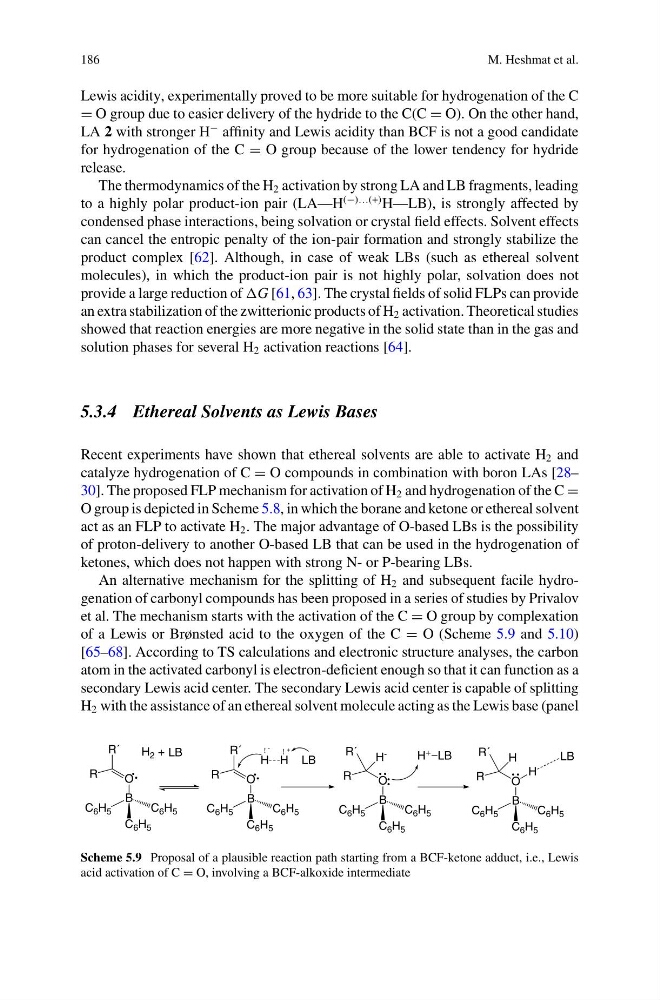
An alternative mechanism for the splitting of H 2 and subsequent facile hydrogenation of carbonyl compounds has been proposed in a series of studies by Privalov
et al. The mechanism starts with the activation of the C = O group by complexation
of a Lewis or Brønsted acid to the oxygen of the C = O (Scheme 5.9 and 5.10)
[65–68]. According to TS calculations and electronic structure analyses, the carbon
atom in the activated carbonyl is electron-deficient enough so that it can function as a
secondary Lewis acid center. The secondary Lewis acid center is capable of splitting
H 2 with the assistance of an ethereal solvent molecule acting as the Lewis base (panel
R
O
B
C 6 H 5
C 6 H 5
C 6 H 5
R
O
B
C 6 H 5
C 6 H 5
C 6 H 5
H -
H + LB
H 2 + LB
R
O
B
C 6 H 5
C 6 H 5
C 6 H 5
LB
H H
! -
! +
R
O
B
C 6 H 5
C 6 H 5
C 6 H 5
H
LB
H
Scheme 5.9 Proposal of a plausible reaction path starting from a BCF-ketone adduct, i.e., Lewis
acid activation of C = O, involving a BCF-alkoxide intermediate
M. Heshmat et al.
Lewis acidity, experimentally proved to be more suitable for hydrogenation of the C
= O group due to easier delivery of the hydride to the C(C = O). On the other hand,
LA 2 with stronger H
− affinity and Lewis acidity than BCF is not a good candidate
for hydrogenation of the C = O group because of the lower tendency for hydride
release.
The thermodynamics of the H 2 activation by strong LA and LB fragments, leading
to a highly polar product-ion pair (LA—H
(−)…(+) H—LB), is strongly affected by
condensed phase interactions, being solvation or crystal field effects. Solvent effects
can cancel the entropic penalty of the ion-pair formation and strongly stabilize the
product complex [62]. Although, in case of weak LBs (such as ethereal solvent
molecules), in which the product-ion pair is not highly polar, solvation does not
provide a large reduction of [61, 63]. The crystal fields of solid FLPs can provide
an extra stabilization of the zwitterionic products of H 2 activation. Theoretical studies
showed that reaction energies are more negative in the solid state than in the gas and
solution phases for several H 2 activation reactions [64].
5.3.4 Ethereal Solvents as Lewis Bases
Recent experiments have shown that ethereal solvents are able to activate H 2 and
catalyze hydrogenation of C = O compounds in combination with boron LAs [28–
30]. The proposed FLP mechanism for activation of H 2 and hydrogenation of the C =
O group is depicted in Scheme 5.8, in which the borane and ketone or ethereal solvent
act as an FLP to activate H 2 . The major advantage of O-based LBs is the possibility
of proton-delivery to another O-based LB that can be used in the hydrogenation of
ketones, which does not happen with strong N- or P-bearing LBs.
An alternative mechanism for the splitting of H 2 and subsequent facile hydrogenation of carbonyl compounds has been proposed in a series of studies by Privalov
et al. The mechanism starts with the activation of the C = O group by complexation
of a Lewis or Brønsted acid to the oxygen of the C = O (Scheme 5.9 and 5.10)
[65–68]. According to TS calculations and electronic structure analyses, the carbon
atom in the activated carbonyl is electron-deficient enough so that it can function as a
secondary Lewis acid center. The secondary Lewis acid center is capable of splitting
H 2 with the assistance of an ethereal solvent molecule acting as the Lewis base (panel
R
O
B
C 6 H 5
C 6 H 5
C 6 H 5
R
O
B
C 6 H 5
C 6 H 5
C 6 H 5
H -
H + LB
H 2 + LB
R
O
B
C 6 H 5
C 6 H 5
C 6 H 5
LB
H H
! -
! +
R
O
B
C 6 H 5
C 6 H 5
C 6 H 5
H
LB
H
Scheme 5.9 Proposal of a plausible reaction path starting from a BCF-ketone adduct, i.e., Lewis
acid activation of C = O, involving a BCF-alkoxide intermediate