

5 Mechanistic Insight into the Hydrogen Activation by Frustrated Lewis Pairs
185
tBu3P
THF
LA/LB
complex
TS
Ion pair
B(p-C6F4CF3)3
BCF
B(C6F5)2{3,5-(CF3)2C6H3}
B(C6F5)2(C6Cl5)
B(C6F5)(C6Cl5)2
B(C6Cl5)3
B(C6F4H)2(C6Cl2H3)
B(C6F4H)2(C6Cl3H2)
B(C6F3H2)2(C6Cl2H3)
B(C6F3H2)2(C6Cl3H2)
B(CH(C6F5)2)3
B(C6F5)2(C6H5)
B(C6F5)(C6H5)2
B(C6H5)3
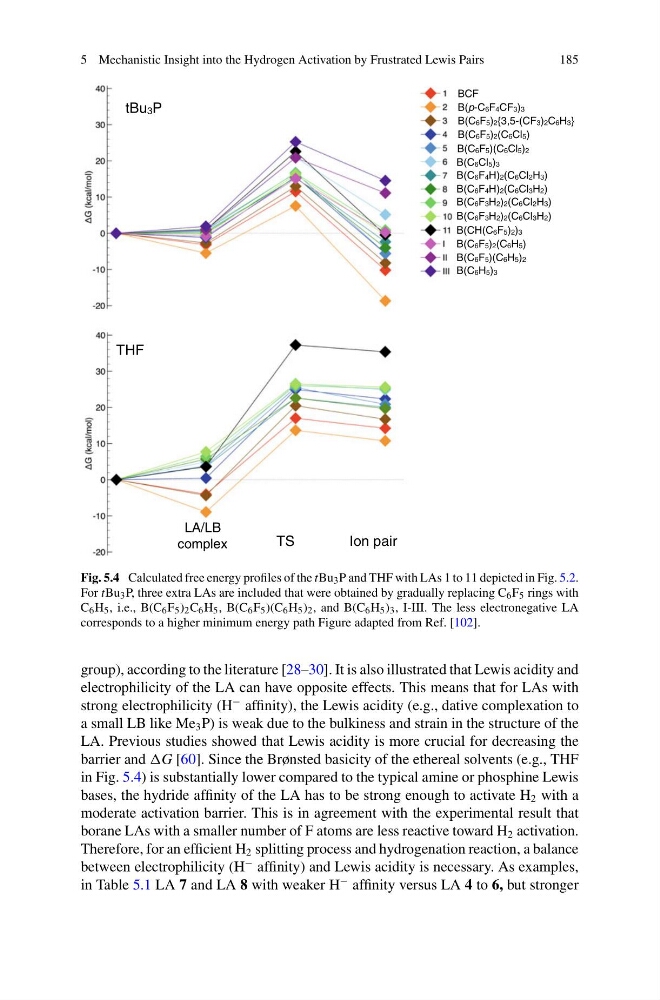
Fig. 5.4 Calculated free energy profiles of the tBu 3 P and THF with LAs 1 to 11 depicted in Fig. 5.2.
For tBu 3 P, three extra LAs are included that were obtained by gradually replacing C 6 F 5 rings with
C 6 H 5 , i.e., B(C 6 F 5 ) 2 C 6 H 5 , B(C 6 F 5 )(C 6 H 5 ) 2 , and B(C 6 H 5 ) 3 , I-III. The less electronegative LA
corresponds to a higher minimum energy path Figure adapted from Ref. [102].
group), according to the literature [28–30]. It is also illustrated that Lewis acidity and
electrophilicity of the LA can have opposite effects. This means that for LAs with
strong electrophilicity (H
− affinity), the Lewis acidity (e.g., dative complexation to
a small LB like Me 3 P) is weak due to the bulkiness and strain in the structure of the
LA. Previous studies showed that Lewis acidity is more crucial for decreasing the
barrier and [60]. Since the Brønsted basicity of the ethereal solvents (e.g., THF
in Fig. 5.4) is substantially lower compared to the typical amine or phosphine Lewis
bases, the hydride affinity of the LA has to be strong enough to activate H 2 with a
moderate activation barrier. This is in agreement with the experimental result that
borane LAs with a smaller number of F atoms are less reactive toward H 2 activation.
Therefore, for an efficient H 2 splitting process and hydrogenation reaction, a balance
between electrophilicity (H
− affinity) and Lewis acidity is necessary. As examples,
in Table 5.1 LA 7 and LA 8 with weaker H
− affinity versus LA 4 to 6, but stronger
185
tBu3P
THF
LA/LB
complex
TS
Ion pair
B(p-C6F4CF3)3
BCF
B(C6F5)2{3,5-(CF3)2C6H3}
B(C6F5)2(C6Cl5)
B(C6F5)(C6Cl5)2
B(C6Cl5)3
B(C6F4H)2(C6Cl2H3)
B(C6F4H)2(C6Cl3H2)
B(C6F3H2)2(C6Cl2H3)
B(C6F3H2)2(C6Cl3H2)
B(CH(C6F5)2)3
B(C6F5)2(C6H5)
B(C6F5)(C6H5)2
B(C6H5)3
Fig. 5.4 Calculated free energy profiles of the tBu 3 P and THF with LAs 1 to 11 depicted in Fig. 5.2.
For tBu 3 P, three extra LAs are included that were obtained by gradually replacing C 6 F 5 rings with
C 6 H 5 , i.e., B(C 6 F 5 ) 2 C 6 H 5 , B(C 6 F 5 )(C 6 H 5 ) 2 , and B(C 6 H 5 ) 3 , I-III. The less electronegative LA
corresponds to a higher minimum energy path Figure adapted from Ref. [102].
group), according to the literature [28–30]. It is also illustrated that Lewis acidity and
electrophilicity of the LA can have opposite effects. This means that for LAs with
strong electrophilicity (H
− affinity), the Lewis acidity (e.g., dative complexation to
a small LB like Me 3 P) is weak due to the bulkiness and strain in the structure of the
LA. Previous studies showed that Lewis acidity is more crucial for decreasing the
barrier and [60]. Since the Brønsted basicity of the ethereal solvents (e.g., THF
in Fig. 5.4) is substantially lower compared to the typical amine or phosphine Lewis
bases, the hydride affinity of the LA has to be strong enough to activate H 2 with a
moderate activation barrier. This is in agreement with the experimental result that
borane LAs with a smaller number of F atoms are less reactive toward H 2 activation.
Therefore, for an efficient H 2 splitting process and hydrogenation reaction, a balance
between electrophilicity (H
− affinity) and Lewis acidity is necessary. As examples,
in Table 5.1 LA 7 and LA 8 with weaker H
− affinity versus LA 4 to 6, but stronger