

5 Mechanistic Insight into the Hydrogen Activation by Frustrated Lewis Pairs
187
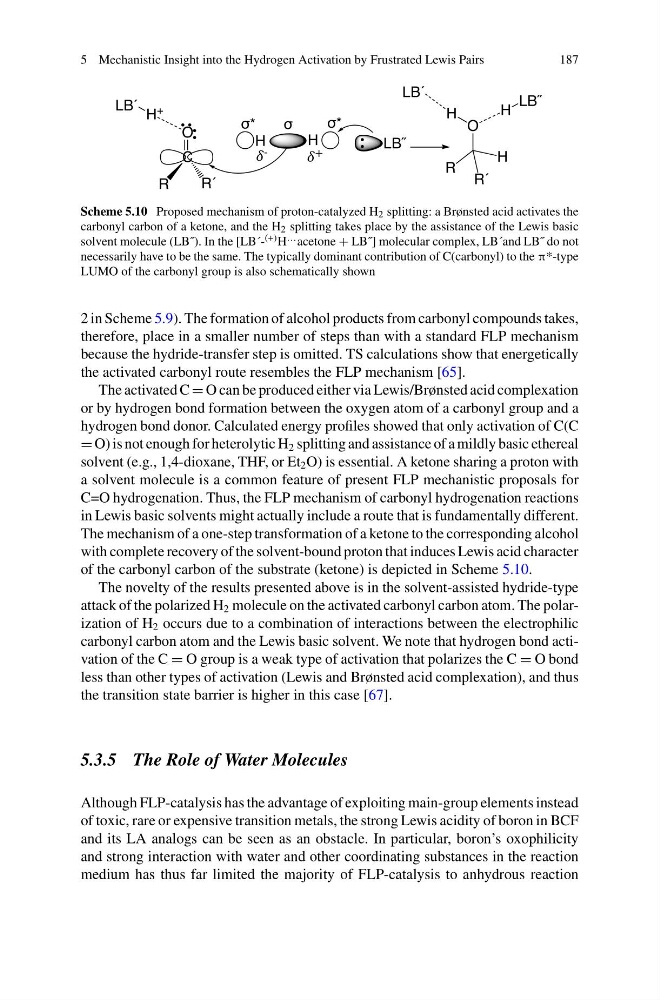
Scheme 5.10 Proposed mechanism of proton-catalyzed H 2 splitting: a Brønsted acid activates the
carbonyl carbon of a ketone, and the H 2 splitting takes place by the assistance of the Lewis basic
solvent molecule (LB˝). In the [LB´- (+) H … acetone + LB˝] molecular complex, LB´and LB˝ do not
necessarily have to be the same. The typically dominant contribution of C(carbonyl) to the π*-type
LUMO of the carbonyl group is also schematically shown
2 in Scheme 5.9). The formation of alcohol products from carbonyl compounds takes,
therefore, place in a smaller number of steps than with a standard FLP mechanism
because the hydride-transfer step is omitted. TS calculations show that energetically
the activated carbonyl route resembles the FLP mechanism [65].
The activated C = O can be produced either via Lewis/Brønsted acid complexation
or by hydrogen bond formation between the oxygen atom of a carbonyl group and a
hydrogen bond donor. Calculated energy profiles showed that only activation of C(C
= O) is not enough for heterolytic H 2 splitting and assistance of a mildly basic ethereal
solvent (e.g., 1,4-dioxane, THF, or Et 2 O) is essential. A ketone sharing a proton with
a solvent molecule is a common feature of present FLP mechanistic proposals for
C=O hydrogenation. Thus, the FLP mechanism of carbonyl hydrogenation reactions
in Lewis basic solvents might actually include a route that is fundamentally different.
The mechanism of a one-step transformation of a ketone to the corresponding alcohol
with complete recovery of the solvent-bound proton that induces Lewis acid character
of the carbonyl carbon of the substrate (ketone) is depicted in Scheme 5.10.
The novelty of the results presented above is in the solvent-assisted hydride-type
attack of the polarized H 2 molecule on the activated carbonyl carbon atom. The polarization of H 2 occurs due to a combination of interactions between the electrophilic
carbonyl carbon atom and the Lewis basic solvent. We note that hydrogen bond activation of the C = O group is a weak type of activation that polarizes the C = O bond
less than other types of activation (Lewis and Brønsted acid complexation), and thus
the transition state barrier is higher in this case [67].
5.3.5 The Role of Water Molecules
Although FLP-catalysis has the advantage of exploiting main-group elements instead
of toxic, rare or expensive transition metals, the strong Lewis acidity of boron in BCF
and its LA analogs can be seen as an obstacle. In particular, boron’s oxophilicity
and strong interaction with water and other coordinating substances in the reaction
medium has thus far limited the majority of FLP-catalysis to anhydrous reaction
187
Scheme 5.10 Proposed mechanism of proton-catalyzed H 2 splitting: a Brønsted acid activates the
carbonyl carbon of a ketone, and the H 2 splitting takes place by the assistance of the Lewis basic
solvent molecule (LB˝). In the [LB´- (+) H … acetone + LB˝] molecular complex, LB´and LB˝ do not
necessarily have to be the same. The typically dominant contribution of C(carbonyl) to the π*-type
LUMO of the carbonyl group is also schematically shown
2 in Scheme 5.9). The formation of alcohol products from carbonyl compounds takes,
therefore, place in a smaller number of steps than with a standard FLP mechanism
because the hydride-transfer step is omitted. TS calculations show that energetically
the activated carbonyl route resembles the FLP mechanism [65].
The activated C = O can be produced either via Lewis/Brønsted acid complexation
or by hydrogen bond formation between the oxygen atom of a carbonyl group and a
hydrogen bond donor. Calculated energy profiles showed that only activation of C(C
= O) is not enough for heterolytic H 2 splitting and assistance of a mildly basic ethereal
solvent (e.g., 1,4-dioxane, THF, or Et 2 O) is essential. A ketone sharing a proton with
a solvent molecule is a common feature of present FLP mechanistic proposals for
C=O hydrogenation. Thus, the FLP mechanism of carbonyl hydrogenation reactions
in Lewis basic solvents might actually include a route that is fundamentally different.
The mechanism of a one-step transformation of a ketone to the corresponding alcohol
with complete recovery of the solvent-bound proton that induces Lewis acid character
of the carbonyl carbon of the substrate (ketone) is depicted in Scheme 5.10.
The novelty of the results presented above is in the solvent-assisted hydride-type
attack of the polarized H 2 molecule on the activated carbonyl carbon atom. The polarization of H 2 occurs due to a combination of interactions between the electrophilic
carbonyl carbon atom and the Lewis basic solvent. We note that hydrogen bond activation of the C = O group is a weak type of activation that polarizes the C = O bond
less than other types of activation (Lewis and Brønsted acid complexation), and thus
the transition state barrier is higher in this case [67].
5.3.5 The Role of Water Molecules
Although FLP-catalysis has the advantage of exploiting main-group elements instead
of toxic, rare or expensive transition metals, the strong Lewis acidity of boron in BCF
and its LA analogs can be seen as an obstacle. In particular, boron’s oxophilicity
and strong interaction with water and other coordinating substances in the reaction
medium has thus far limited the majority of FLP-catalysis to anhydrous reaction